
KV3, Valley of the Kings
25.7411° N · 32.6027° E · Memorial
Photo: Wikimedia Commons contributor · Public domain · Wikimedia Commons
KV3, Valley of the Kings is an ancient Egyptian tomb. It is near Luxor, Egypt. Tomb numbering began with John Gardner Wilkinson in 1827. The free Lokali audio guide runs 7 minutes.
✓ Published October 2026 · how we write these guides
Visitor facts
| Lokali audio guide | 7 min · free |
|---|---|
| Type | Memorial |
| Location | Luxor, Egypt |
| Coordinates | 25.7411, 32.6027 |
| Languages | 50+, in the Lokali app |
The story
Stand still for a moment and feel the ground. It is pale limestone chip, loose and dry, and it crunches under every step. The light here bounces off the cliffs from every side, so even the shadows feel bright. Somewhere behind you, a guide calls out a tomb number, and the sound carries off the rock walls. You are standing in front of one of the quieter doorways in the Valley of the Kings. Its name is short and plain... KV3.
That name needs a little unpacking. KV stands for Kings' Valley, and the number is simply a place in a list. In 1827, the British traveller John Gardner Wilkinson painted numbers beside the tomb entrances he could see. He started near the mouth of the valley and worked his way along. Tomb number three was one of the first he reached. Archaeologists still use his system today, adding new numbers as new tombs are found, right up to the sixty-two of Tutankhamun and beyond.
So who was this tomb for? Most scholars link it to the reign of Ramesses the Third, a pharaoh of the Twentieth Dynasty who ruled in the twelfth century before Christ. The tomb appears to have been cut for one of his sons. Which son, exactly, is not known for certain. Egyptologists have debated the question for a long time, and the evidence is thin. What matters is the idea behind it — a king preparing a resting place for his child, close to the royal burials.
Ramesses the Third is worth a moment of attention. He is often described as the last great warrior king of the New Kingdom. His own tomb, known as KV11, lies elsewhere in this same valley. His vast memorial temple stands across the hills at Medinet Habu, where carved walls show his battles against invaders from the sea. Yet his reign also had trouble at home. Records from the period describe workers stopping work because their rations had not arrived — one of the earliest recorded labour strikes in history.
Those workers matter here. Tombs like this one were cut by a skilled community of craftsmen who lived in a village now called Deir el-Medina, over the ridge to the west. They walked to work along mountain paths, stayed for days at a time, and cut into the rock with copper chisels and stone hammers. Lamps burned inside as they worked, and the cutting followed a plan. Every corridor you might see in a tomb like this began as a line drawn by these people.
Here is the first surprise. Many visitors expect every royal tomb to be covered in bright paint, with gods and stars across the ceilings. KV3 is different. Very little decoration survives inside, and much of the tomb appears to be plain cut stone. It seems the work was never fully finished, or that the tomb was never used for the burial it was meant for. Scholars are not certain whether any prince was ever laid to rest here at all.
The layout itself follows a familiar pattern for the period. A sloping entrance leads into straight corridors that run deep into the hillside. Further in, there is a larger chamber with pillars cut from the living rock — the stone was simply left standing as the room was carved around it. Think of it as architecture made by subtraction. Nothing was built here. Everything you could see was made by taking rock away.
Now the second surprise, and perhaps the most human part of this tomb's story. Many centuries after the pharaohs, Egypt became largely Christian. Early Christians, often called Copts — the name for Egypt's native Christian community — came into this valley. Some of them used the old royal tombs as shelters, cells, or places of prayer. KV3 was one of the tombs adapted in this way. A space cut for a prince of the old gods became, for a time, a Christian chapel.
That layering is something you can carry with you through the whole valley. These tombs were not sealed and forgotten for three thousand years. Some stood open since ancient times. Greek and Roman travellers came to look. Hermits and monks lived in the shade of the corridors. Later, European travellers arrived with notebooks and paint brushes. Each group left something behind, even if it was only soot from a lamp or a scratched name on a wall.
In the early twentieth century, the tomb was cleared of the debris that had washed into it over the centuries. Here is a detail to remember about this valley. It looks bone dry, but rare and violent rainstorms do strike these hills. When they do, flash floods pour down the slopes, carrying stone and mud into any open doorway. Many tombs here were found packed with this hardened flood fill. Clearing it, basket by basket, has been a large part of archaeology in the valley.
Look up now, beyond the entrance. Above the valley rises a peak that the Egyptians knew well. Today it is often called el-Qurn, which means the horn. From many angles it has a natural pyramid shape. Many scholars think this was one reason the kings of the New Kingdom chose this valley. After centuries of building pyramids by hand, they could be buried beneath one made by nature, in a place that was easier to guard.
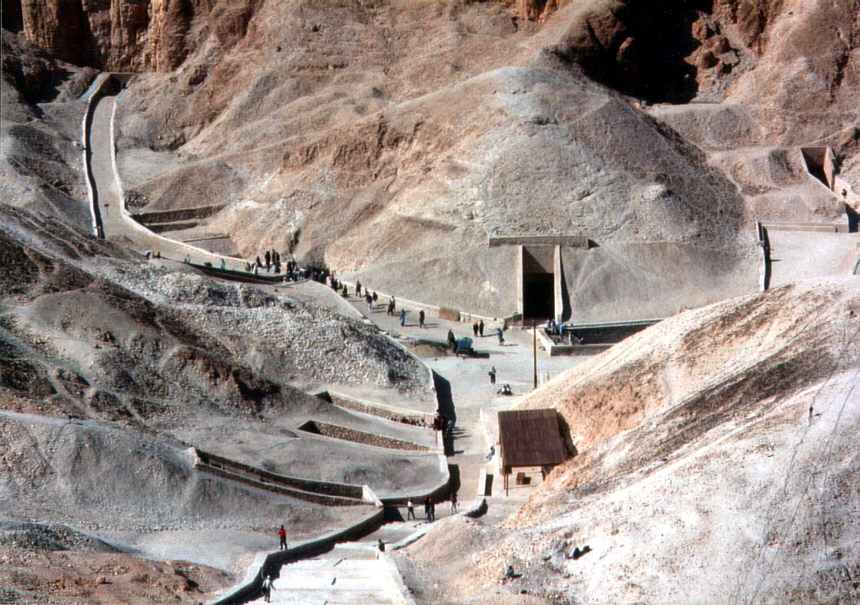
It is worth knowing that KV3 is not one of the tombs regularly open to visitors. The valley's authorities rotate which tombs are open to protect them, and smaller tombs like this one are often closed. Even so, the entrance tells you a lot. Notice how the doorway is cut straight into the slope, and how the rock around it is rough and layered. That is the same stone the workers faced, with the same heat on their backs.
Before you move on, let the place settle around you. Listen to the footsteps on the gravel paths, the low voices of other groups, the occasional engine of the small visitor train. Feel how the walls of the valley hold the heat. This doorway belonged to a prince whose name we cannot say with certainty, then to Christians seeking quiet, and now to you, for a few minutes. As you walk on, look at each numbered entrance in a new way — every one is a small story still waiting for its details.
Key facts
What to look for
Practical tips
Common questions
Is there a free audio guide to KV3, Valley of the Kings?
Yes — the Lokali app narrates KV3, Valley of the Kings free of charge in 50+ languages. The guide runs about 7 minutes, covers the history, what to look for on site and practical tips, and works offline once downloaded.
Where is KV3, Valley of the Kings?
KV3, Valley of the Kings is near Luxor, Egypt, at 25.7411, 32.6027. Tap the map link on this page for directions from where you are.
What is KV3, Valley of the Kings known for?
Tomb numbering began with John Gardner Wilkinson in 1827. Linked to the reign of Ramesses the Third.
What should you look for at KV3, Valley of the Kings?
The number plate beside the tomb entrance. Rough layered limestone around the cut doorway. The pyramid-shaped peak of el-Qurn above the valley.
What should you know before visiting KV3, Valley of the Kings?
Check on site whether KV3 is open during your visit. Visit early morning to avoid the strongest midday heat.
When is the best time to visit KV3, Valley of the Kings?
Visit early morning to avoid the strongest midday heat.
On the map
Opens directions to KV3, Valley of the Kings from your location.
More to see in Luxor


Hear KV3, Valley of the Kings in your language
The full story, narrated, in 50+ languages. Download it before you go and it plays offline, at your own pace, with no ticket and no tour group.