
Photo: R.F.Morgan · CC BY-SA 3.0 · Wikimedia Commons
KV4 is an ancient Egyptian tomb. It is near Luxor, Egypt. Tomb cut for Ramesses XI, last Twentieth Dynasty king. The free Lokali audio guide runs 6 minutes.
✓ Published October 2026 · how we write these guides
Visitor facts
| Lokali audio guide | 6 min · free |
|---|---|
| Type | Archaeological Site |
| Location | Luxor, Egypt |
| Coordinates | 25.7408, 32.6029 |
| Languages | 50+, in the Lokali app |
The story
Step out of the sun and into the mouth of this tomb, and the air changes at once. It is cooler here, and dry, with a faint chalky smell of limestone dust. The walls around you are pale and rough. In many places they are bare. That bareness is the first clue to the story you are about to hear.
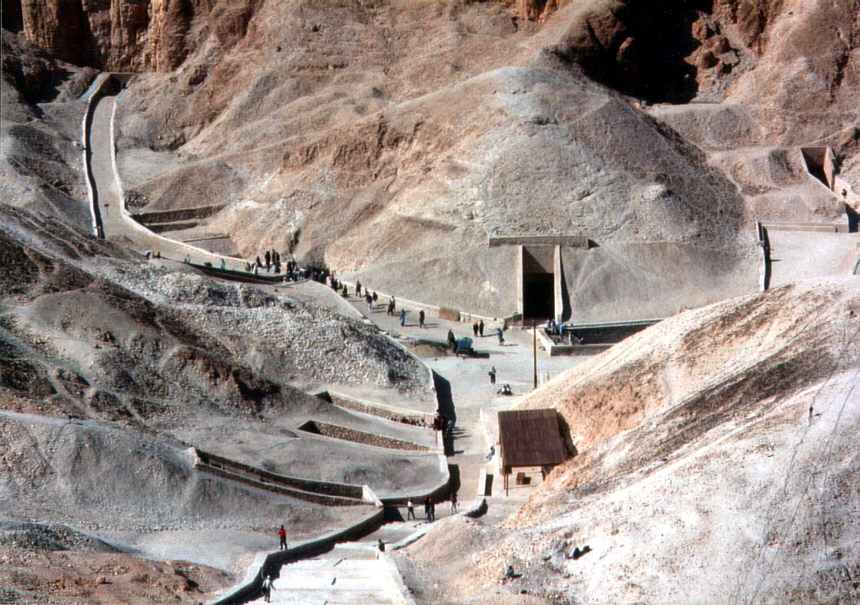
You are standing in KV4, in the Valley of the Kings on the west bank of Luxor. The letters stand for Kings' Valley, and the number comes from a numbering system that early explorers began. This tomb was cut for Ramesses XI, the last king of Egypt's Twentieth Dynasty. His reign closed the era that historians call the New Kingdom, the age of the great warrior pharaohs and the temples of Karnak and Luxor across the river.
Here is the first surprise. Archaeologists generally regard this as the last royal tomb ever begun in the Valley of the Kings. For roughly five centuries, kings had carved their eternal homes into these cliffs. After this one, the tradition here simply stopped. So the corridor around you is, in a sense, the final sentence of a very long chapter.
Look at the scale of the entrance and the corridor. The cutting is wide and confident, with a high ceiling and a long, sloping descent. The plan follows the late Ramesside style, with a straight axis running deep into the hillside. Earlier tombs often turned corners. By this period, the builders preferred a single, direct line, as if aiming straight at the underworld.
Now notice what is missing. In the famous tombs nearby, the walls carry painted gods, star-filled ceilings, and long texts that guide the king through the night. Here, most of the surfaces are plain stone. The decoration was barely started. The work seems to have halted while the tomb was still being prepared, leaving a raw and honest view of how these monuments were actually made.
That unfinished state tells you something about the world outside the valley. The end of Ramesses XI's reign was a troubled time. Royal power was weakening, and in the south, the high priests of the god Amun at Thebes held more and more real authority. Records from this era also describe tomb robbery trials, when officials investigated thieves who had broken into royal burials. The old order was coming apart.
And here is the second surprise. Ramesses XI was almost certainly never buried in this tomb. Egyptologists believe he was laid to rest somewhere else, possibly in the north of Egypt, where the centre of power was moving. His actual burial place has never been found. So this grand corridor was prepared for a king who did not come home to it.
Walk further in, toward the burial chamber, and watch for the deep shaft cut into the floor. This vertical pit drops down into the rock. Its exact purpose is debated. Some scholars think it was meant as a final burial pit. Others see it as a later addition. Either way, it gives the chamber an unusual, vertical depth that you will not see in most other tombs here.
That shaft held real treasure for modern archaeologists. In the late 1970s, the British Egyptologist John Romer led excavations in this tomb. In the debris, his team found fragments of burial equipment from earlier royal tombs, including pieces linked to much older kings. This suggests that, after the New Kingdom ended, priests may have used KV4 as a kind of workshop for handling older royal burials.
That idea fits a larger story. In the centuries after Ramesses XI, the priests of Amun gathered many royal mummies from damaged tombs and moved them to safer hiding places. They rewrapped bodies and recorded their work. Many of these kings were later discovered together in hidden caches. This unfinished tomb may have been one stage in that quiet rescue operation, a place where the ancient dead were sorted and protected.
The tomb also stayed open long after the pharaohs were gone. Visitors in the Greek and Roman periods came to the valley, and early Christian communities later lived in parts of the west bank. Look along the walls near the entrance for scratched graffiti. These marks were left by people who stood exactly where you stand, centuries ago, looking into the same dark corridor.
Take a moment to touch the scene with your eyes rather than your hands. You can see chisel marks in the stone, the small grooves left by copper and stone tools. You can see where the rock is smooth and where it is still rough. In a finished tomb, plaster and paint hide all of this. Here, the work of the ancient quarrymen and stonecutters is left open for you to read.
This is why KV4 rewards a slower visit. It has none of the bright colour that draws crowds to other tombs. Instead, it shows the bones of a royal tomb, the moment when a great tradition paused and never resumed. It shows a king who never arrived, and priests who came later to protect the dead of earlier ages.
As you walk back up the slope toward the light, listen to the change in sound. The quiet of the corridor gives way to voices, footsteps, and the wind moving through the valley. Look at the bright cliffs above the entrance. Every tomb in this valley was cut into that same stone... and this was the last one they began.
Key facts
What to look for
Practical tips
Common questions
Is there a free audio guide to KV4?
Yes — the Lokali app narrates KV4 free of charge in 50+ languages. The guide runs about 6 minutes, covers the history, what to look for on site and practical tips, and works offline once downloaded.
Where is KV4?
KV4 is near Luxor, Egypt, at 25.7408, 32.6029. Tap the map link on this page for directions from where you are.
What is KV4 known for?
Tomb cut for Ramesses XI, last Twentieth Dynasty king. Generally regarded as the last royal tomb begun here.
What should you look for at KV4?
Bare walls where decoration was never completed. Chisel grooves left by ancient stonecutting tools. The deep vertical shaft in the burial chamber floor.
What should you know before visiting KV4?
Visit early morning before the valley heats up. Carry water; the valley has very little shade.
When is the best time to visit KV4?
Visit early morning before the valley heats up.
On the map
Opens directions to KV4 from your location.
More to see in Luxor


Hear KV4 in your language
The full story, narrated, in 50+ languages. Download it before you go and it plays offline, at your own pace, with no ticket and no tour group.