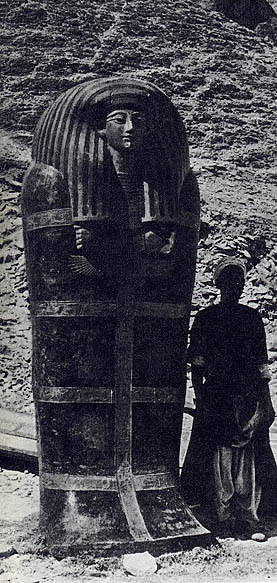
Photo: Wikimedia Commons contributor · Public domain · Wikimedia Commons
Tomb of Yuya and Thuya is a tomb of Yuya and Tjuyu in the Valley of Kings. Tomb number KV46 in the Valley of the Kings. The free Lokali audio guide runs 6 minutes.
✓ Published October 2026 · how we write these guides
Visitor facts
| Lokali audio guide | 6 min · free |
|---|---|
| Type | Memorial |
| Location | Luxor, Egypt |
| Coordinates | 25.7408, 32.6028 |
| Languages | 50+, in the Lokali app |
The story
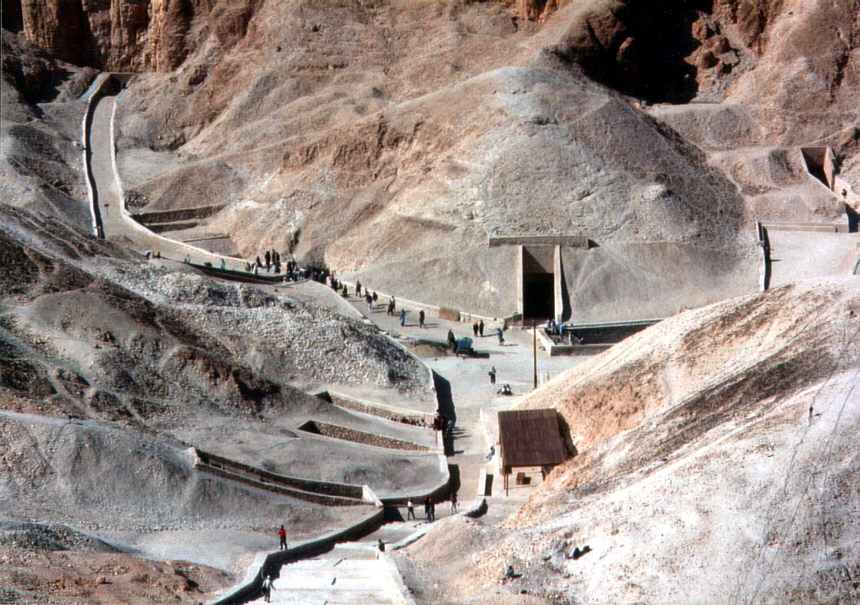
Stand still for a moment and listen. In the Valley of the Kings, the air is dry and close. Pale limestone cliffs hold the heat, and the gravel shifts underfoot. Somewhere in this sun-bleached ravine is a doorway that gives no hint of what it once held. That doorway leads to the tomb of Yuya and Thuya, known to archaeologists as KV46.
The name sounds modest. There are no pharaohs here, no grand painted corridors, no long descent lined with gods. Yet for almost twenty years, this small tomb held a remarkable title. Before Tutankhamun was found in 1922, this was the richest and most complete burial ever uncovered in the valley. To understand why, you need to meet the couple who were buried here.
Yuya and Thuya were not royalty by birth. They were a noble couple who lived in the fourteenth century before Christ, during the Eighteenth Dynasty, a high point of Egyptian wealth and power. Their great fortune was their daughter, Tiye. She married the pharaoh Amenhotep the Third and became one of the most influential queens in Egyptian history. That marriage made Yuya and Thuya the grandparents of Akhenaten, the pharaoh who tried to turn Egypt toward the worship of a single sun god.
Yuya held important titles at court. He was called God's Father, an honorific linked to his place in the royal family. He was also associated with the king's chariotry and horses. Thuya served in religious roles. She was a singer for the god Amun and held a position connected with the god Min. Both of them are thought to have had ties to Akhmim, a town further north along the Nile.
Here is the first surprise. Burial in the Valley of the Kings was almost entirely reserved for kings. A private couple buried here was very unusual. It shows how much favour they had with the pharaoh. Amenhotep the Third, it seems, gave his wife's parents a place among royalty — a gift of honour that lasted far longer than any palace he built.
The tomb was found in February 1905. The excavation was funded by Theodore Davis, a wealthy American who sponsored digging in the valley for years. The work on the ground was led by the archaeologist James Quibell. When the team cleared the entrance, they found that robbers had entered in ancient times. But the thieves had left most of the burial behind. What remained was astonishing.
Picture the scene the excavators described. A sloping passage, then a burial chamber crowded with objects. Gilded coffins, stacked one inside another. Painted boxes. Jars of food and oils. Beds, chairs, even a chariot. Much of it still carried a soft gleam of gold in the lamplight. According to a popular account of that day, one visitor held a candle too close to the resin-coated coffins, and the whole find nearly caught fire. Whether every detail of that tale is true, it captures the tension of the moment.
The two mummies inside were in exceptional condition. Yuya's face is one of the best preserved from ancient Egypt. His features are calm and clear, and his hair is still visible. Thuya, too, survived with remarkable detail. For modern visitors who see them, they do not feel like distant symbols. They look like real grandparents, resting after long lives at court.
The second surprise came much later, from science rather than shovels. In 2010, a team studying royal mummies used DNA testing. They linked Yuya and Thuya to an unnamed female mummy long known simply as the Elder Lady. The results suggested she was their daughter — Queen Tiye herself. After more than three thousand years, a mother and father were connected again to their child through genetic evidence.
Among the treasures, a few objects stand out. One is a wooden chair made for Princess Sitamun, a granddaughter of the couple. It carries carved and gilded scenes, and its size suggests it was made for a child. There was also a light chariot, a sign of Yuya's link with horses. These objects are not here anymore. Nearly everything from the tomb was taken to Cairo, where it went on display in the Egyptian Museum. Some pieces have since moved to newer museum galleries.
So what remains in the valley? Honestly, very little to the eye. The tomb itself was never decorated. There are no painted walls like those in the royal tombs nearby. It is a fairly small cut into the rock, with steps and a passage leading down to a single chamber. Access is often restricted, and it is not usually part of the regular visitor rotation. Many people pass close by without knowing it is here.
That absence is part of the story. The royal tombs around you were made to impress the gods and to last forever, and most were stripped bare long ago. This plain, private tomb held on to its treasures. It reminds us that what survives from the past often depends on chance — on which doors robbers opened, and which they left half finished. As you look around, notice how the cliffs fold together into narrow side valleys. The ancient builders chose this place because it was remote and guarded, and because the peak above resembles a natural pyramid. Yuya and Thuya were laid to rest in that same protected landscape, close to the kings they served.
Before you move on, take one more look at the quiet rock and the dusty paths. Somewhere beneath this ground, a couple who lived in the shadow of a pharaoh was once remembered with gold and care. Their faces now rest in a museum far to the north. But this valley, with its heat and its silence, is still the place where their family story began to be told again.
Key facts
What to look for
Practical tips
Common questions
Is there a free audio guide to Tomb of Yuya and Thuya?
Yes — the Lokali app narrates Tomb of Yuya and Thuya free of charge in 50+ languages. The guide runs about 6 minutes, covers the history, what to look for on site and practical tips, and works offline once downloaded.
Where is Tomb of Yuya and Thuya?
Tomb of Yuya and Thuya is near Luxor, Egypt, at 25.7408, 32.6028. Tap the map link on this page for directions from where you are.
What is Tomb of Yuya and Thuya known for?
Tomb number KV46 in the Valley of the Kings. Discovered in February 1905 by James Quibell.
What should you look for at Tomb of Yuya and Thuya?
Plain undecorated rock entrance unlike nearby royal tombs. Narrow side valleys where cliffs fold together. Pyramid-shaped peak rising above the valley.
What should you know before visiting Tomb of Yuya and Thuya?
Check locally whether KV46 is open before planning around it. Visit the Cairo collections to see the tomb's treasures.
When is the best time to visit Tomb of Yuya and Thuya?
Come early to avoid the strongest midday heat in the valley.
On the map
Opens directions to Tomb of Yuya and Thuya from your location.
More to see in Luxor


Hear Tomb of Yuya and Thuya in your language
The full story, narrated, in 50+ languages. Download it before you go and it plays offline, at your own pace, with no ticket and no tour group.