
Photo: Berthold Werner · Public domain · Wikimedia Commons
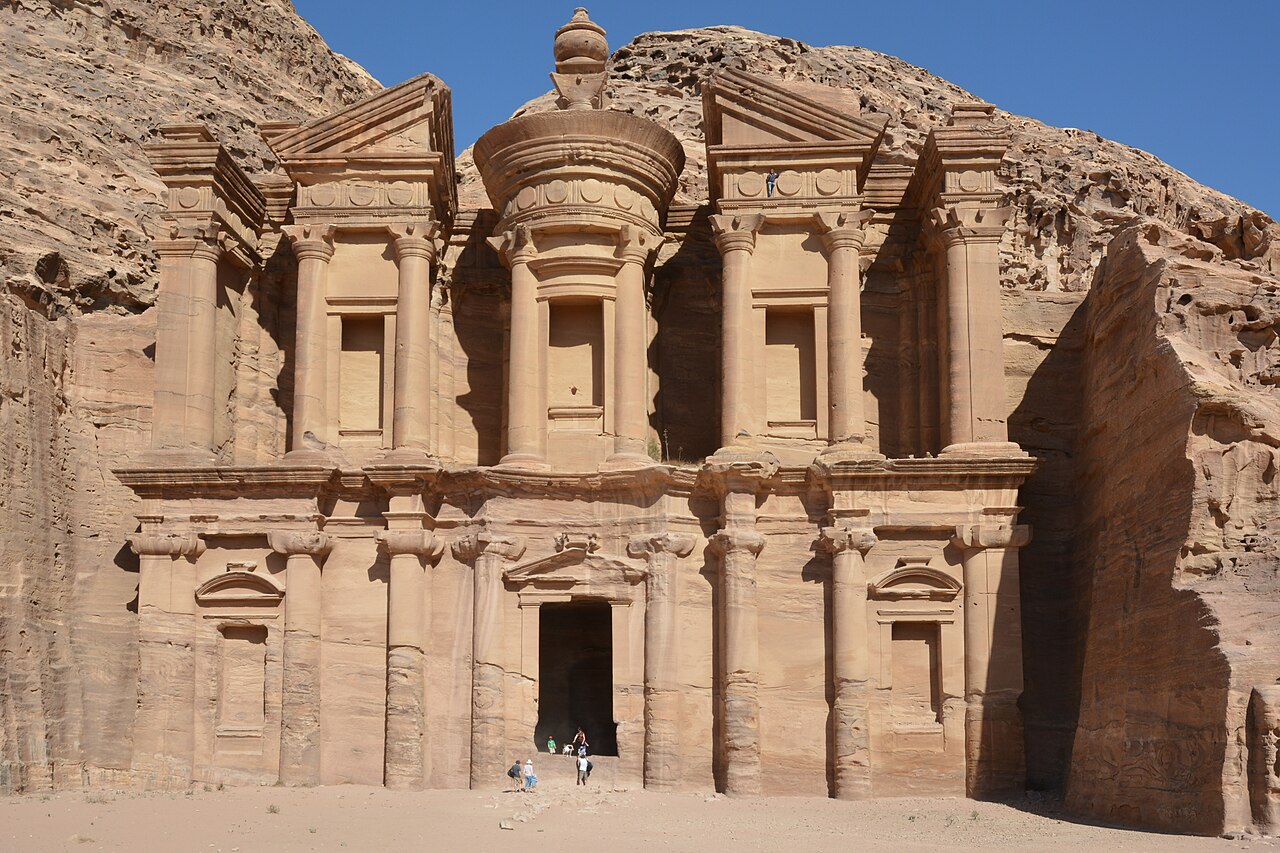
Ed-Deir is a building carved out of rock in Petra, Jordan. Carved directly from the sandstone cliff, not built from blocks. The free Lokali audio guide runs 7 minutes.
✓ Published October 2026 · how we write these guides
Visitor facts
| Lokali audio guide | 7 min · free |
|---|---|
| Type | Monument |
| Location | Ma'an, Jordan |
| Coordinates | 30.3382, 35.4309 |
| Languages | 50+, in the Lokali app |
The story
Listen to your own breathing first. After the long climb, your lungs are working hard, and the air up here is thin and dry. Under your shoes, the stone steps are worn smooth and rounded at the edges, polished by countless feet. Then the path opens out, and a wide, flat plateau lies ahead of you. On the far side, carved straight out of the mountain, stands a vast façade of rose and honey-coloured sandstone. This is Ed-Deir, the building most people call the Monastery.
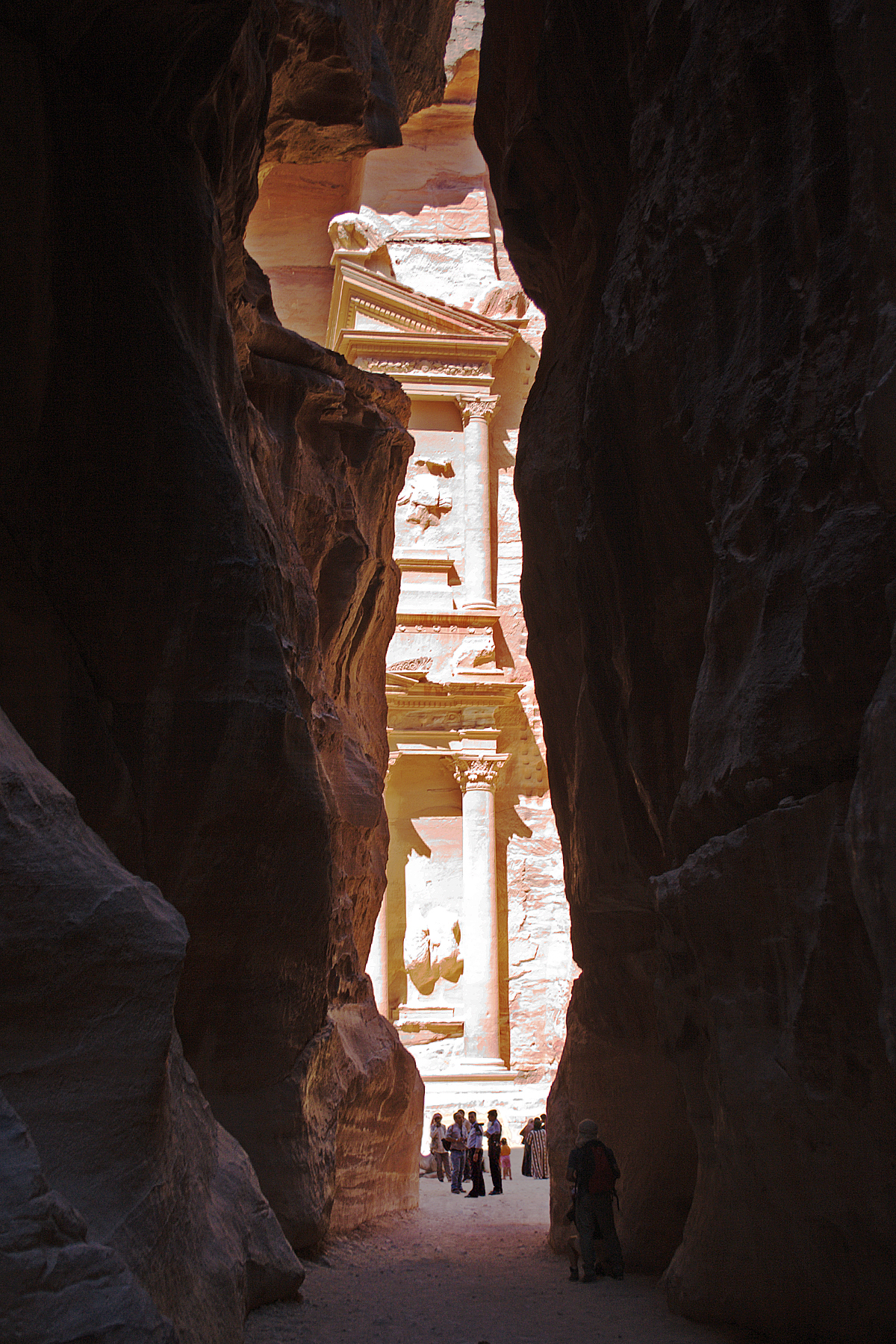
Take a moment before you walk closer. Most visitors to Petra see the Treasury first, down in the narrow gorge, and it fills their memory. Ed-Deir is different. It stands high above the city and away from the crowds, open to the sky on every side. The light reaches it freely, and the wind moves across the plateau. Many people who make the climb say that this building, not the Treasury, is the one they remember most clearly.
The façade was not built in the usual sense. Nobody carried stones up here and stacked them. The Nabataeans carved it out of the living rock. Nabataeans were the Arab people who built Petra and grew rich on the caravan trade in incense and spices. Their stonemasons almost certainly worked from the top down. They cut away the cliff layer by layer, so they never needed tall scaffolding against a finished surface below.
Scholars commonly date Ed-Deir to around the first century of the common era. That was a confident and wealthy period for the Nabataean kingdom. Look at the scale. The façade is wider and taller than the Treasury, and the doorway alone rises several times the height of a person. Stand at its base and look up. The people walking past the entrance show you how large the carving really is.
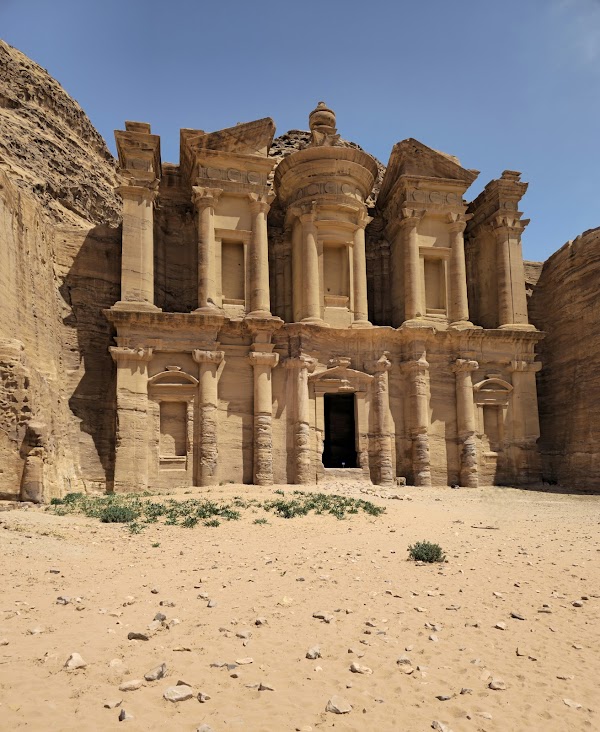
Now compare the style with the Treasury, if you remember it. The Treasury is full of carved figures and decoration. Ed-Deir is much plainer. Its columns are simple and strong, and its capitals — the decorated tops of the columns — are a simplified local form. Some scholars see this as a mature Nabataean style, less dependent on Greek models. Others think some decorative details were simply never finished. Either way, the plain surfaces make the building feel solid and calm.
Raise your eyes to the very top. There you will see a round structure crowned by a large carved urn. It sits inside a pediment that is split open in the middle — a broken pediment, as architects call it. The same design appears on the Treasury, which suggests a shared architectural language across Petra. Local stories say treasure was once hidden inside these urns. That is folklore, not history, but it shows how much these carvings have stirred the imagination.
Here is the first surprise. Despite its name, Ed-Deir was almost certainly not built as a monastery. The name comes from Arabic and means simply 'the monastery'. It probably comes from crosses carved on the interior walls, which suggest Christian use during the Byzantine period. By that time, Petra had already declined, and the building was centuries old. So the name you know records a later chapter of the building, not the reason it was made.
What was it originally for? Nobody can say with complete certainty. Many scholars believe it was a ceremonial hall for religious gatherings and shared feasts. There is a widely discussed theory linking it to the worship of a Nabataean king who was honoured as a god after his death. The large open plateau in front supports the idea of gatherings. It is a natural place for many people to stand together facing the sacred building.
If entry is permitted when you visit, step through the doorway. The second surprise is how simple the inside is. After that huge façade, you find a single plain chamber cut into the rock. At the back is a recessed niche, which probably once held a sacred object. Benches carved along the sides suggest people sat here together. The room is cool and quiet, and your voice sounds different against the bare stone.
Notice the stone itself, both inside and out. Petra's sandstone carries bands of colour — rose, ochre, cream, and darker rust — that run in waves through the walls. These colours come from minerals in the rock. Wind and blowing sand have softened many edges of the façade over the centuries. Some details are crisp and sharp. Others are rounded and faded, like soap that has been held in water for a long time.
Turn around now and look at the plateau and the hills behind you. Across from the façade there is usually a small Bedouin tea shop with a shaded seating area. It is one of the best places to sit and look at the whole building at once. Families from the local Bdul Bedouin community have lived among these hills for generations. Many of the people selling tea, jewellery, or donkey rides along the path belong to this community.
If you still have energy, follow the short trails to the higher points nearby. Simple signs point the way to viewpoints. From these rocky edges, the land falls away towards the deep valley of Wadi Araba, the long desert rift that runs towards the Dead Sea. On a clear day, ridge after ridge of bare mountains fades into a blue haze. The wind is stronger here, so hold onto your hat and stay well back from the edge.
As you rest, think about the path you climbed. The steps were cut and repaired by hand, generation after generation. Along the way you passed small carved chambers, and perhaps the Lion Triclinium, a dining hall named after the worn lions carved beside its entrance. Every part of this mountain was used, shaped, and walked. Ed-Deir was the destination at the top of a sacred route, and you have just followed that same route.
Before you start the long walk down, look at the façade once more. Watch how the colour changes as the sun moves or a cloud passes over. The stone may look pale one moment and glow warm orange the next. Listen to the wind across the plateau, the clink of tea glasses, and the scrape of sandals on rock. Then take the first step down, slowly, and carry this quiet picture with you.
Key facts
What to look for
Practical tips
Common questions
Is there a free audio guide to Ed-Deir?
Yes — the Lokali app narrates Ed-Deir free of charge in 50+ languages. The guide runs about 7 minutes, covers the history, what to look for on site and practical tips, and works offline once downloaded.
Where is Ed-Deir?
Ed-Deir is near Ma'an, Jordan, at 30.3382, 35.4309. Tap the map link on this page for directions from where you are.
What is Ed-Deir known for?
Carved directly from the sandstone cliff, not built from blocks. Commonly dated to around the first century of the common era.
What should you look for at Ed-Deir?
The large carved urn crowning the round central structure. The broken pediment split open around the urn. Simple, plain column capitals with very little decoration.
What should you know before visiting Ed-Deir?
Start the climb early to avoid the strongest midday heat. Carry plenty of water; the steps offer little shade.
When is the best time to visit Ed-Deir?
Start the climb early to avoid the strongest midday heat.
On the map
Opens directions to Ed-Deir from your location.
More to see in Ma'an
Hear Ed-Deir in your language
The full story, narrated, in 50+ languages. Download it before you go and it plays offline, at your own pace, with no ticket and no tour group.