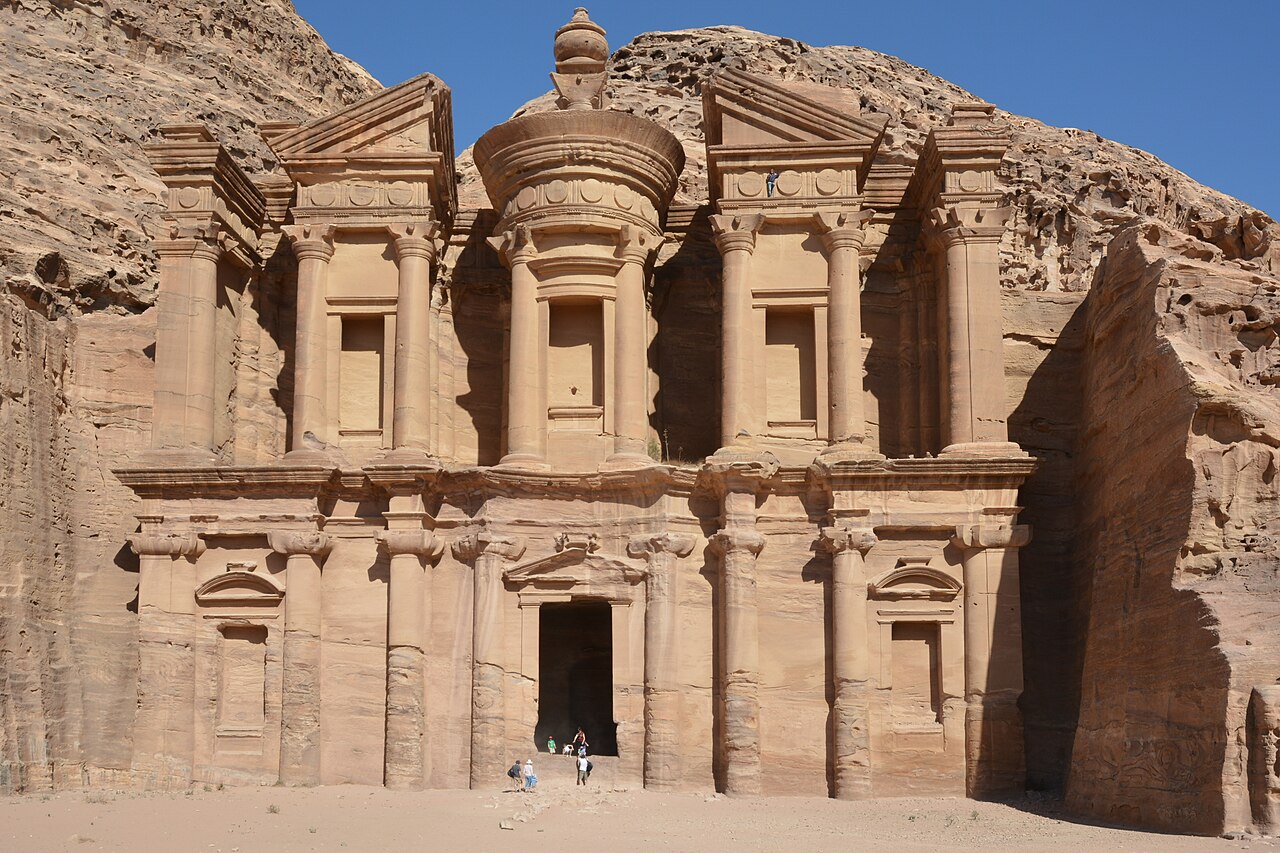
Petra is an archaeological site in Petra, Jordan. Nabataean capital for five centuries, controlling Arabian trade routes. Treasury carved top-down in first century before Christ. Most visitors spend 4-6 hours here. The free Lokali audio guide runs 7 minutes.
✓ Verified October 2026 · how we write these guides
Visitor facts
| Time needed | 4-6 hours |
|---|---|
| Lokali audio guide | 7 min · free |
| Type | Archaeological Site |
| Best for | Editors’ pick |
| Location | Petra, Jordan |
| Coordinates | 30.3286, 35.4444 |
| Languages | 45, in the Lokali app |
The story
The canyon walls press close, rose-red sandstone striped with cream and charcoal, and the path narrows until the sky becomes a ribbon of blue overhead. You are walking the Siq, a natural gorge carved by water over millions of years, and with each step the rock face changes color as the sun shifts angle. The silence here is thick, broken only by the shuffle of feet on ancient paving stones worn smooth by centuries of pilgrims, traders, and travelers.
Then the corridor opens, and through the gap you see it—the Treasury, Al-Khazneh, its facade carved directly into the cliff face. The Nabataeans built this around the first century before Christ, chiseling downward from the top of the rock, no scaffolding, no modern tools, just bronze chisels and patience. The columns stand nine stories tall, their capitals decorated with floral motifs that blend Greek, Egyptian, and Arabian design. The urn at the summit is pocked with bullet holes—Bedouin tribesmen in the nineteenth century believed it held the pharaoh's treasure and shot at it hoping gold would spill out. It never did. The Treasury was likely a royal tomb, though no burial has ever been found inside.
Petra was not always silent. For five hundred years it was the capital of the Nabataean Kingdom, a trading empire that controlled the incense routes between Arabia and the Mediterranean. Caravans brought frankincense from Yemen, myrrh from Somalia, spices from India, and the Nabataeans taxed every load that passed through their red rock city. They grew wealthy enough to carve over eight hundred tombs and temples into these cliffs, each one a statement of power and faith. The city had running water—an engineering feat that still astonishes. Look up as you walk and you will see channels cut into the rock, part of a system that collected winter rains and fed them into cisterns and fountains throughout the valley.
The Romans annexed Petra in the year one hundred and six, and for a while the city thrived under new rule. They built a colonnaded street, a theater that seats four thousand, and public baths. But the trade routes shifted. Merchants began using sea routes to move goods, and Petra's income dried up. Earthquakes in the fourth and sixth centuries shattered buildings and cracked the water system. By the seventh century, when Islamic armies swept through the region, Petra was already half-abandoned. Bedouin tribes moved into the tombs, using them as homes and animal shelters, and the city faded from Western memory for over a thousand years.
A Swiss explorer named Johann Ludwig Burckhardt brought Petra back to European attention in 1812. He disguised himself as a Muslim pilgrim, dyed his skin, learned Arabic, and convinced a local guide to take him to the tomb of Aaron on the mountain above the city. On the way, he saw the Treasury and realized he had found the lost city described in ancient texts. He could not linger—his disguise was fragile—but he made notes and sketches that eventually reached London. Within decades, artists and archaeologists were making the difficult journey to sketch and study the ruins.
Walk beyond the Treasury and the valley opens into a wide basin. The Street of Facades lines the path to your left, a row of simpler tombs stacked like apartments in the rock. The Royal Tombs rise on the right, each one massive and distinct. The Urn Tomb has a courtyard carved into the cliff, with arches that frame the desert beyond. The Corinthian Tomb mimics the Treasury's design but was never finished—you can see where the carvers stopped mid-column. The Palace Tomb is the largest, its facade imitating a Roman palace with three stories of doorways and windows, though the upper levels were built from masonry because the rock face ran out.
The theater sits in a natural bowl, carved from the living rock in the first century before Christ and expanded by the Romans. Thirty-three rows of seats curve around a stage that once hosted performances in Greek and Latin. The Nabataeans cut through earlier tombs to build it—if you look at the back wall of the theater, you can see the dark openings of burial chambers that were sliced in half when the seats were carved. It is a strange collision of the sacred and the public, death and entertainment sharing the same stone.
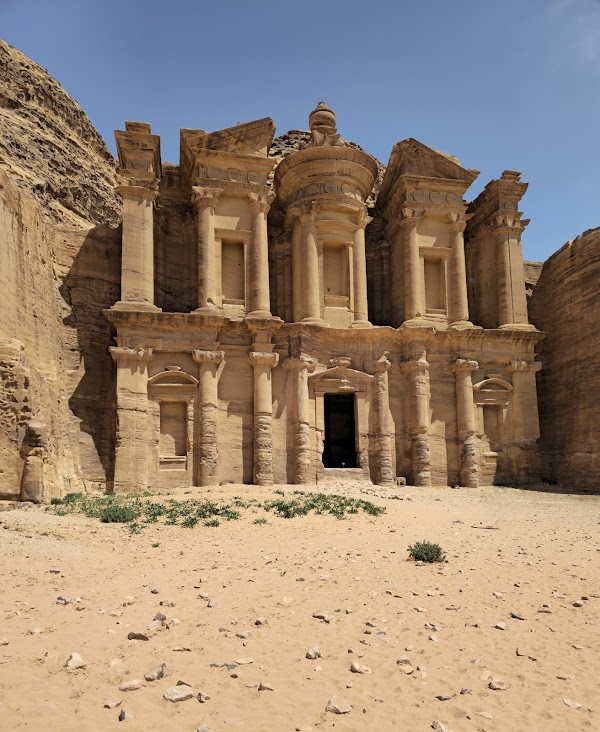
Climb the steps to the Monastery, Ad-Deir, and you will understand the scale of Nabataean ambition. The path is over eight hundred rock-cut steps, winding up the mountainside, and the facade at the top is even larger than the Treasury—forty-five metres wide, fifty metres tall. It was likely a temple, though later Christians used it as a church, which is how it got its name. The doorway is so large you feel like a child standing in it. The urn on the roof is eight metres tall. From the plateau in front of the Monastery, you can see across the valley to the mountains of Israel and the edge of the Negev Desert.
Petra is not frozen in time—it is still being discovered. Archaeologists estimate that eighty-five percent of the city remains unexcavated, buried under sand and rubble. In 2010, satellite imaging revealed a massive platform and a pool complex near the Treasury, structures no one knew existed. In 2016, researchers found a large ceremonial platform buried beneath the sand in the city center. Each dig season turns up new walls, new inscriptions, new questions about how the Nabataeans lived and what they believed.
The light changes fast here. In the morning, the Treasury glows pale pink. By midday, the stone turns white-hot under the desert sun. Late afternoon is when the red deepens, and the carved details—the friezes of gods, the column capitals, the doorways leading into darkness—become sharp and dramatic. By evening, the rock is the color of dried blood, and the shadows are long enough to walk through. The Bedouin who still live near the site will tell you the jinn come out at night, spirits who guard the tombs and whisper in the empty corridors. Whether you believe that or not, there is something uncanny about standing in this valley as the last light drains away, surrounded by two thousand years of silence carved into stone.
Key facts
What to look for
Practical tips
Common questions
How long do you need at Petra?
Plan 4-6 hours. That is the time most visitors spend at Petra. The free Lokali audio guide runs 7 minutes and is made to listen to while you walk.
Is there a free audio guide to Petra?
Yes — the Lokali app narrates Petra free of charge in 50+ languages. No ticket, tour group or subscription, and it works offline once downloaded.
Where is Petra?
Petra is in Petra, Jordan, at 30.3286, 35.4444. Tap the map link on this page for directions.
What should you know before visiting Petra?
Walk the Siq early morning for cool air and soft light
What is Petra known for?
Nabataean capital for five centuries, controlling Arabian trade routes
What is the best time to visit Petra?
Walk the Siq early morning for cool air and soft light
On the map
Opens directions to Petra from your location.
More to see in Petra

Hear Petra in your language
The full story, narrated, in 50+ languages. Download it before you go and it plays offline, at your own pace, with no ticket and no tour group.