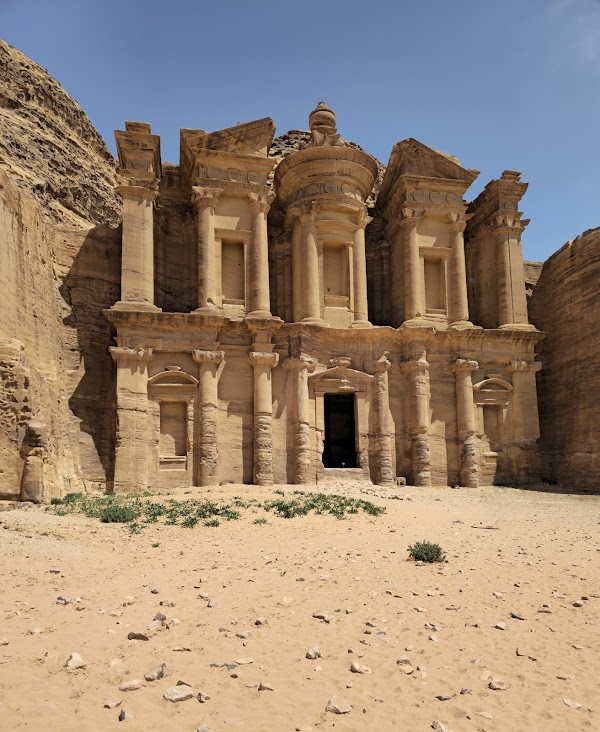
The Royal Tombs is a monument in Petra, Jordan. A row of grand tombs in the eastern cliff. Includes the Urn, Silk, Corinthian, and Palace tombs. Most visitors spend 45-60 min here. The free Lokali audio guide runs 5 minutes.
✓ Verified October 2026 · how we write these guides
Visitor facts
| Time needed | 45-60 min |
|---|---|
| Lokali audio guide | 5 min · free |
| Type | Monument |
| Best for | History |
| Location | Petra, Jordan |
| Coordinates | 30.3281, 35.4389 |
| Languages | 45, in the Lokali app |
The story
Look up at the eastern cliff in the late afternoon. The bare rock face catches the low sun and begins to glow. Carved into that wall stands a row of huge stone facades, one beside the next. These are the Royal Tombs. From the valley floor they look like a city of doorways cut straight into the mountain.
The name tells you what people long believed. These tombs were so large and grand that they must have held kings, queens, or great nobles of Petra. The Nabataean rulers wanted to be remembered. So they had their resting places carved high in the cliff, where every traveler below would see them and look up.
There are several tombs in this group, set side by side. Each has its own character and its own name. Together they form one of the grandest sights in the whole city. Plan to spend time walking along the base of the cliff, looking up at each facade in turn and climbing the steps between them.
Begin with the Urn Tomb. It sits on top of a row of supporting vaults, reached by a flight of stairs. In front spreads a wide open courtyard. Stand in that courtyard and look back over the valley. The view stretches far across Petra. This tomb was built to impress from a height, and it still does.
The Urn Tomb had a second life. Long after the Nabataeans, around the year 447, local Christians turned the inner chamber into a church. An old inscription on the wall records the change. So this single room served first as a royal grave and later as a place of worship, across many centuries of use.
Move along to the Silk Tomb. Its name comes from the rock itself. The sandstone here runs with bands of pink, yellow, gray, and white, swirled together like folds of colored cloth. The carved facade is fairly worn now. But the natural pattern in the stone is the real reason to stop and look closely here.
Next comes the Corinthian Tomb. Its upper part may remind you of the Treasury, down near the Siq. You can see a similar broken crown and round urn at the top. Time has worn this facade hard, and parts have crumbled away. Still, the echo of that grander cousin is clear once you know to look for it.
The largest of the group is the Palace Tomb. Its wide front rises in several levels, one above the next. The design imitates the face of a grand Roman palace, which gave the tomb its name. The upper sections were not all carved from the cliff. Some were built from cut blocks, since the rock face ran out before the design did.
Take time to study the doorways. Each tomb opens into plain inner chambers cut from the rock. Step inside one if you can, and feel how the temperature drops in the shadowed stone. As with most monuments in Petra, the carvers spent their skill on the outer face. The rooms inside are simple and bare. The grand fronts were meant for the living to admire, not for the dead who rested within.
The light here changes everything. In flat midday sun the facades can look pale and worn. But as the afternoon fades, the low light rakes across the cliff. The carvings deepen into rose, gold, and orange. This is the hour photographers wait for. If you can, plan your visit to this wall for the late day.
Climb the steps and paths that link the tombs. From higher up you gain a new view down over the heart of Petra. You can see the old main street, the ruins, and the crowds moving far below. The Nabataeans chose this height with care. Their dead would forever overlook the living city they had built.
Think about the effort behind this wall. Each facade meant months or years of careful cutting by hand. Workers hung on the cliff with simple tools, shaping the rock from the top down. A whole row of such monuments, side by side, shows how much wealth and pride once filled this desert capital.
Before you leave, find a spot across the valley and look back at the whole cliff at once. Seen together, the Royal Tombs form a single grand wall of stone and shadow. The sun drops lower, the colors deepen, and the carved doorways darken. Then the light fades, and the tombs settle back into the quiet mountain.
Key facts
What to look for
Practical tips
Common questions
How long do you need at The Royal Tombs?
Plan 45-60 min. That is the time most visitors spend at The Royal Tombs. The free Lokali audio guide runs 5 minutes and is made to listen to while you walk.
Is there a free audio guide to The Royal Tombs?
Yes — the Lokali app narrates The Royal Tombs free of charge in 50+ languages. No ticket, tour group or subscription, and it works offline once downloaded.
Where is The Royal Tombs?
The Royal Tombs is in Petra, Jordan, at 30.3281, 35.4389. Tap the map link on this page for directions.
What should you know before visiting The Royal Tombs?
Visit in late afternoon for the warmest light
What is The Royal Tombs known for?
A row of grand tombs in the eastern cliff
What is the best time to visit The Royal Tombs?
Visit in late afternoon for the warmest light
On the map
Opens directions to The Royal Tombs from your location.
More to see in Petra

Hear The Royal Tombs in your language
The full story, narrated, in 50+ languages. Download it before you go and it plays offline, at your own pace, with no ticket and no tour group.