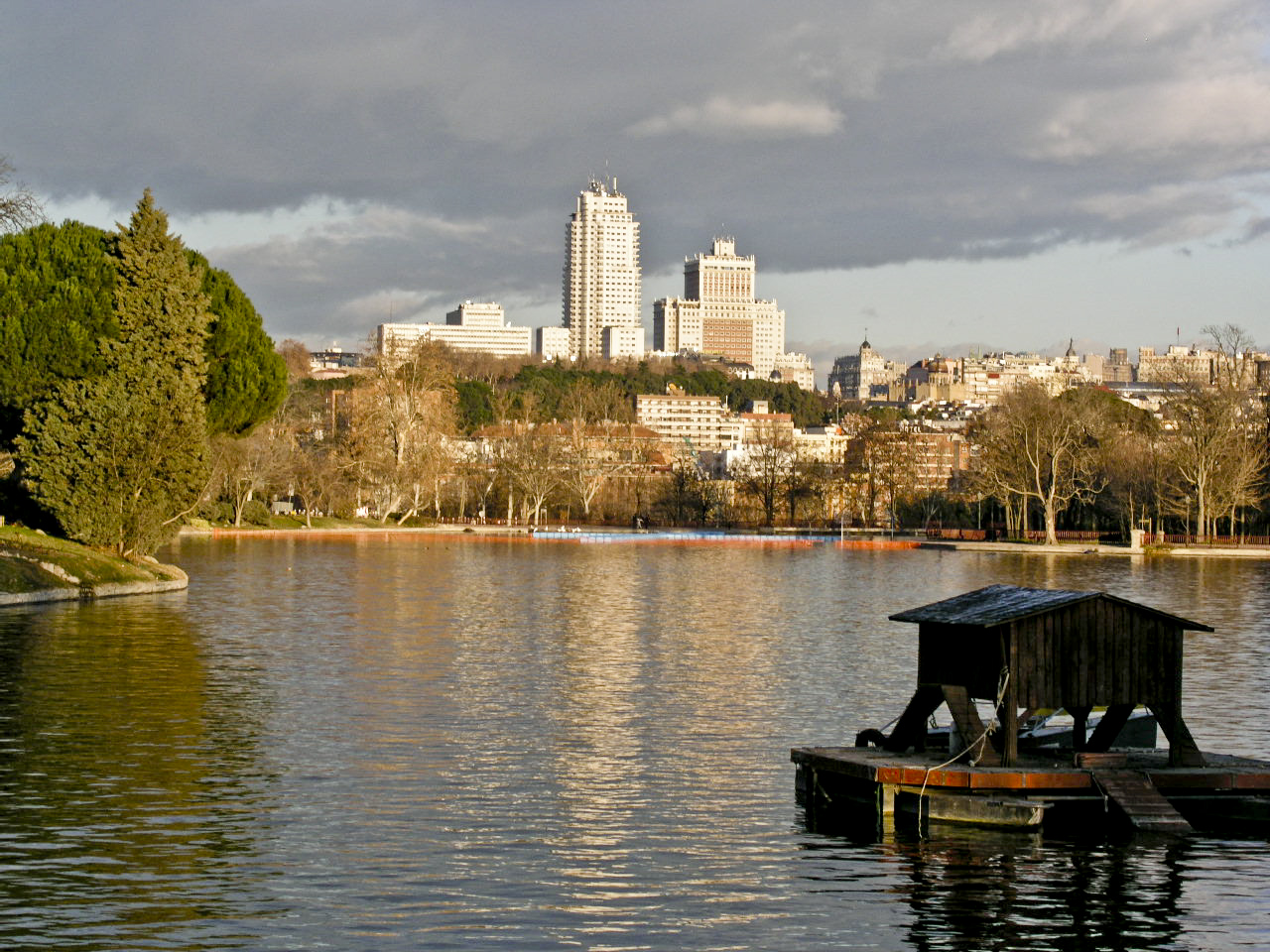
Photo: Håkan Svensson Xauxa · CC BY 2.5 · Wikimedia Commons
Casa de Campo is a cultural property in Madrid y Pozuelo de Alarcón, Spain. Covers roughly 1,700 hectares on Madrid's western edge. The free Lokali audio guide runs 7 minutes.
✓ Published October 2026 · how we write these guides
Visitor facts
| Lokali audio guide | 7 min · free |
|---|---|
| Type | Historic Site |
| Location | Madrid, Spain |
| Coordinates | 40.4229, -3.7559 |
| Official website | esmadrid.com |
| Languages | 50+, in the Lokali app |
The story
Listen for a moment. Underfoot there is dry, sandy soil and a crunch of pine needles. Overhead, the wind moves through the umbrella-shaped crowns of stone pines. Somewhere behind you, a city of more than three million people is going about its day. Here, though, the air smells of resin and warm earth. Welcome to Casa de Campo, the great green lung on the western edge of Madrid. It feels less like a park and more like a piece of open countryside that the city simply grew around.
Size is the first surprise. Casa de Campo covers roughly 1,700 hectares. That makes it several times larger than the Retiro, the formal park most visitors know in the centre of town. It is the largest public park in Madrid by a wide margin. You can walk here for hours on dirt tracks and never retrace your steps. Many first-time visitors arrive expecting flower beds and fountains. Instead, they find rolling hills, scrubland and woods.
The name gives a clue to its origins. Casa de Campo means, quite simply, the country house. In the sixteenth century, the land belonged to a noble family, the Vargas, who kept a residence here. When King Philip the Second moved his court to Madrid in the 1560s, he wanted a private retreat close to the royal palace. He acquired the estate and began to expand it. For centuries afterwards, this was royal hunting ground, closed to ordinary people.
Think about what that meant. While Madrid grew crowded and noisy just across the river, this land stayed wild by design. Kings and their guests hunted deer, rabbits and birds among these oaks. Gardens, orchards and water features were added near the old house over time. The rest was kept as open woodland. That long royal protection is the reason the city still has so much untouched ground on its doorstep today.
The gates opened to everyone in 1931. That year, Spain became a republic, and the new government handed the royal estate to the people of Madrid. It was a powerful symbol. A place reserved for kings now belonged to working families from the nearby neighbourhoods. Photographs from that period show crowds picnicking under the trees and swimming in the summer heat. The park's public life began with a political change.
That calm did not last. During the Spanish Civil War, from 1936 to 1939, Madrid was under siege. The front line ran straight through Casa de Campo. Nationalist forces held positions here, facing Republican defenders across the river and the university district. Here is a detail many visitors miss. If you explore the higher, quieter ground, you can still find concrete bunkers and the faint lines of old trenches. Some are now marked with small information panels.
Now turn your attention to the trees. The stone pine is the one with the flat, umbrella-like top. You will also see holm oaks, the dark, small-leaved evergreen oak of central Spain. Near the streams and lower ground, ash trees grow. Together they create something close to the dehesa, the open wooded pastureland typical of the Spanish interior. In spring, the grass turns briefly green and wildflowers appear. By late summer, everything fades to gold and dust.
Wildlife is easy to spot if you move quietly. Rabbits dart across the paths at dawn and dusk. Red squirrels climb the pine trunks. Magpies, with their black and white wings and long tails, call loudly from the branches. Around the water, ducks and gulls gather. Birdwatchers come here for woodpeckers and birds of prey as well. For a park inside a capital city, the amount of animal life is genuinely surprising.
Most people find their way to the lake sooner or later. It sits on the eastern side of the park, close to the metro station that shares its name. You can rent a rowing boat and drift out onto the water. Look east from the shore. Across the trees, you will see the pale outline of the Royal Palace and the domes of the Almudena Cathedral. It is one of the best views of old Madrid, and it costs you nothing but a short walk.
Around the lake, the park becomes more social. Terraces serve cold drinks and small plates under the shade. On weekends, families spread blankets on the grass and cyclists stop to refuel. Runners circle the water in the early morning. This is where you see Casa de Campo as locals use it. It is not a sight to tick off. It is a back garden for an entire city.
There is a playful way to arrive, too. A cable car, the Teleférico, runs from the Argüelles area near the city centre across the river and into the park. The cabins pass slowly over rooftops, the Manzanares river and the treetops. From above, you understand the scale of this green space properly. The cable car has carried passengers since the late 1960s, and it remains a small adventure for children and adults alike.
Casa de Campo also holds several large attractions within its borders. The Madrid zoo and aquarium sits in the southern part of the park. Nearby is the Parque de Atracciones, an amusement park with rides and roller coasters. You will also find a large exhibition ground and an indoor arena used for concerts and events. Because the park is so big, these places never dominate it. Walk ten minutes in another direction and they disappear behind the trees.
Before you leave, pause where you are. Notice the light. In the afternoon, it falls low and golden through the pine needles. Notice the sound of the city, distant and soft, like the sea heard from inland. Kings rode through this land. Soldiers dug in along these hills. Now there is you, a path, and the open sky. As you walk back toward the gates, look at the oaks one more time. Some of them were already here long before any of us.
Key facts
What to look for
Practical tips
Common questions
Is there a free audio guide to Casa de Campo?
Yes — the Lokali app narrates Casa de Campo free of charge in 50+ languages. The guide runs about 7 minutes, covers the history, what to look for on site and practical tips, and works offline once downloaded.
Where is Casa de Campo?
Casa de Campo is in Madrid, Spain, at 40.4229, -3.7559. Tap the map link on this page for directions from where you are.
What is Casa de Campo known for?
Covers roughly 1,700 hectares on Madrid's western edge. Largest public park in Madrid, several times the Retiro.
What should you look for at Casa de Campo?
Umbrella-shaped crowns of the stone pine trees. Royal Palace silhouette visible from the lake shore. Concrete Civil War bunkers on the higher ground.
What should you know before visiting Casa de Campo?
Arrive by the Teleférico for an aerial view first. Rent a rowing boat on the lake for palace views.
When is the best time to visit Casa de Campo?
Visit early morning to spot rabbits and squirrels.
On the map
Opens directions to Casa de Campo from your location.
More to see in Madrid


Hear Casa de Campo in your language
The full story, narrated, in 50+ languages. Download it before you go and it plays offline, at your own pace, with no ticket and no tour group.