
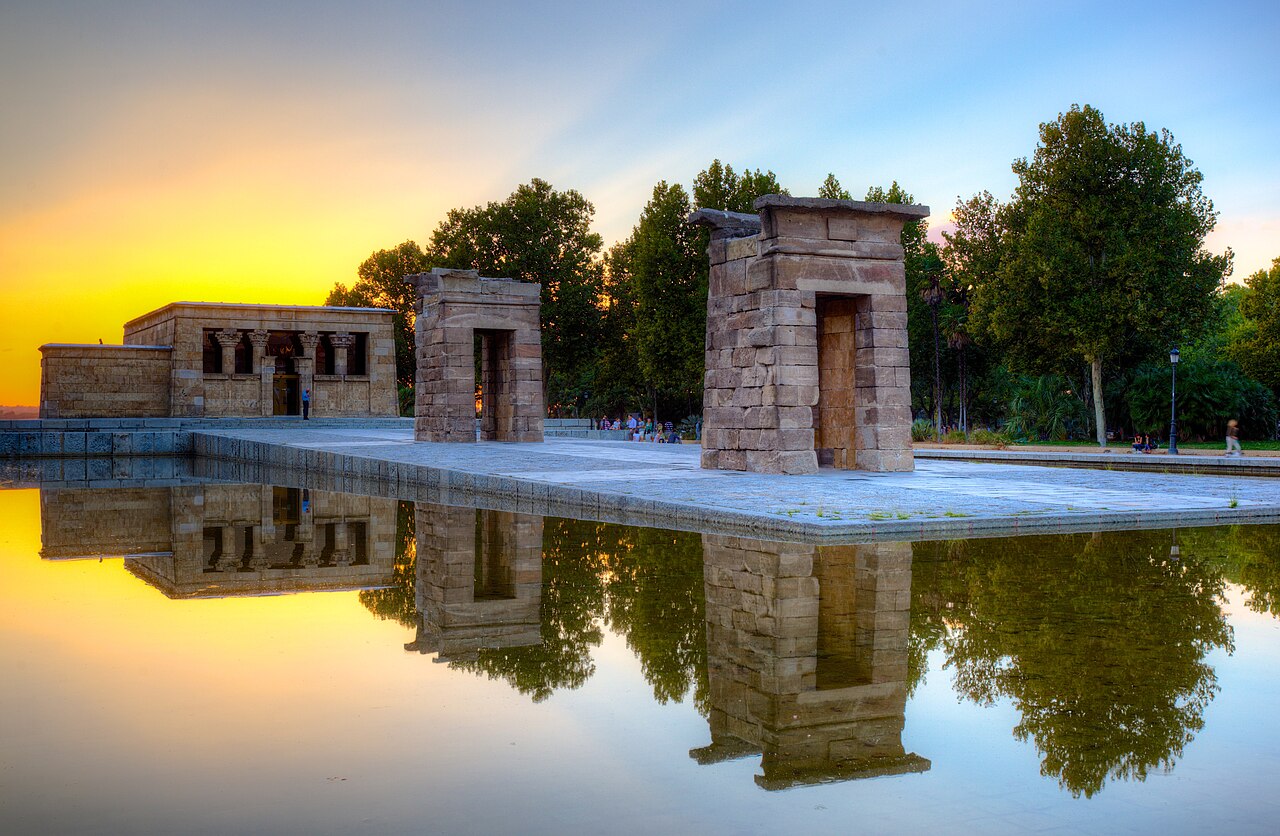
Photo: Pool Moncloa · Attribution · Wikimedia Commons
Palace of Moncloa is a residence of the Prime Minister of Spain. It is in Madrid, Spain. Official residence of Spain's head of government since 1977. The free Lokali audio guide runs 7 minutes.
✓ Published October 2026 · how we write these guides
Visitor facts
| Lokali audio guide | 7 min · free |
|---|---|
| Type | Palace |
| Location | Madrid, Spain |
| Coordinates | 40.4436, -3.7369 |
| Languages | 50+, in the Lokali app |
The story
Listen for a moment. Traffic hums along the wide roads of northwest Madrid. Pine needles and dry earth scent the air, and somewhere beyond a tall fence a flag lifts in the breeze. You will not see guards posing for photographs or crowds queuing at a gate. This place is quiet on purpose. Behind those trees stands the Palace of Moncloa, the home and office of Spain's head of government. It is the address where the country's hardest decisions are often made.
First, a word about what you can and cannot see. Moncloa is a working government compound, not a museum. It sits inside a secure perimeter, and ordinary visitors usually experience it from the outside. That is fine. The setting itself tells a story. You are standing at the edge of the city, where Madrid's dense centre loosens into parkland, university campuses and long avenues. The palace was placed here, away from the old royal heart of the capital, and that distance feels deliberate.
The word Moncloa is used far beyond this one building. Spaniards say Moncloa the way the British say Downing Street or Americans say the White House. When a newspaper writes that Moncloa has responded, it means the government has spoken. So the palace has become shorthand for power itself. Yet the name is much older than any modern government. It belongs to the whole district around you, and the estate carried it for centuries.
Where does the name come from? The most common explanation links it to the Counts of Monclova, a noble title held by a family that owned land here in the seventeenth century. Over time, Monclova seems to have softened into Moncloa in everyday speech. Treat that as the popular account rather than a settled fact. Either way, the land passed through aristocratic hands and later into royal and then state ownership. For generations it was a country estate, a green retreat just outside the city walls.
Now for the first surprise. The palace you are near is not the original building. During the Spanish Civil War, from 1936 to 1939, the front line ran through this part of Madrid. The fighting around the nearby University City was some of the fiercest in the siege of the capital. The old palace was badly damaged and effectively destroyed. What stands today is a reconstruction from the years after the war, built to echo the earlier house.
That rebuilding followed a style Madrid knows well. Look for the language of the Habsburg era, the period when Spain's kings of the Habsburg family made Madrid their capital. Think red brick walls, pale stone trim around windows and doors, and dark slate roofs with pointed towers. You can see the same look in the Plaza Mayor and in older buildings across the centre. At Moncloa, the style gives a postwar building the calm look of something much older.
For several decades after its reconstruction, the palace did not house a prime minister at all. It served as a residence for foreign heads of state and important guests visiting Spain. Leaders on official trips could stay here, surrounded by gardens and quiet, rather than in a city hotel. The house was a place of hospitality and diplomacy. Its later role as the seat of government came only with a much larger change in Spanish life.
That change was the transition to democracy. After the death of Francisco Franco in 1975, Spain began to move from dictatorship toward a parliamentary system. In 1977, the prime minister Adolfo Suárez became the first head of government to make Moncloa his official residence. Since then, every leader of the Spanish government has lived and worked here. So this compound is closely tied to the story of modern, democratic Spain.
Here is the second surprise, and it is one of the most important moments in the palace's life. Also in 1977, political parties from across the spectrum met here and signed a set of agreements known as the Moncloa Pacts. The country faced high inflation and deep uncertainty. Rivals who had very different visions for Spain agreed on shared economic and political measures. Many historians see the pacts as a model of compromise during the transition. The name of this building is attached to that idea of agreement.
Over the years, Moncloa has grown into more than one house. The compound includes several buildings for offices, meetings and staff, as well as the residence itself. Each leader has left a small personal mark. One charming example belongs to Felipe González, who led the government from 1982 to 1996. He was a keen grower of bonsai, the Japanese art of miniature trees. His collection was cared for at Moncloa and later donated to a public garden outside Madrid.
Think about that image for a moment. Inside a compound built for serious decisions, a prime minister trimmed tiny trees by hand. It is a reminder that this is also a home. Families have lived here. Children have grown up behind these walls. Ordinary evenings have passed in rooms where, the next morning, ministers might gather to debate a national crisis. The quiet you notice outside is partly security. It is also partly domestic privacy.
If you have time, the surrounding area rewards a slow walk. Nearby you will find the Parque del Oeste, a large green park with shaded paths and city views. The Museum of the Americas sits close by, as does the tall Moncloa lighthouse viewing tower. The University City campus spreads out to the north. On some streets in this part of Madrid, you can still find traces of the Civil War front, a sobering contrast to the calm today.
Before you move on, look again at the trees and the fence line in front of you. Notice how little the palace tries to impress from the road. There is no grand avenue leading to a dramatic façade, no balcony made for speeches. Power here keeps its head down. As you walk away, listen for the traffic returning to its steady hum. Somewhere behind you, the work of governing Spain carries on, quietly, among the pines.
Key facts
What to look for
Practical tips
Common questions
Is there a free audio guide to Palace of Moncloa?
Yes — the Lokali app narrates Palace of Moncloa free of charge in 50+ languages. The guide runs about 7 minutes, covers the history, what to look for on site and practical tips, and works offline once downloaded.
Where is Palace of Moncloa?
Palace of Moncloa is in Madrid, Spain, at 40.4436, -3.7369. Tap the map link on this page for directions from where you are.
What is Palace of Moncloa known for?
Official residence of Spain's head of government since 1977. Adolfo Suárez was the first prime minister to live here.
What should you look for at Palace of Moncloa?
Red brick walls typical of Madrid's Habsburg style. Dark slate roofs with pointed tower tops. Pale stone framing around windows and doorways.
What should you know before visiting Palace of Moncloa?
View the compound from outside; it is a secure government site. Combine your visit with a walk through Parque del Oeste.
On the map
Opens directions to Palace of Moncloa from your location.
More to see in Madrid


Hear Palace of Moncloa in your language
The full story, narrated, in 50+ languages. Download it before you go and it plays offline, at your own pace, with no ticket and no tour group.