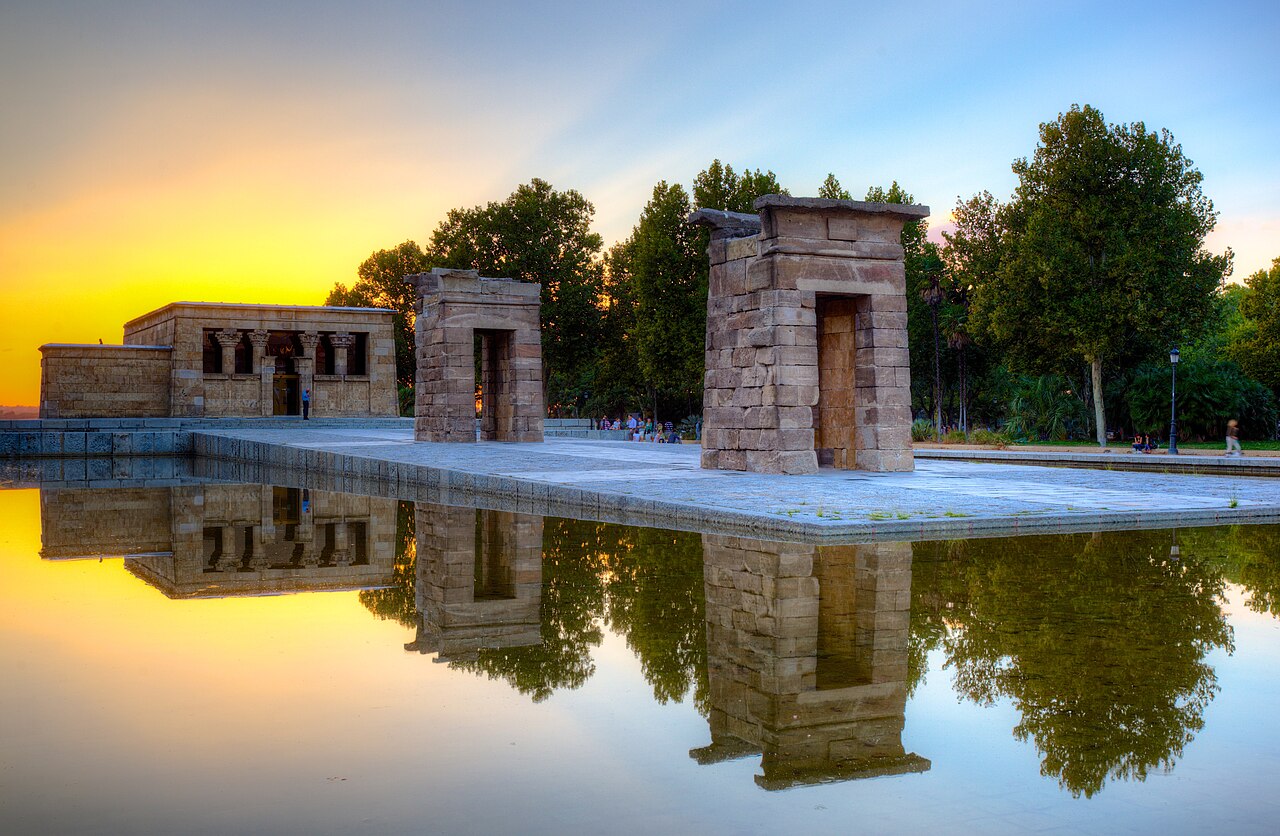
Temple of Debod is an ancient Egyptian temple from the 2nd century BCE, relocated to Madrid in 1968 as a gift from Egypt. It is in Madrid, Spain. Most visitors spend 30–45 min here. The free Lokali audio guide runs 6 minutes.
✓ Verified August 2026 · how we write these guides
Visitor facts
| Time needed | 30–45 min |
|---|---|
| Lokali audio guide | 6 min · free |
| Type | Monument |
| Best for | Photography |
| Location | Madrid, Spain |
| Coordinates | 40.4269, -3.7179 |
| Languages | 45, in the Lokali app |
The story
The wind moves across an open hill, just west of the city center. Ahead of you stands a small stone temple, framed by a shallow pool of water. Its sandstone glows warm and golden in the afternoon light. Birds cross the open sky above it. You are looking at something more than two thousand years old. And the surprising part is this: it did not begin here at all.
This is the Temple of Debod. It was first carved far away, in the south of Egypt, near a village called Debod, close to the banks of the Nile. The stone came from Nubian quarries in the desert. The builders worked beside the great river, in a land of strong heat and tall palm trees, far from the streets and traffic of Madrid.
The temple is very old. Its earliest parts were raised around 200 BC. A Kushite king named Adikhalamani ordered the first small chapel. Over the years that followed, later Egyptian rulers and then Roman emperors added new rooms and decorations. They dedicated the temple to Amun and to Isis. Both were gods of great power and meaning to the people who lived along the Nile.
For many centuries the temple stood quietly by the river. Then, in the twentieth century, the river itself began to change. Egypt built a great dam at Aswan. The dam was meant to control the floods of the Nile and to make electricity for the country. But it also created an enormous lake behind it. Many ancient monuments stood in the path of the rising water. They would soon be lost.
The world chose to act. Experts and engineers from many countries traveled to Nubia to save its temples. Spanish teams played their part, helping to rescue the famous temples at Abu Simbel. To give thanks for this help, Egypt offered four of its threatened monuments to other nations. One of those generous gifts was the Temple of Debod. It was given to Spain in 1968.
Moving an entire temple is slow and careful work. Each block of stone was studied, numbered, and gently taken apart. The pieces were packed and carried by ship across the sea. Here in Madrid, workers rebuilt the temple slowly, block by block, on this open hill. The doors opened to the public in 1972. The temple now stood in a city far from the warm river valley of its birth.
Walk slowly toward the entrance. You will pass through two stone gateways, known as pylons. Long ago they marked the sacred path toward the heart of the temple. Today they stand apart from the main building, lined up in a neat row. Picture a long avenue between them, leading worshippers inward, one step at a time, toward the holy rooms ahead.
Move into the building itself. The light grows dim and cool. The inner rooms are small, and at first they may seem plain. But look closely at the walls around you. You can still see carved figures and ancient symbols. Some scenes show kings offering gifts to the gods. The lines are soft now, worn gentle by the passing of time and by the temple's long journey north.
The hill where you are standing holds its own story too. Long ago a large military barracks stood on this very spot. It was badly damaged during the Spanish Civil War in the nineteen thirties, and later cleared away. For years afterward the ground lay open and empty. The arrival of the ancient temple gave this quiet space a new purpose, and a new center.
This is a place people love most at sunset. As the sun sinks behind the trees of the park, the sky fills with orange and soft pink. The temple's dark shape is mirrored in the still water of the pool. Visitors gather on the grass and benches. Voices drop low. For a few minutes, the ancient stone and the modern city seem to share the very same light.
Take a moment to think about how rare this sight truly is. Very few ancient Egyptian temples stand anywhere outside Egypt. This is the only one in all of Spain. To find it here, among Spanish pine trees and the hum of city traffic, is a strange and fortunate thing. It is a small piece of the Nile, carried far to the north.
The temple has survived a great deal. It has watched kingdoms rise and fall. It has crossed deserts, a river, and a wide sea to reach this hill. Wars and floods have passed it by. Through all of it, the stone has endured, patient and steady, waiting for each new visitor who comes to stand before it.
So stay here a while, beside the water. Let the noise of the city fade gently behind you. Watch the light shift across the old stone walls. These blocks have traveled farther than most of us ever will, and they have lasted far longer. In the calm of the evening, they ask only one thing of you. Slow down, and look.
Key facts
What to look for
Practical tips
Common questions
How long do you need at Temple of Debod?
Plan 30–45 min. That is the time most visitors spend at Temple of Debod. The free Lokali audio guide adds about 6 minutes of narration you can listen to as you walk, so it fits inside your visit rather than adding to it.
Is there a free audio guide to Temple of Debod?
Yes — the Lokali app narrates Temple of Debod free of charge in 50+ languages. It covers the history, what to look for on site and practical tips, and it works offline once downloaded.
Where is Temple of Debod?
Temple of Debod is in Madrid, Spain, at 40.4269, -3.7179. Tap the map link on this page for directions from where you are.
What should you know before visiting Temple of Debod?
Come near sunset for the warm golden light.
What is Temple of Debod known for?
Earliest parts built around 200 BC in Nubia.
What is the best time to visit Temple of Debod?
Visit at sunset when the stone glows and the city lights begin.
On the map
Opens directions to Temple of Debod from your location.
More to see in Madrid


Hear Temple of Debod in your language
The full story, narrated, in 50+ languages. Download it before you go and it plays offline, at your own pace, with no ticket and no tour group.