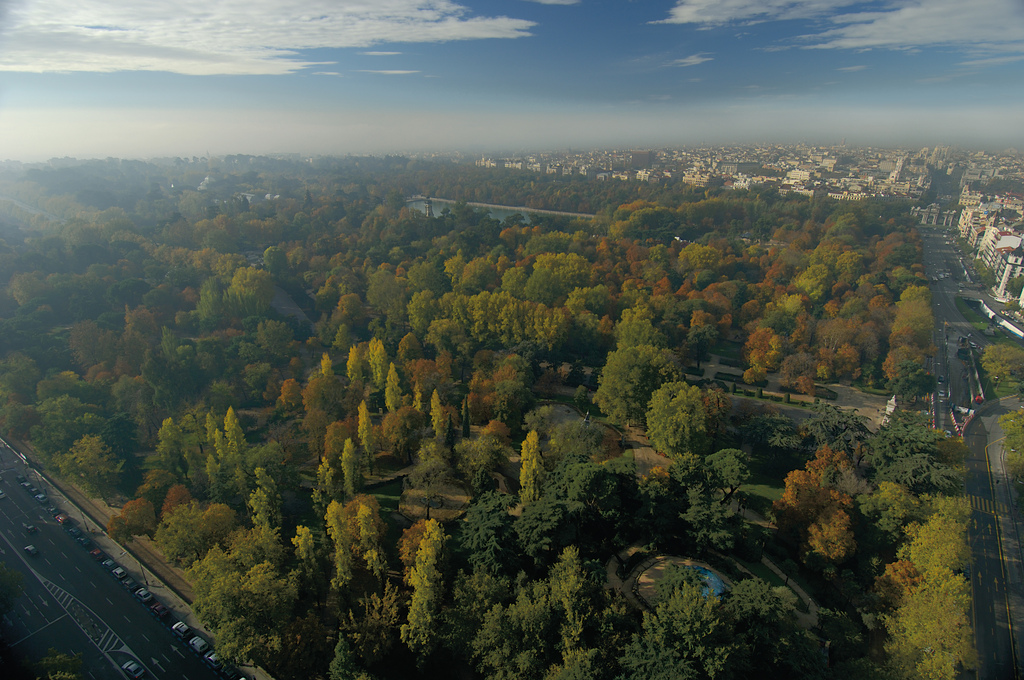
Retiro Park is a park in Madrid, Spain. Madrid's most beloved green space, a 125-hectare refuge with tree-lined walks, a large lake, formal gardens, and the Crystal Palace pavilion. Most visitors spend 1–2 hours here. The free Lokali audio guide runs 5 minutes.
✓ Verified August 2026 · how we write these guides
Visitor facts
| Time needed | 1–2 hours |
|---|---|
| Lokali audio guide | 5 min · free |
| Type | Park |
| Best for | Romantic |
| Location | Madrid, Spain |
| Coordinates | 40.4158, -3.6838 |
| Languages | 45, in the Lokali app |
The story
Pass through the gate and the city seems to exhale. Tall trees rise on either side of the path. The air smells of leaves and damp earth. Somewhere ahead, water moves and people laugh. You have entered one of the largest green spaces in Madrid, a wide park once kept only for kings. A breeze carries the smell of grass and the distant sound of music.
This is the Buen Retiro Park. Its name means, more or less, the park of the pleasant retreat. It covers around 125 hectares, a great spread of paths, gardens, and trees in the heart of the city. People simply call it the Retiro. For many in Madrid, it is the green lung of their home.
The park began in the seventeenth century. It was created for King Philip the Fourth, as the grounds of a royal palace called the Buen Retiro. Here the court could rest, walk, and hold grand entertainments. For a long time, ordinary people could not enter. These lawns and lakes belonged to the crown alone.
That changed in 1868. After years of royal ownership, the park was opened to the public. The gates were thrown wide, and the people of Madrid came in. What had once been a private royal escape became a shared place for the whole city. It has belonged to everyone ever since.
Near the center lies the great pond, a large rectangle of open water. People come here to rent small boats and row across the surface. On warm days the water fills with slow-moving craft. Around the edges, friends sit and talk. The sound of oars and voices drifts over the pond. Pigeons and sparrows hop between the feet of resting visitors, hoping for crumbs. Out on the water, a parent and child laugh as their boat turns in slow circles.
Above the water stands a tall stone monument. A grand half-circle of columns rises behind a statue of King Alfonso the Twelfth on horseback. It was finished in 1922. The columns curve around the eastern shore. From the steps below, you can watch the boats and look back across the whole pond.
Walk on and you will find a building made almost entirely of glass. This is the Crystal Palace. It was built in 1887 to display plants brought from the Philippines. Its iron frame holds great panes of glass that catch the light. Inside, the air is bright. Today it often holds art shows and quiet exhibitions.
Nearby sits a calm pond ringed by trees, with the glass palace reflected on its surface. Ducks paddle past. The whole scene feels gentle and still. Find a bench here and rest. Watch the light pass through the glass walls and scatter across the water in soft, shifting shapes.
The park holds many smaller treasures. There is a rose garden, full of color in late spring and early summer. There are quiet fountains and shaded paths. One well-known fountain shows a fallen angel, a rare statue on such a subject. Each corner of the park seems to hold a small surprise. Statues of poets and kings stand quietly along the avenues, easy to miss if you walk too fast.
On weekends the park fills with life. Families spread blankets on the grass. Drummers gather in loose circles, and their rhythm carries far across the lawns. Puppet shows draw rings of children. Joggers trace the longer paths, while old friends play chess in the shade. The Retiro belongs to all of them at once, each finding a different corner to enjoy.
In 2021 the park earned a special honor. Together with the nearby tree-lined avenue called the Paseo del Prado, the Retiro was named a World Heritage Site. The judges saw it as a fine example of a green and cultured city space, shaped over centuries with both art and science in mind.
The Retiro is best understood by walking it slowly. Let the wide main paths lead you, then turn off onto the smaller ones. Pass street performers and quiet readers. Sit when you wish. The park rewards those who wander without a plan, who let one path simply open onto the next.
Find a bench beneath a tree and stay a while. Listen to the leaves move overhead. Kings once walked these grounds in private, and now the gates stand open to all. A park like this holds the slow patience of trees. It has watched the city grow around it, and it offers its shade to anyone who stops to rest.
Key facts
What to look for
Practical tips
Common questions
How long do you need at Retiro Park?
Plan 1–2 hours. That is the time most visitors spend at Retiro Park. The free Lokali audio guide adds about 5 minutes of narration you can listen to as you walk, so it fits inside your visit rather than adding to it.
Is there a free audio guide to Retiro Park?
Yes — the Lokali app narrates Retiro Park free of charge in 50+ languages. It covers the history, what to look for on site and practical tips, and it works offline once downloaded.
Where is Retiro Park?
Retiro Park is in Madrid, Spain, at 40.4158, -3.6838. Tap the map link on this page for directions from where you are.
What should you know before visiting Retiro Park?
Rent a rowboat on the large central pond.
What is Retiro Park known for?
Created in the seventeenth century for King Philip the Fourth.
What is the best time to visit Retiro Park?
Rent a rowboat on the lake at sunset for a view of the city skyline.
On the map
Opens directions to Retiro Park from your location.
More to see in Madrid


Hear Retiro Park in your language
The full story, narrated, in 50+ languages. Download it before you go and it plays offline, at your own pace, with no ticket and no tour group.