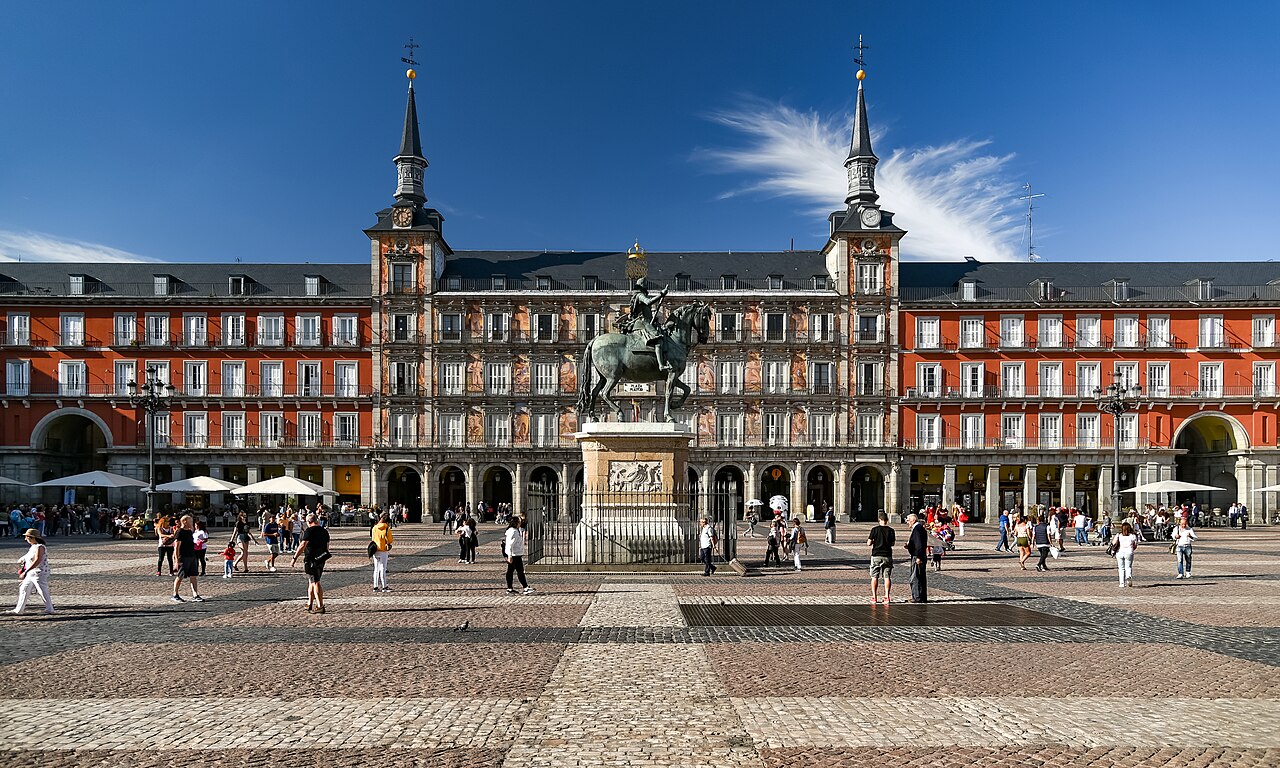
Plaza Mayor is a square in Madrid, Spain. Madrid's most historic square, built in the 16th century and surrounded by arcaded buildings. Most visitors spend 30–60 min here. The free Lokali audio guide runs 5 minutes.
✓ Verified August 2026 · how we write these guides
Visitor facts
| Time needed | 30–60 min |
|---|---|
| Lokali audio guide | 5 min · free |
| Type | Square |
| Best for | Local life |
| Location | Madrid, Spain |
| Coordinates | 40.4155, -3.7077 |
| Languages | 45, in the Lokali app |
The story
Step out of a narrow street and into sudden open space. The noise changes. Above you the sky opens wide, framed on all sides by rows of red-toned buildings. Rows of balconies look down from every wall. You are standing in the great rectangular square at the old heart of Madrid. The smell of fresh coffee drifts from the cafes beneath the arches.
This is the Plaza Mayor, which means the main square. For four centuries it has been a center of city life. It is shaped as a clean rectangle, fully enclosed by buildings. Tall houses with many balconies rise on each side. Stone archways lead in and out at the corners and along the walls.
The square was built in the early seventeenth century. Work was carried out between 1617 and 1619, during the reign of King Philip the Third. The architect Juan Gómez de Mora drew the plans. He gave the square its firm, even shape, with matching fronts on every side and a strong sense of order.
In the very center stands a man on horseback, cast in dark metal. This is a statue of King Philip the Third, the king who ordered the square. The figure is calm and proud upon its horse. Around it people meet, rest, and take photographs. The statue marks the still heart of the open space.
One building stands out from the rest. It is called the Casa de la Panadería, the bakery house, set on the northern side. Its front is covered in painted figures and patterns. The bright murals you see today were made in 1992 by an artist named Carlos Franco. They show mythical faces and flowing shapes. Two pointed towers rise at its corners, setting the building apart from its neighbors.
This square has seen a great deal of life, and not all of it gentle. Over the centuries it hosted busy markets and grand royal ceremonies. Bullfights were once held here. So too were public trials and harsh punishments during the years of the Spanish Inquisition. The same stones have known both joy and fear.
Fire has shaped the square as well. Three times serious fires broke out here, in 1631, in 1672, and again in 1790. Each time, parts of the square had to be rebuilt. After the last great fire, the architect Juan de Villanueva led the work, giving the square much of the closed, even look it carries today.
Look up at the walls around you. Count the balconies if you can. Hundreds of them face the square. Long ago, people would gather on these balconies to watch the events below, from festivals to ceremonies. The square worked like a great open theater, with the action in the middle and the crowd looking down.
Now find the archways that lead out of the square. There are several of them, set into the walls. One staircase descends through an arch toward the streets below, known as the Cuchilleros arch. Through these openings, the square connects to the tangle of old lanes that surround it on every side.
On many days a market fills part of the square. Long ago, stalls here sold bread, cloth, and food to the whole city. That trading spirit still lingers. Around the winter holidays, rows of stalls return, selling small gifts and figures for the season. The square has always been a place to buy, to sell, and to meet.
By day, the square fills with motion. People cross from one arch to another. Painters set up their easels. At the edges, cafes place their tables under the arcades, in the cool shade of the covered walkways. Visitors pause to rest, to eat, and to watch the steady flow of the crowd.
The square shifts in the evening light. As the sun lowers, the reddish fronts of the buildings seem to deepen in color. Lamps begin to glow beneath the arcades. The open center grows calmer. The square that felt so full by day takes on a slower, softer mood as night draws near. Couples linger over dinner, in no hurry to leave.
Stand for a moment in the middle, near the king on his horse. Turn slowly and take in the ring of balconies all around you. These walls have held markets and trials, fires and festivals, for four hundred years. The square has seen the whole long story of the city. Now it simply makes room for you, and for this quiet moment, before you walk back into the streets.
Key facts
What to look for
Practical tips
Common questions
How long do you need at Plaza Mayor?
Plan 30–60 min. That is the time most visitors spend at Plaza Mayor. The free Lokali audio guide adds about 5 minutes of narration you can listen to as you walk, so it fits inside your visit rather than adding to it.
Is there a free audio guide to Plaza Mayor?
Yes — the Lokali app narrates Plaza Mayor free of charge in 50+ languages. It covers the history, what to look for on site and practical tips, and it works offline once downloaded.
Where is Plaza Mayor?
Plaza Mayor is in Madrid, Spain, at 40.4155, -3.7077. Tap the map link on this page for directions from where you are.
What should you know before visiting Plaza Mayor?
Sit at an arcade cafe in the shade.
What is Plaza Mayor known for?
Built between 1617 and 1619 under King Philip the Third.
What is the best time to visit Plaza Mayor?
Sit at a café table in the shade of the arcades and watch the crowd.
On the map
Opens directions to Plaza Mayor from your location.
More to see in Madrid


Hear Plaza Mayor in your language
The full story, narrated, in 50+ languages. Download it before you go and it plays offline, at your own pace, with no ticket and no tour group.