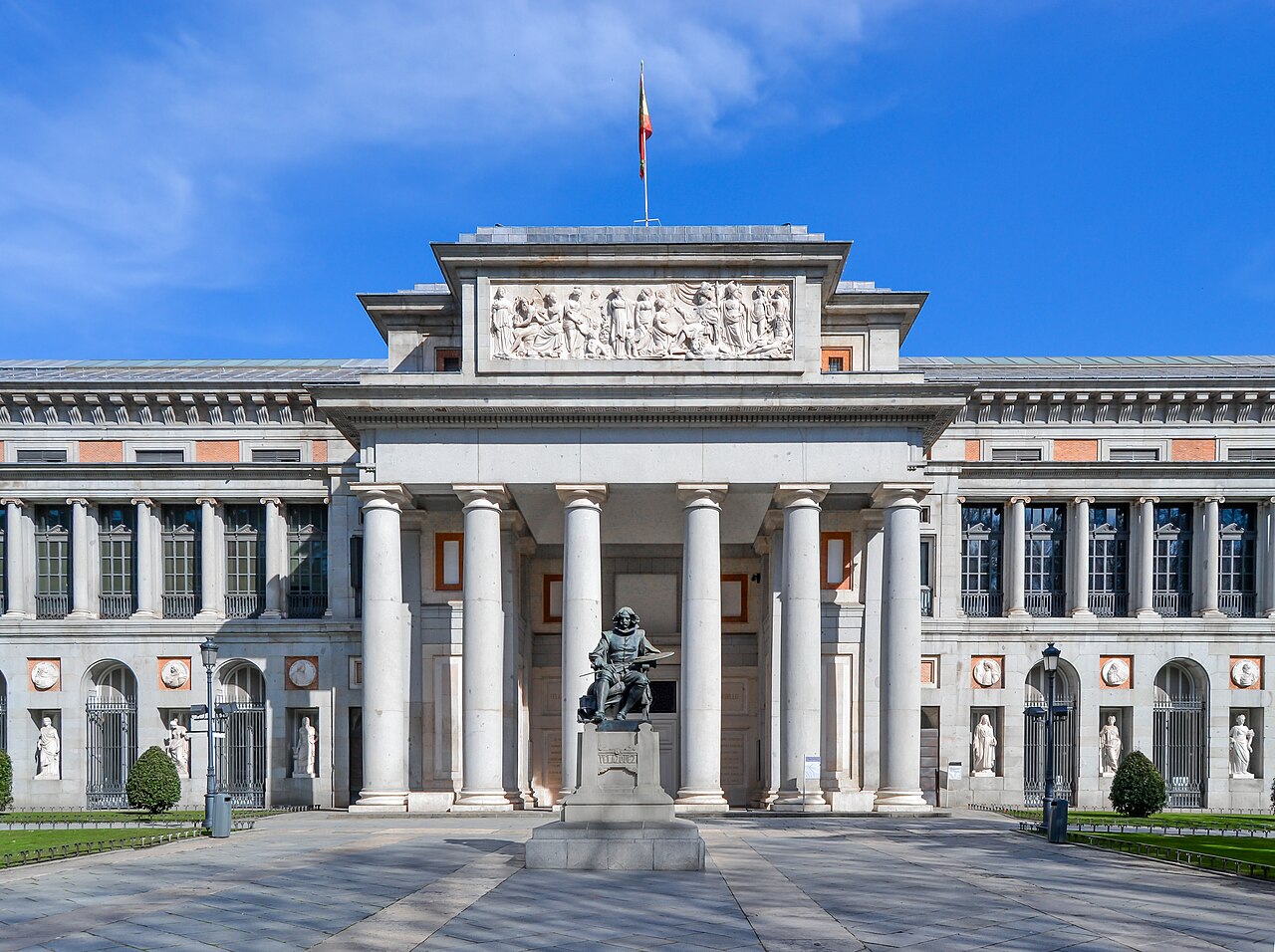
Museo Nacional del Prado is a museum in Madrid, Spain. One of Europe's finest art museums, housing masterworks by Velázquez, Goya, Bosch, and Rubens. Most visitors spend 2–4 hours here. The free Lokali audio guide runs 3 minutes.
✓ Verified August 2026 · how we write these guides
Visitor facts
| Time needed | 2–4 hours |
|---|---|
| Lokali audio guide | 3 min · free |
| Type | Museum |
| Best for | Editors' pick |
| Location | Madrid, Spain |
| Coordinates | 40.4135, -3.6892 |
| Languages | 45, in the Lokali app |
The story
The Prado began as a royal project and became Spain's great public painting museum. Its building was designed by Juan de Villanueva in 1785 for a Natural History Cabinet ordered by Charles III. Its final role changed under Ferdinand VII, encouraged by Queen Maria Isabel de Braganza, and the Royal Museum of Paintings and Sculptures opened to the public in November 1819.
The official history is clear that the first catalogue listed 311 paintings, while the wider royal holdings behind the museum were much larger. The Prado's foundation is the Spanish royal collection, enriched over centuries by Habsburg and Bourbon monarchs.
That foundation explains the museum's power. The Prado is not a general survey of world art; it is strongest where royal collecting was strongest: Velazquez, Goya, El Greco, Titian, Rubens, Bosch, Raphael, and many others whose works entered through dynastic taste, diplomacy, devotion, and power.
To visit well, read the museum as a palace collection made public. Court portraiture, religious painting, mythology, empire, and private vision all meet here, and the best rooms show how Spanish painting speaks to the rest of Europe without losing its own intensity.
The Prado's identity comes from royal collecting more than from encyclopedic coverage. That is why the museum feels so strong in Spanish, Italian, and Flemish painting, and why certain artists appear with unusual depth. The collection reflects dynastic taste, court politics, religious patronage, and the Habsburg and Bourbon worlds.
The Villanueva building also carries a changed purpose. It was originally designed for a Natural History Cabinet, but the project became the Royal Museum of Paintings and Sculptures in the early nineteenth century. That shift from Enlightenment science to public art museum is part of the Prado's institutional story.
A reliable Prado guide should avoid calling it simply Spain's Louvre. The comparison hides what makes it specific: court portraiture, religious intensity, imperial imagination, European diplomacy, and a deep conversation between Spanish painters and foreign artists collected by the monarchy.
Look at the museum as a study of power and vision. Velazquez and Goya are central not just because they are famous, but because they reveal how artists could work inside court systems while also changing what painting could say about reality, authority, violence, and private perception.
Key facts
What to look for
Practical tips
Common questions
How long do you need at Museo Nacional del Prado?
Plan 2–4 hours. That is the time most visitors spend at Museo Nacional del Prado. The free Lokali audio guide adds about 3 minutes of narration you can listen to as you walk, so it fits inside your visit rather than adding to it.
Is there a free audio guide to Museo Nacional del Prado?
Yes — the Lokali app narrates Museo Nacional del Prado free of charge in 50+ languages. It covers the history, what to look for on site and practical tips, and it works offline once downloaded.
Where is Museo Nacional del Prado?
Museo Nacional del Prado is in Madrid, Spain, at 40.4135, -3.6892. Tap the map link on this page for directions from where you are.
What should you know before visiting Museo Nacional del Prado?
Start with Spanish painting, then branch into Italian and Flemish galleries.
What is Museo Nacional del Prado known for?
Juan de Villanueva designed the building in 1785.
What is the best time to visit Museo Nacional del Prado?
Arrive before 10 a.m.
On the map
Opens directions to Museo Nacional del Prado from your location.
More to see in Madrid




Hear Museo Nacional del Prado in your language
The full story, narrated, in 50+ languages. Download it before you go and it plays offline, at your own pace, with no ticket and no tour group.