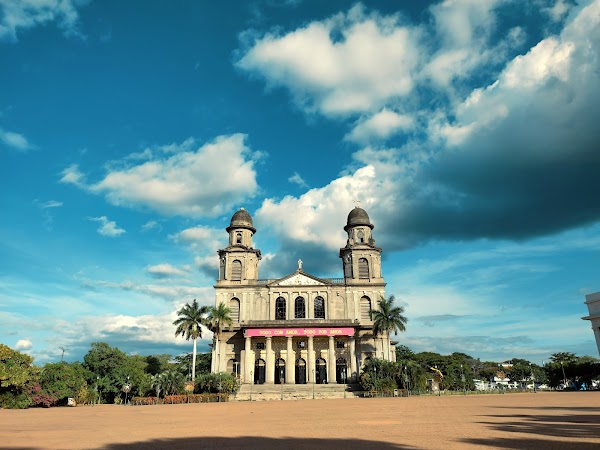
Old Cathedral is a striking neoclassical cathedral completed in 1928, featuring a distinctive dome and twin bell towers. It is in Managua, Nicaragua. Most visitors spend 30–45 min here. The free Lokali audio guide runs 5 minutes.
✓ Verified August 2026 · how we write these guides
Visitor facts
| Time needed | 30–45 min |
|---|---|
| Lokali audio guide | 5 min · free |
| Type | Cathedral |
| Best for | History |
| Location | Managua, Nicaragua |
| Coordinates | 12.1150, -86.2419 |
| Languages | 45, in the Lokali app |
The story
Stand in the open plaza and look up. Two grey towers rise against a hot tropical sky. The window frames hold no glass. Pigeons pass through them as if the building were made of air. This is the Old Cathedral of Managua, the Catedral de Santiago. It has watched over this city for almost a hundred years. For more than half of that time, it has stood empty.
The cathedral looks heavy, but it hides a light secret. Under the concrete skin there is a skeleton of steel. That frame was made in Belgium and shipped across the Atlantic Ocean in pieces. Workers began to raise it in 1928. A Belgian engineer named Pablo Dambach directed the project. Ten years later, in 1938, the finished cathedral opened its doors.
The steel proved its worth early. In 1931, while the cathedral was still under construction, a strong earthquake struck Managua. Much of the city fell that day. The unfinished cathedral did not. Its frame bent with the shock and held. Work continued, and the building rose over a city that was already learning how to start again.
For one generation, life flowed through these doors. Families came for baptisms, weddings, and funerals. Presidents attended mass under the high ceiling. Bells rang out over the rooftops of old Managua. The cathedral faced the main square of the capital, and around it stood theaters, offices, hotels, and cafes. If the city had a heart, it beat here, on this plaza.
Then came the night of December 23, 1972. Just after midnight, the ground under Managua broke. The shaking lasted only seconds. It destroyed the center of the city and killed about 10,000 people. Christmas decorations still hung in the ruined streets. The cathedral survived, but only as a shell. Walls cracked. Towers shifted. Engineers judged the building too dangerous to enter.
People in Managua tell one small detail about that night. They say a clock on the tower stopped at the moment the earth moved, and never ran again. It is a story, so treat it as one. But it fits this place. Time inside the cathedral stopped in 1972, and it has never fully restarted.
The earthquake changed the shape of the whole capital. The old downtown was never rebuilt in the same way. Homes, offices, and markets moved to safer districts far from here. The blocks around the cathedral became open ground, parks, and monuments. That is why central Managua feels so unusual. This ruin is one of the few tall witnesses of the city that existed before.
Walk slowly around the outside and study the facade. A row of saints stands above the main entrance, carved and calm. Two square towers frame the front, each with arched openings. The concrete has darkened with decades of rain and sun. In places you can see cracks, patches, and old repairs. Here, the damage itself is part of the display.
The interior is closed for safety, but the doorways offer long views. Through the fence you can see the empty nave, a hall built for thousands of voices. In sections the roof is open to the sky, and daylight falls where candles once burned. Grass grows in quiet corners. Birds nest where the choir used to sing.
Take your time here, because the site rewards slow looking. Morning light warms the front of the towers and softens the grey concrete. In the heat of midday, the plaza offers little shade, and the building turns hard and bright. Late afternoon is gentler again. Photographers wait for that hour, when long shadows stretch across the plaza and the facade glows.
The cathedral does not stand alone. It faces Plaza de la Revolución, the historic main square. Across the plaza rises the National Palace of Culture, which holds the national museum. Close by are fountains, gardens, and monuments to poets and revolutionaries. Together these places form a short walk through the public memory of Nicaragua.
Managua did build a replacement in the end. The New Cathedral opened in 1993 in another part of the city, with a modern design and many small domes. Yet no one tore the old building down. Plans for repair appear from time to time, and then they fade. The ruin remains, too loved to demolish and too broken to use.
Before you leave, stand still for one minute and listen. Traffic hums somewhere behind the trees. Wind moves through the open towers above you. A building like this does not ask for admiration. It asks for memory. It carries the story of a city that fell in a single night, and of people who stayed and began again.
Key facts
What to look for
Practical tips
Common questions
How long do you need at Old Cathedral?
Plan 30–45 min. That is the time most visitors spend at Old Cathedral. The free Lokali audio guide adds about 5 minutes of narration you can listen to as you walk, so it fits inside your visit rather than adding to it.
Is there a free audio guide to Old Cathedral?
Yes — the Lokali app narrates Old Cathedral free of charge in 50+ languages. It covers the history, what to look for on site and practical tips, and it works offline once downloaded.
Where is Old Cathedral?
Old Cathedral is in Managua, Nicaragua, at 12.1150, -86.2419. Tap the map link on this page for directions from where you are.
What should you know before visiting Old Cathedral?
View the facade from Plaza de la Revolución for the best angle.
What is Old Cathedral known for?
Construction began in 1928 with a Belgian steel frame.
What is the best time to visit Old Cathedral?
Visit early morning to see light pour through the stained glass without crowds.
On the map
Opens directions to Old Cathedral from your location.
More to see in Managua


Hear Old Cathedral in your language
The full story, narrated, in 50+ languages. Download it before you go and it plays offline, at your own pace, with no ticket and no tour group.