
English Football Hall of Fame
53.4858° N · 2.2421° W · Museum
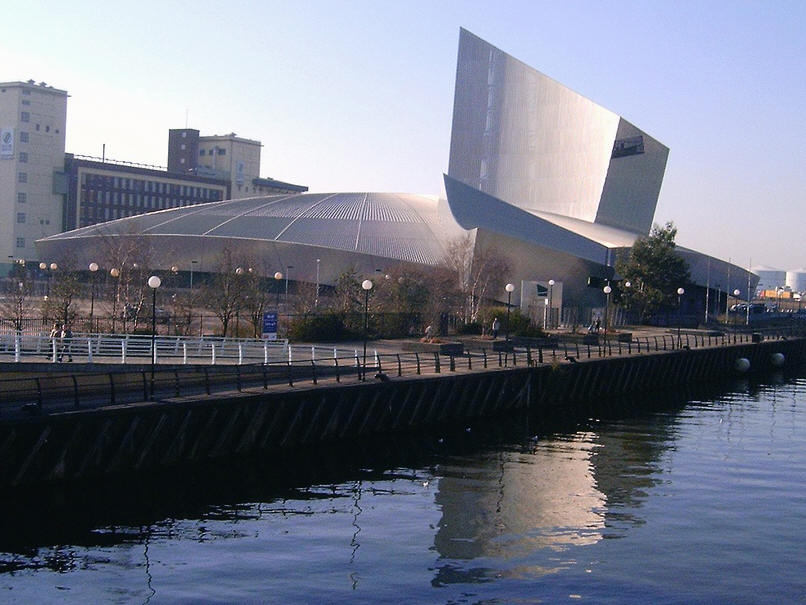
Photo: Marnanel · CC BY-SA 4.0 · Wikimedia Commons
English Football Hall of Fame is a hall of fame in Manchester, England. The Hall of Fame was founded in 2002. The free Lokali audio guide runs 6 minutes.
✓ Published October 2026 · how we write these guides
Visitor facts
| Lokali audio guide | 6 min · free |
|---|---|
| Type | Museum |
| Location | Manchester, United Kingdom |
| Coordinates | 53.4858, -2.2421 |
| Official website | nationalfootballmuseum.com |
| Languages | 50+, in the Lokali app |
The story
Stand for a moment outside the building and look up. A great slanted wedge of glass rises from the paving, its panels tinted a cool green-grey. On a bright day it holds the clouds. On a grey Manchester afternoon it seems to carry the colour of the rain itself. Somewhere nearby, a tram bell rings and a skateboard clatters over stone. This is where English football keeps its memory, and its most honoured names.
The English Football Hall of Fame lives inside the National Football Museum. The museum occupies the Urbis building in Cathedral Gardens, close to Victoria station and the old medieval heart of the city. The Hall of Fame is not a separate building. It is a place within the museum, a gallery of names and faces that football people have chosen to remember. Think of it as the game's roll of honour, and the museum around it as the long story that gives those names meaning.
The Hall of Fame began in 2002. It was created to recognise the players, managers and other figures who shaped the English game. At first, it was housed in Preston, in the north-west of England. Preston was a fitting home, because the museum sat at Deepdale, the ground of one of the oldest professional clubs in the world. For a decade, visitors travelled there to see the inductees honoured.
Then, in the early 2010s, the National Football Museum moved here to Manchester, and the Hall of Fame came with it. The move made sense to many people. Manchester is home to two of the most followed clubs on the planet, and the wider north-west has deep football roots. Some supporters in Preston were sad to see it go. But the new site put the collection in front of far more visitors, right in the centre of a major city.
The building has its own story. Urbis opened in the early 2000s as part of the rebuilding of this area. The city centre had been badly damaged by a large bomb in 1996, and much of the surrounding district was redesigned in the years that followed. Urbis was first planned as a museum about city life itself. When that idea struggled, the glass wedge found a new purpose. Today, football fills it from floor to ceiling.
So who is honoured inside? The list reads like a history of English football in human form. Among the very first inductees were giants of the 1960s, including Bobby Charlton and Bobby Moore, and the Northern Irish winger George Best. Here is something many visitors miss. From the very first year, the Hall of Fame also honoured women. One of the earliest names was Lily Parr, a powerful forward who played for the Dick, Kerr Ladies, a works team from Preston.
That detail matters. In the years after the First World War, women's football drew large crowds in England. Then, in 1921, the Football Association banned women from playing on the grounds of its member clubs. The ban lasted for around fifty years. So when you see women's names alongside the great men of the game, you are looking at a story of a sport that was pushed aside, and then slowly given back its place.
New names are added over time, usually at a ceremony that brings together former players, managers and guests. The inductees are not only goal scorers. There are goalkeepers, defenders, managers and figures from the wider game. Each one arrives with a career behind them, and often with arguments attached. Football fans love to debate who deserves a place. If you have a name you think is missing, you will not be alone in that view.
As you walk through, notice how the gallery feels different from a trophy cabinet. It is about people rather than silverware. The faces look out at you, and the short texts tell you why each person counts. Some were famous across the world. Others were heroes mainly to one town, one stand, one generation. Together they show how the game grew from muddy local pitches into a global industry.
The rest of the museum gives that roll of honour its context. Across several floors, you will find shirts, boots, balls, programmes and photographs from different eras. Look closely at the old leather balls and heavy boots. They help you imagine how hard, slow and physical the early game must have been. There are also interactive areas, where visitors can test their own skills, which explains the cheering you may hear drifting down from upstairs.
The building itself shapes the visit. Because Urbis is a slanted wedge, the floors become smaller as you go higher. Light pours in through the glass walls, and from some points you can look out over Cathedral Gardens and the surrounding streets. It is an unusual setting for old leather and faded wool. The contrast is part of the charm. A game from muddy Victorian fields is displayed inside a sharp, modern glass structure.
When you step back outside, take in the neighbourhood. Manchester Cathedral stands close by, its dark stone a quiet contrast to all that glass. Nearby is Chetham's, a historic school and library with buildings that go back to the fifteenth century. Within a few minutes' walk, you move from medieval stone to Victorian railway brick to twenty-first century glass. Football history sits right in the middle of the city's longer story.
Before you leave, pause in the open square and listen. You may hear skateboards, tram wheels, a group of schoolchildren in replica shirts arguing about their favourite player. That noise is the point of a place like this. The names inside were once just kids kicking a ball somewhere. Look back at the green glass one more time, and think of the next name that will one day be added to the wall.
Key facts
What to look for
Practical tips
Common questions
Is there a free audio guide to English Football Hall of Fame?
Yes — the Lokali app narrates English Football Hall of Fame free of charge in 50+ languages. The guide runs about 6 minutes, covers the history, what to look for on site and practical tips, and works offline once downloaded.
Where is English Football Hall of Fame?
English Football Hall of Fame is in Manchester, United Kingdom, at 53.4858, -2.2421. Tap the map link on this page for directions from where you are.
What is English Football Hall of Fame known for?
The Hall of Fame was founded in 2002. It moved from Preston to Manchester in the early 2010s.
What should you look for at English Football Hall of Fame?
The slanted green-grey glass wedge of the Urbis building. Lily Parr's place among the honoured names. Old leather balls and heavy boots from early eras.
What should you know before visiting English Football Hall of Fame?
Allow extra time for the museum floors around the Hall. Walk from Victoria station, just a few minutes away.
On the map
Opens directions to English Football Hall of Fame from your location.
More to see in Manchester


Hear English Football Hall of Fame in your language
The full story, narrated, in 50+ languages. Download it before you go and it plays offline, at your own pace, with no ticket and no tour group.