
National Football Museum
53.4864° N · 2.2424° W · Museum
Photo: David Dixon · CC BY-SA 2.0 · Wikimedia Commons
National Football Museum is a sports museum in Manchester, United Kingdom. The museum first opened in Preston at Deepdale. The free Lokali audio guide runs 7 minutes.
✓ Published October 2026 · how we write these guides
Visitor facts
| Lokali audio guide | 7 min · free |
|---|---|
| Type | Museum |
| Location | Manchester, United Kingdom |
| Coordinates | 53.4864, -2.2424 |
| Official website | nationalfootballmuseum.com |
| Languages | 50+, in the Lokali app |
The story
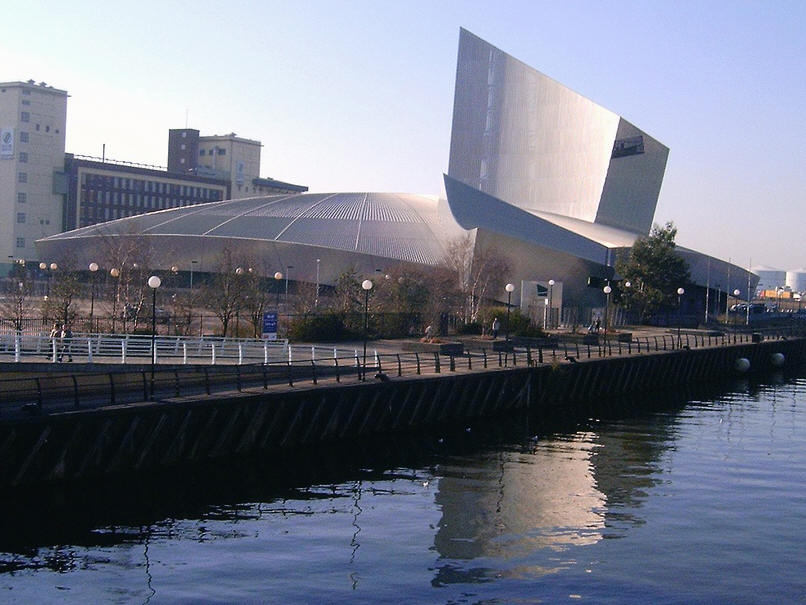
Start outside, on the paving of Cathedral Gardens. Look up at the building in front of you. It rises like a sharp glass wedge, its roofline slanting steeply towards the sky. On a grey Manchester afternoon the panels turn the colour of wet slate. When the sun breaks through, they flash silver. Behind you, trams hum towards Victoria station, and the old sandstone of Manchester Cathedral sits low and dark against all that glass.
This is the National Football Museum, England's national collection for the world's most popular game. But the building came first, and it has its own story. It was built as Urbis, a museum about cities and urban life. It opened in the early 2000s, part of the rebuilding of central Manchester after the 1996 bomb that tore through the city's shopping district. The glass wedge was a statement. Manchester wanted to look forward.
Urbis struggled to find its audience, and the building needed a new purpose. Meanwhile, a national football museum already existed, about fifty kilometres to the north-west, in Preston. It sat at Deepdale, the home ground of Preston North End, one of the oldest professional clubs in the world. In the early 2010s the museum moved here, into the heart of a city that lives and breathes the game. Preston gave the collection its roots. Manchester gave it a crowd.
The move made sense in another way too. Manchester has a quiet claim on how football is organised. In 1888, the Football League was formally set up at a meeting in this city. It was the first league of its kind anywhere, a regular programme of fixtures between professional clubs. That simple idea, teams playing each other home and away across a season, now shapes football on every continent. So the museum stands only a short walk from where the modern fixture list began.
Now step inside. The floors climb upwards in layers, and the slope of the outer glass follows you as you go. Light comes in at odd angles. On busy days you hear it before you see it — the thud of a ball, the shouts of children, the low murmur of fans reading old match programmes. Take a moment here. This is a museum about noise and emotion, housed in a building made of light.
The collection covers football from its scrappy, muddy beginnings. Before the nineteenth century, many versions of the game existed. Some were wild village contests with no fixed number of players and very few rules. Schools and clubs each played their own way. Then, in 1863, the Football Association was founded in London and agreed a shared set of laws. Here is something many visitors miss. That organisation still has no country in its name. It was the first, so it simply called itself the Football Association.
As you walk the galleries, notice how much of the story sits in small objects. Heavy leather balls that soaked up rain and grew painfully hard to head. Boots with thick toecaps and nailed studs. Shirts made from heavy cotton, nothing like the light fabrics players wear today. Medals, caps and tickets fill the cases. Each one belonged to a real person on a real afternoon. Football history is mostly ordinary people, standing on terraces, keeping their match tickets in a drawer for decades.
The museum also tells the story of the women's game, and it is a surprising one. Just after the First World War, women's football drew enormous crowds in England. A team from a Preston factory, Dick, Kerr Ladies, became famous across the country. On Boxing Day in 1920, a match they played at Goodison Park in Liverpool reportedly drew more than fifty thousand people. Then, in 1921, the Football Association banned women from playing on its members' grounds. That ban lasted for about fifty years.
Think about that for a moment. Generations of women grew up loving the game but were pushed to its edges. When the restriction finally lifted in the early 1970s, the sport had to rebuild almost from nothing. Today's packed stadiums for women's matches are, in one sense, a return to something that already happened a century ago. Exhibitions on this history change over time, so look out for what is on display during your visit.
This building is also home to the English Football Hall of Fame. Players, managers and figures from the game are honoured here, from the early professional era to the present day. You will find names that every fan knows, and others that only older supporters will recognise. It is worth reading slowly. The Hall of Fame celebrates men and women whose careers were played out in front of crowds, but whose stories are often quieter than their reputations.
Football here is not only something to look at. Parts of the museum invite you to play. In the interactive areas, visitors test their passing, their shooting and their reactions against targets and timers. It is often the loudest corner of the building. Parents, grandparents and children take turns, and the competition becomes surprisingly serious. If you want to try, check at the desk, because some games may need a separate ticket or a timed slot.
One more thing that many people miss. Look at how the exhibits connect football to wider life. Industry, war, migration, television and money all shaped the game. Factory towns gave the north of England many of its oldest clubs. Workers had Saturday afternoons free, and they went to watch their local team. In this way, the museum is still a little like Urbis. It is a story about cities, told through the game that cities chose to love.
When you leave, stand once more in Cathedral Gardens and look back at the slanted glass. Listen to the trams, the voices, perhaps a ball being kicked against a wall somewhere nearby. On match days you may see shirts of red or sky blue passing through the square. The museum holds the memories. But the game itself is still out here, on the streets, in the parks, in the conversations of people walking past you right now.
Key facts
What to look for
Practical tips
Common questions
Is there a free audio guide to National Football Museum?
Yes — the Lokali app narrates National Football Museum free of charge in 50+ languages. The guide runs about 7 minutes, covers the history, what to look for on site and practical tips, and works offline once downloaded.
Where is National Football Museum?
National Football Museum is in Manchester, United Kingdom, at 53.4864, -2.2424. Tap the map link on this page for directions from where you are.
What is National Football Museum known for?
The museum first opened in Preston at Deepdale. It moved into Manchester's former Urbis building in the 2010s.
What should you look for at National Football Museum?
The steep slanted glass roofline seen from Cathedral Gardens. Old leather footballs that once grew heavy in rain. Nailed studs and hard toecaps on early football boots.
What should you know before visiting National Football Museum?
Arrive early on weekends to avoid crowded interactive areas. Check at the desk whether interactive games need a slot.
When is the best time to visit National Football Museum?
Arrive early on weekends to avoid crowded interactive areas.
On the map
Opens directions to National Football Museum from your location.
More to see in Manchester


Hear National Football Museum in your language
The full story, narrated, in 50+ languages. Download it before you go and it plays offline, at your own pace, with no ticket and no tour group.