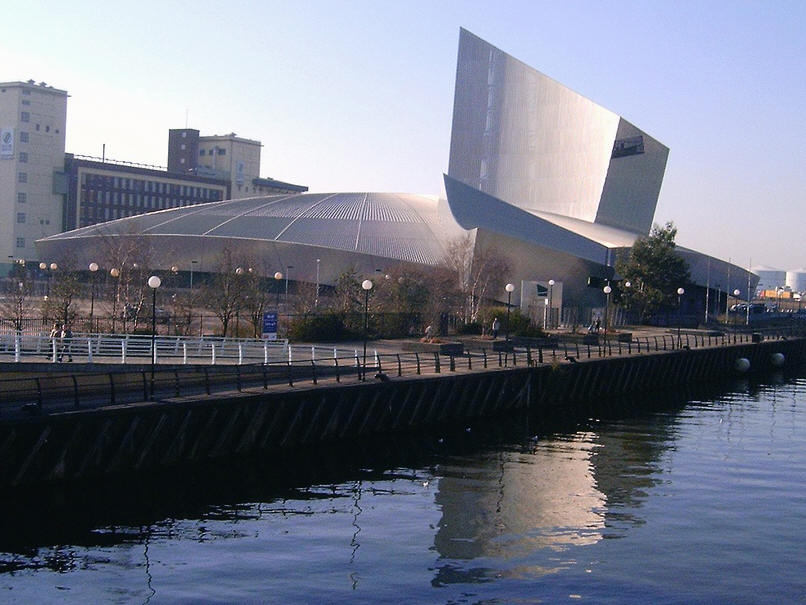
Imperial War Museum North
53.4697° N · 2.2989° W · Museum
Photo: Imperial_War_Museum_2008.jpg: pit-yacker from UK derivative work: IxK85 (talk) · CC BY-SA 2.0 · Wikimedia Commons
Imperial War Museum North is a military museum in Manchester, England. Opened in 2002 beside the Manchester Ship Canal. The free Lokali audio guide runs 6 minutes.
✓ Published October 2026 · how we write these guides
Visitor facts
| Lokali audio guide | 6 min · free |
|---|---|
| Type | Museum |
| Location | Salford, United Kingdom |
| Coordinates | 53.4697, -2.2989 |
| Official website | iwm.org.uk |
| Languages | 50+, in the Lokali app |
The story
Stand at the foot of the tallest shard and listen. Wind moves through the open structure above you, and the metal frame hums a little. Below, the water of the Manchester Ship Canal lies flat and grey. The building in front of you has almost no straight lines. Its silver walls tilt, bend, and meet at angles that seem slightly wrong. That is deliberate.
This is Imperial War Museum North. It opened in 2002 at Salford Quays, on the Trafford side of the canal. It was the first museum of the Imperial War Museums family to open outside the south of England. The aim was simple. War has shaped the lives of people in the north just as much as anywhere else, and their stories deserved a home here, beside the old docks.
The architect was Daniel Libeskind, the designer later known for his master plan at the World Trade Center site in New York. This was his first completed building in the United Kingdom. His idea started with a globe. He imagined the Earth broken apart by conflict, then took the fragments and pieced them together again. The building you see is made from those imagined pieces.
Libeskind called them shards, and there are three. The Earth Shard holds the main exhibition space and represents the ground where wars are fought. The Water Shard holds the café and looks out over the canal, a nod to the sea and to this working waterway. The Air Shard is the tall, open tower above you. It represents the sky, where so many modern wars have been fought.
Here is a detail many visitors miss. The Air Shard is not fully closed. Its frame is open to the weather, so rain, wind, and the cries of gulls come straight in. On many days you can take a lift up to a viewing platform near the top. From there, the old docks, the newer towers of MediaCityUK, and the long line of the canal spread out below you. Check on the day, because access can change.
Now step inside the Earth Shard. Pay attention to the floor beneath your feet. It is not flat. It curves gently, like the surface of a globe, so you are walking across a fragment of the planet. Some visitors only notice it after a few minutes, when they realise they have been walking slightly uphill or downhill. The walls lean too. The effect is quiet, but it keeps you a little off balance... much as war does to ordinary life.
The main hall is dark, high, and open. Large objects stand on the floor — military vehicles, weapons, and pieces of machinery that seem enormous at close range. Around the edges, a timeline runs through the twentieth century and into the present day. It follows the major conflicts that involved Britain and the Commonwealth, from the First World War onward. The focus is not only on battles. It is on how war changed families, work, cities, and memory.
Keep an eye out for the tall structures called Time Stacks. These are clusters of display cases, drawers, and panels built around a theme. You can open some of the drawers yourself. Inside you may find letters, uniforms, ration books, or small personal objects. It is a museum that rewards curiosity. The smallest thing in a drawer can carry more weight than the largest gun in the hall.
Then, at regular times through the day, the lights go down. The walls of the main hall become screens. This is the Big Picture show, a projection that surrounds you on every side. Images, voices, and music fill the space, often built from photographs and first-hand accounts. People stop where they stand. Some sit on the floor. For a few minutes, the whole room becomes one shared experience, and the slanted walls suddenly make sense as a canvas.
One of the most affecting objects here is a twisted piece of steel from the World Trade Center in New York, destroyed in the attacks of September 2001. It connects the museum's story to the twenty-first century. It is a reminder that this is not only a museum of the distant past. The conflicts on display reach into the lives of people walking through the hall today.
The museum also looks at life on the home front, which matters deeply in this part of England. Manchester and Salford were industrial cities, full of factories, rail lines, and docks. In wartime, that made them targets for bombing. It also made them places where many people worked to supply the war effort. As you move through the displays, think about the streets outside, and the families who once lived and worked beside this canal.
When you leave, look back at the building from across the water. The footbridge to the other side links the museum with The Lowry, the arts centre on the opposite bank. From the bridge, the shards look sharp and silver against the sky. On a bright day the aluminium cladding throws back the light. On a grey day it turns almost the same colour as the clouds, and the building seems to merge with the weather.
Take a moment before you go. Listen again to the wind through the open tower, and to the water moving against the quay. Notice the angles of the walls, still refusing to settle into straight lines. Libeskind wanted a building that felt broken and rebuilt at the same time. As you walk away along the canal, that idea may stay with you — that people, like places, often carry the shape of what they have been through.
Key facts
What to look for
Practical tips
Common questions
Is there a free audio guide to Imperial War Museum North?
Yes — the Lokali app narrates Imperial War Museum North free of charge in 50+ languages. The guide runs about 6 minutes, covers the history, what to look for on site and practical tips, and works offline once downloaded.
Where is Imperial War Museum North?
Imperial War Museum North is near Salford, United Kingdom, at 53.4697, -2.2989. Tap the map link on this page for directions from where you are.
What is Imperial War Museum North known for?
Opened in 2002 beside the Manchester Ship Canal. Designed by architect Daniel Libeskind, his first UK building.
What should you look for at Imperial War Museum North?
The gently curved floor shaped like the Earth's surface. Open frame of the Air Shard exposed to wind and rain. Leaning walls that double as projection screens.
What should you know before visiting Imperial War Museum North?
Check the timetable for the next Big Picture show. Ask on arrival whether the Air Shard platform is open.
On the map
Opens directions to Imperial War Museum North from your location.
More to see near Imperial War Museum North


Hear Imperial War Museum North in your language
The full story, narrated, in 50+ languages. Download it before you go and it plays offline, at your own pace, with no ticket and no tour group.