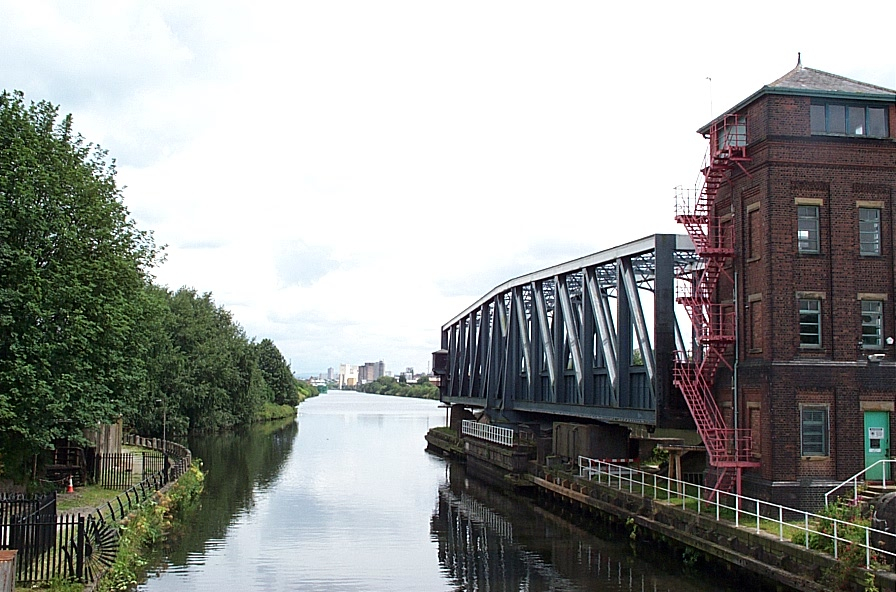
Barton Swing Aqueduct
53.4748° N · 2.3521° W · Bridge
Photo: Jhsteel · CC BY-SA 3.0 · Wikimedia Commons
Barton Swing Aqueduct is a navigable aqueduct. It is near Salford, United Kingdom. Believed to be the world's only swing aqueduct. The free Lokali audio guide runs 6 minutes.
✓ Published October 2026 · how we write these guides
Visitor facts
| Lokali audio guide | 6 min · free |
|---|---|
| Type | Bridge |
| Location | Salford, United Kingdom |
| Coordinates | 53.4748, -2.3521 |
| Languages | 50+, in the Lokali app |
The story
Stand still for a moment and listen. Below you, the wide brown water of the Manchester Ship Canal moves slowly between its banks. Above it, held in a long iron box, runs a second, narrower canal. Water is crossing over water. Pigeons settle on the rivets, and a narrowboat's engine may thud somewhere nearby. This is the Barton Swing Aqueduct, on the edge of Salford, and nothing else in the world quite matches it.
At first glance it looks like an ordinary iron bridge. Grey-painted girders, a squat control tower in the middle, gates at each end. But inside that iron structure is a trough full of canal water. Boats on the Bridgewater Canal float straight across it. And when a large ship needs to pass along the canal below, the entire trough turns on its pivot. The water stays inside, and the boats wait at the edges.
To understand why anyone would build such a thing, we need to go back to the eighteenth century. The Duke of Bridgewater owned coal mines at Worsley, just to the west. He wanted a cheap way to move that coal into Manchester. Horses and carts were slow and expensive. So he commissioned a canal. It became one of the first great canals of the industrial age, and it helped to start a national craze for canal building across Britain.
The engineer most closely linked with the project was James Brindley. At Barton, his canal had to cross the River Irwell. Rather than drop down to the river with locks, Brindley carried the canal over it on a stone aqueduct. It opened in 1761. Many people at the time thought the idea was foolish. Sceptics reportedly expected the structure to collapse under the weight of the water. It did not. It stood for more than a century.
Then Manchester grew more ambitious. In the late nineteenth century, the city wanted direct access to the sea, so that ocean-going ships could reach its docks without paying fees at Liverpool. The answer was the Manchester Ship Canal, a huge waterway cut inland from the Mersey estuary. It opened in 1894. Its route followed the line of the Irwell right through Barton, and Brindley's low stone arches stood squarely in the way.
Here is the problem the engineers faced. Big ships need tall, clear headroom. A fixed aqueduct high enough for them would have required long climbs of locks on the old canal at both sides. That would slow the coal boats badly. The designer of the Ship Canal, Edward Leader Williams, chose a far bolder answer. He would keep the old canal at its original level, and simply move it out of the way whenever a ship came through.
The result is what you see in front of you. The swinging section is a steel and iron trough roughly a hundred metres long. It rests on a central island in the middle of the Ship Canal. The ironwork was made by the Manchester firm of Andrew Handyside and Company. When full, the trough holds hundreds of tonnes of water, and the total moving weight runs well over a thousand tonnes. Yet it rotates as one single unit.
How do you swing a bathtub of that size without emptying it? This is the clever part, and most visitors miss it. Before the turn begins, gates close at each end of the trough. Matching gates close on the fixed canal banks too. Each gate seals in its own body of water. The trough then pivots on the island with its water still on board. When it swings back, the gates open again, and the canal joins up as if nothing happened.
The aqueduct does not work alone. Look just beside it, and you will see the Barton Road Swing Bridge, which carries traffic over the Ship Canal. Leader Williams designed it as part of the same scheme. Both structures pivot on the same island, and they were planned to swing together. When a tall vessel approaches, road and canal both turn aside at once, and an open channel appears between them for the ship to pass.
Swings do not happen often now. The Ship Canal carries far less traffic than in its busy years, and the movement depends on vessel schedules. So you should not expect to see it turn. If you are lucky enough to watch it happen, it is slow and almost silent. A long iron box, full of water, turns gently in the middle of a river. People on the banks often simply stop talking and watch.
What happened to Brindley's original stone aqueduct? It was demolished to make way for the new channel. But it was not entirely lost. A fragment of one of its arches survives near the site, a quiet reminder of the earlier crossing. Looking from that old stone to the iron trough gives you two very different answers to the same question, separated by more than a hundred years of engineering.
The structure today is a listed historic monument, protected for its engineering importance. It is still a working part of the canal network. Narrowboats and pleasure craft cross the trough throughout the year. Walkers and cyclists follow the towpaths on either side. Nearby, in the village of Barton, the Victorian church of All Saints by the architect Edward Welby Pugin adds a touch of Gothic stone to this landscape of iron and water.
Before you leave, look at the aqueduct once more. Notice the gates at each end, closed only when the trough must move. Notice the island in the river, and the tower that controls the swing. Watch the water above, still and dark, and the water below, wider and moving. Two canals from two centuries meet here, one resting on top of the other. As you walk away along the bank, listen again — the water is still crossing over water.
Key facts
What to look for
Practical tips
Common questions
Is there a free audio guide to Barton Swing Aqueduct?
Yes — the Lokali app narrates Barton Swing Aqueduct free of charge in 50+ languages. The guide runs about 6 minutes, covers the history, what to look for on site and practical tips, and works offline once downloaded.
Where is Barton Swing Aqueduct?
Barton Swing Aqueduct is near Salford, United Kingdom, at 53.4748, -2.3521. Tap the map link on this page for directions from where you are.
What is Barton Swing Aqueduct known for?
Believed to be the world's only swing aqueduct. Opened in 1894 with the Manchester Ship Canal.
What should you look for at Barton Swing Aqueduct?
Sealing gates at both ends of the iron trough. The central island where the trough pivots. Barton Road Swing Bridge sharing the same island.
What should you know before visiting Barton Swing Aqueduct?
Walk the towpath to see the aqueduct from several angles. Do not expect a swing; movements depend on ship traffic.
On the map
Opens directions to Barton Swing Aqueduct from your location.
More to see near Barton Swing Aqueduct


Hear Barton Swing Aqueduct in your language
The full story, narrated, in 50+ languages. Download it before you go and it plays offline, at your own pace, with no ticket and no tour group.