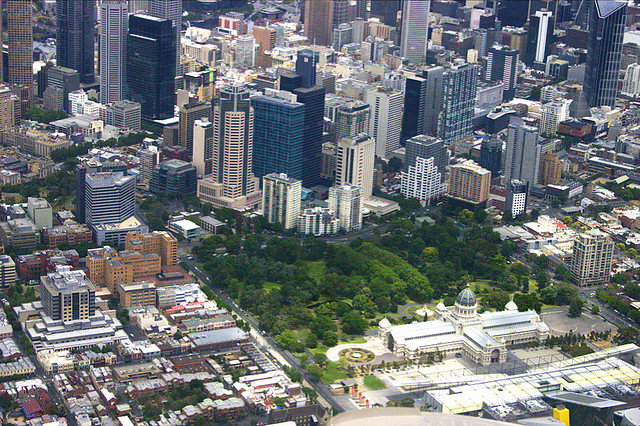
Carlton Gardens
37.8061° S · 144.9700° E · Botanical Garden
Photo: Andrew Lukaris · CC BY-SA 2.0 · Wikimedia Commons
Carlton Gardens is a garden in Melbourne, Victoria, Australia. Royal Exhibition Building opened for the 1880 international exhibition. The free Lokali audio guide runs 7 minutes.
✓ Published October 2026 · how we write these guides
Visitor facts
| Lokali audio guide | 7 min · free |
|---|---|
| Type | Botanical Garden |
| Location | Melbourne, Australia |
| Coordinates | -37.8061, 144.9700 |
| Languages | 50+, in the Lokali app |
The story
Listen for a moment. Gravel crunches under passing shoes. Wind moves through the canopy of old trees above the paths. Somewhere a magpie calls, a long liquid warble that belongs to this country. Then you look up the avenue, and at the far end a great dome rises over the treetops. This is Carlton Gardens, on the northern edge of central Melbourne, and you are standing in one of the most important public spaces in Australia.
The gardens fill a long rectangle of land between Nicholson Street, Rathdowne Street, Victoria Street and Carlton Street. They split into two halves. The southern garden is the formal, ornamental part, with lawns, flower beds and fountains. The northern garden holds the Melbourne Museum and quieter green space. The Royal Exhibition Building sits between them like a hinge. Most people come for the building. But the gardens were designed to frame it, and the two belong together.
To understand why this place exists, go back to the gold rush of the mid nineteenth century. Gold made Melbourne rich very quickly. Within a few decades, the city was one of the wealthiest in the British Empire, and it wanted the world to notice. The chosen stage was an international exhibition. In that era, these were grand fairs where nations displayed machines, art, crafts and produce. They worked as advertisements for progress itself.
So Melbourne built a palace for its own exhibition, which opened in 1880. The architect was Joseph Reed, who designed many of the city's major public buildings in that period. Look at the long arms of the building and the central dome. The dome is often compared to Brunelleschi's dome on Florence Cathedral, the Renaissance masterpiece in Italy. The style mixes several European influences. The message was simple: this young colonial city could build on a European scale.
Here is a detail many visitors miss. What you see today is only part of the original exhibition site. For the big fairs, large temporary annexes spread across the grounds around the main hall. Those additions came down long ago. The surviving Great Hall was the permanent heart of the complex. So when you picture the 1880 exhibition, imagine far more structure here than stands now... and crowds moving between halls full of the world's goods.
A second exhibition followed in 1888, marking a century since British colonisation of Australia. Then came the moment that gives this building its deepest importance. In 1901 the separate colonies joined together as one nation, the Commonwealth of Australia. The first Federal Parliament opened in this building in May of that year. A new country began its official life under this dome.
There is a twist. After that opening, the Federal Parliament moved into Victoria's own Parliament House, a short walk south on Spring Street. The Victorian state parliament then needed somewhere to sit. It used the Royal Exhibition Building for many years, until the national capital moved to Canberra in 1927. For more than two decades, Melbourne effectively served as Australia's temporary capital. Many Australians are surprised to learn this.
The building has served many other roles. During the influenza pandemic after the First World War, it was used as a hospital. In wartime it housed military functions. Over the twentieth century, it hosted dances, examinations, trade shows and sporting events. Generations of Melbourne students sat their final exams in its halls. The building aged with the city, and for a time its future was uncertain.
That changed. In 2004, the Royal Exhibition Building and Carlton Gardens were listed together as a UNESCO World Heritage Site. They were the first buildings in Australia to receive that status. UNESCO recognised them as one of the few surviving major halls from the great age of international exhibitions. Notice the wording — the listing covers the gardens too. The landscape and the architecture were judged as one designed place.
Now walk to the southern side of the building and find the large fountain in front of the main entrance. This is the Hochgurtel Fountain, made for the 1880 exhibition. Look closely at the figures. Water creatures, children and plants cover its tiers. Water spills down from basin to basin, and on a warm day the spray cools the air. It is a good place to stop and look back at the full face of the building.
The gardens themselves follow a nineteenth century plan of long, straight paths. Many of the avenues are lined with mature trees, including plane trees and elms, which give deep summer shade. In autumn their leaves turn gold and drift across the gravel. The paths lead the eye toward the dome from several directions. That was intentional. Wherever you walk, the building stays the focal point.
At the northern end, the modern Melbourne Museum stands in sharp contrast to Reed's hall. It opened in 2000, with bold angles, metal and glass. Some people disliked it at first. Others enjoy the conversation between old and new. Inside you will find natural history, Indigenous cultures and the story of Melbourne itself. Remember that this land was home to the Wurundjeri people of the Kulin Nation long before any exhibition arrived.
The gardens are also simply a local park. Office workers eat lunch on the lawns. Families from nearby Carlton and Fitzroy walk dogs and push prams. Each year the grounds host the Melbourne International Flower and Garden Show, when displays fill the paths. At dusk, watch the trees carefully. Brushtail possums often come out after dark in Melbourne's parks, and they are curious about visitors.
Before you leave, stand still on one of the avenues and look toward the dome once more. Picture the crowds of 1880, the new parliament of 1901, the exam halls and the hospital beds. Then notice what is here right now. The crunch of gravel. The light through the leaves. The sound of water from the fountain. This place was built to show a city to the world. Today it is quietly shared by everyone who walks through.
Key facts
What to look for
Practical tips
Common questions
Is there a free audio guide to Carlton Gardens?
Yes — the Lokali app narrates Carlton Gardens free of charge in 50+ languages. The guide runs about 7 minutes, covers the history, what to look for on site and practical tips, and works offline once downloaded.
Where is Carlton Gardens?
Carlton Gardens is in Melbourne, Australia, at -37.8061, 144.9700. Tap the map link on this page for directions from where you are.
What is Carlton Gardens known for?
Royal Exhibition Building opened for the 1880 international exhibition. Architect Joseph Reed designed the Royal Exhibition Building.
What should you look for at Carlton Gardens?
The Hochgurtel Fountain's carved figures and tiered basins. The central dome rising above the treetops. Long straight avenues aligned toward the dome.
What should you know before visiting Carlton Gardens?
Visit in autumn when the avenue trees turn gold. Stand at the southern fountain for the full building facade.
When is the best time to visit Carlton Gardens?
Stay until dusk to spot possums in the trees.
On the map
Opens directions to Carlton Gardens from your location.
More to see in Melbourne



Hear Carlton Gardens in your language
The full story, narrated, in 50+ languages. Download it before you go and it plays offline, at your own pace, with no ticket and no tour group.