
Photo: fir0002 flagstaffotos [at] gmail.com Canon 20D + Tamron 28-75mm f/2.8 · GFDL 1.2 · Wikimedia Commons
Melbourne Museum is a museum in Victoria, Australia. Melbourne Museum opened to the public in 2000. The free Lokali audio guide runs 7 minutes.
✓ Published October 2026 · how we write these guides
Visitor facts
| Lokali audio guide | 7 min · free |
|---|---|
| Type | Museum |
| Location | Melbourne, Australia |
| Coordinates | -37.8033, 144.9714 |
| Official website | museumsvictoria.com.au |
| Languages | 50+, in the Lokali app |
The story
Stand still for a moment in the forecourt and listen. Behind you, wind moves through the old elms of Carlton Gardens. In front of you, sharp angles of steel and glass rise into the sky, painted in bold, flat colours. Two centuries of Melbourne meet right here, on the same patch of lawn. The ground under your feet is a crossroads between the city that was, and the city that keeps arguing about what it wants to be.
This is Melbourne Museum, the largest of the public museums run by Museums Victoria. The building opened in 2000, which makes it young by museum standards. But the collection inside is much older. The state's natural history collection began in the 1850s, during the gold rush years, when money poured into the colony and Melbourne wanted the institutions of a serious city. For generations, those collections lived in the city centre, before moving here.
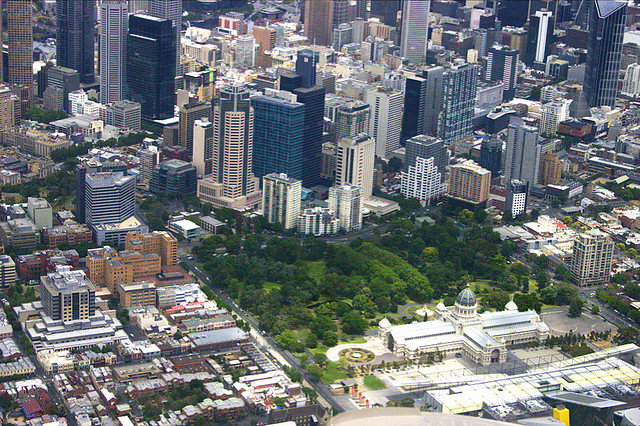
Turn and look across the gardens. That ornate building with the great dome is the Royal Exhibition Building. It was built for the international exhibition of 1880, when Melbourne invited the world to admire its wealth. In 2004, the building and the surrounding Carlton Gardens were listed together as a UNESCO World Heritage Site. So the modern museum sits inside a protected nineteenth-century landscape. That contrast is not an accident. It is part of the conversation.
The museum was designed by the Melbourne architecture firm Denton Corker Marshall. Their work does not try to imitate the old dome. Instead, the building uses long blades, tilted planes, and a huge roof that seems to lean forward over the entrance. Some locals loved it from the start. Others found it too loud beside the gardens. Either way, it starts a debate, and good public buildings often do. Notice how the roofline pulls your eye upward, almost like a gesture of welcome.
Step inside, and the scale changes. The halls are tall and open, with light coming in from above. Sound carries far here. You will hear school groups echoing down the corridors, the squeak of shoes on polished floors, the low hum of a busy public building. This is not a hushed, velvet-rope kind of museum. It was built for families, for curious teenagers, for anyone who wants to wander and touch and ask questions.
Now, here is the first surprise. Somewhere inside this building there is a real, living forest. The Forest Gallery is an indoor space planted with native Victorian trees and ferns, under a high, angular glass roof. Birds, fish, and other small creatures live among the plants. The air feels cooler and damper the moment you walk in. You can smell wet soil and leaf litter. It is a strange sensation... to stand inside a museum and hear birdsong.
The forest is not there for decoration. It shows the kind of tall, wet forest that once covered large parts of Victoria, the state of which Melbourne is the capital. Many of these forests were cleared or burned in the last two centuries. Walking the gallery path, you get a small, quiet sense of that lost landscape. Take your time here. The animals are easy to miss if you rush. Patience is rewarded with a flash of movement in the undergrowth.
Next, find Bunjilaka, the Aboriginal Cultural Centre within the museum. Bunjil is the creator spirit, often shown as a wedge-tailed eagle, for the Kulin peoples whose country includes the land under Melbourne. The galleries here tell the story of First Peoples in Victoria — in their own voices, wherever possible. You will see objects, hear spoken testimony, and meet ideas about country, family, and survival. This is living culture, not ancient history behind glass.
That difference matters. For a long time, museums in Australia collected Aboriginal objects without permission, and presented their makers as a vanishing people. Bunjilaka was shaped to do something different. It works with community elders and artists, and it speaks openly about dispossession and resistance. Listen closely to the recorded voices. They carry humour as well as grief. Many visitors leave this space with a very different picture of Australia than the one they arrived with.
Now for the second surprise, and it has four legs. In a glass case in the museum stands Phar Lap, the chestnut racehorse who became a national hero during the Great Depression of the 1930s. He won race after race, and ordinary people followed him like a sports star. When he died suddenly in the United States in 1932, the country grieved. What you see here is his preserved hide, mounted over a model. His heart is in Canberra. His skeleton went to New Zealand, where he was born.
If dinosaurs are more your style, head for the natural history galleries. Fossil skeletons stand in long rows, posed as if they are still walking. One of the star pieces is a Triceratops skeleton, the three-horned plant-eater, which the museum acquired in recent years. It is considered one of the most complete examples of its kind ever found. Look at the frill behind the skull. Then look at the size of the horns. Imagine meeting that in a forest.
There is much more under this roof than one visit can hold. You will find galleries on the history of Melbourne itself, on the human body and mind, on insects, and on the science of the natural world. A dedicated children's gallery welcomes the youngest visitors. Next door, an IMAX cinema screens films on a giant screen. So choose a few rooms you care about, and let the rest wait for another day. This museum is better enjoyed slowly than conquered.
Before you leave, walk back out into the forecourt. Look once more at the tilted blades of the new building, and then at the old dome across the lawn. In a single glance, you can see how Melbourne has told its story across almost 150 years. The trees between them are older than most of the people walking past. Breathe in the smell of cut grass. Listen to the trams on the streets nearby. Then take the long way back, through the gardens.
Key facts
What to look for
Practical tips
Common questions
Is there a free audio guide to Melbourne Museum?
Yes — the Lokali app narrates Melbourne Museum free of charge in 50+ languages. The guide runs about 7 minutes, covers the history, what to look for on site and practical tips, and works offline once downloaded.
Where is Melbourne Museum?
Melbourne Museum is in Melbourne, Australia, at -37.8033, 144.9714. Tap the map link on this page for directions from where you are.
What is Melbourne Museum known for?
Melbourne Museum opened to the public in 2000. Designed by architecture firm Denton Corker Marshall.
What should you look for at Melbourne Museum?
Tilted roof blades leaning out over the main entrance. Living native trees under the Forest Gallery's glass roof. The bony frill behind the Triceratops skull.
What should you know before visiting Melbourne Museum?
Visit the Forest Gallery early for quieter birdsong. Plan your route around two or three galleries.
When is the best time to visit Melbourne Museum?
Visit the Forest Gallery early for quieter birdsong.
On the map
Opens directions to Melbourne Museum from your location.
More to see in Melbourne


Hear Melbourne Museum in your language
The full story, narrated, in 50+ languages. Download it before you go and it plays offline, at your own pace, with no ticket and no tour group.