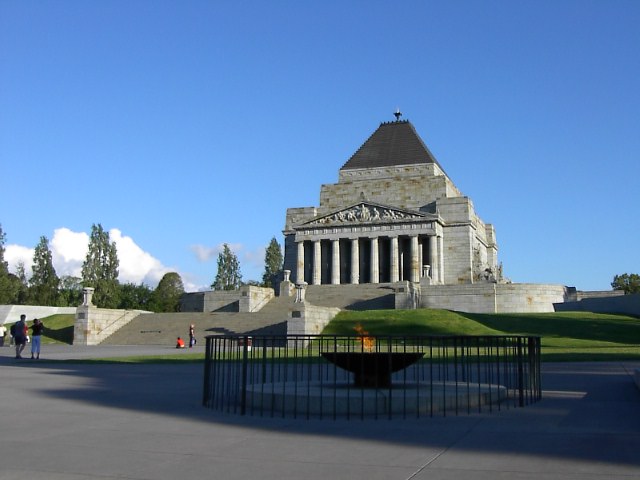
Shrine of Remembrance
37.8306° S · 144.9734° E · Monument
Photo: Adam Carr at English Wikipedia · Public domain · Wikimedia Commons
Shrine of Remembrance is a memorial located in Kings Domain on St Kilda Road, Melbourne, Australia. Dedicated in November 1934 after construction began late 1920s. The free Lokali audio guide runs 7 minutes.
✓ Published October 2026 · how we write these guides
Visitor facts
| Lokali audio guide | 7 min · free |
|---|---|
| Type | Monument |
| Location | Melbourne, Australia |
| Coordinates | -37.8306, 144.9734 |
| Official website | shrine.org.au |
| Languages | 50+, in the Lokali app |
The story
Listen for a moment. The traffic of Saint Kilda Road is right behind you, yet it already sounds far away. Ahead, the grey granite rises in broad, stepped layers, and the ground slopes gently upward under your feet. The air changes here. It grows quieter, slower, and somehow cooler. You are walking toward the Shrine of Remembrance, Melbourne's great memorial to the men and women who served in war. Take your time on the approach. That was always part of the plan.
The Shrine began as a promise after the First World War. Victoria had sent tens of thousands of people to that conflict, and many never came home. Families had no graves to visit. Their sons and brothers lay buried on the other side of the world, in Gallipoli, France, and Palestine. The city wanted one place where that grief could gather. After years of debate about the design, construction began in the late 1920s, and the building was dedicated in November 1934.
Here is the first surprise. The two architects, Philip Hudson and James Wardrop, were both veterans of that same war. They were not designing an abstract monument. They were designing a place for their own lost friends. Their design looks back to the ancient world on purpose. The stepped roof echoes the Mausoleum of Halicarnassus, one of the Seven Wonders of the ancient world. The columned porticoes at the front recall the Parthenon in Athens. The message was simple. This loss deserved the same weight as the great tombs of history.
Now look at the stone itself. The outer walls are granite, quarried in Victoria and brought here in heavy blocks. It is a pale grey, flecked with darker grains, and it takes the light softly rather than shining. On a cloudy day the building can look almost silver. On a hot afternoon it glows warm and pale against the blue sky. Run your eye up the corners and you will see carved figures standing guard at the top of the buttresses. They represent ideals such as Peace, Justice, Patriotism, and Sacrifice.
The timing of the building matters too. Much of the work happened during the Great Depression, when many Melburnians had lost their jobs. Money for the Shrine came largely from public donations, collected from ordinary people across the state. So the stones in front of you carry two stories at once. They remember the war dead. They also carry the effort of a struggling city that still chose to give.
When you step inside, the light drops away. This central space is called the Sanctuary. It is calm and dim, and voices fall naturally to a whisper. In the middle of the floor lies the Stone of Remembrance, set low into the ground. You must look down to read it. That is deliberate. Every visitor bows their head, whether they mean to or not. The inscription reads, "Greater love hath no man", words taken from the Gospel of John.
Now for the detail most visitors miss. High above you, there is a small opening in the roof. The architects aligned it so that at eleven o'clock on the morning of the eleventh of November, a ray of sunlight falls across the Stone and lands on the word "Love". That is the moment the guns fell silent in 1918. Daylight saving time later shifted the clock, so today a system of mirrors helps guide the beam. The ray still appears every half hour inside the Sanctuary, so you may see it during your visit.
Walk back out and find the stairs to the upper balconies. This is the second surprise. From up here, the whole city lines up in front of you. The view runs straight down Saint Kilda Road and on along Swanston Street, into the heart of Melbourne. That long axis is not an accident. The Shrine was placed so that the living city and its memorial face each other. Below, the wide boulevard carries trams and cars. Behind you, the parklands of the Kings Domain spread out in green.
Down in the forecourt, you will see a small flame burning. This is the Eternal Flame. It was lit by Queen Elizabeth the Second during her visit to Melbourne in 1954, and it has burned ever since. Nearby stands a later memorial for the Second World War, added as the purpose of the Shrine grew. It no longer remembers only one war. It now holds space for every conflict and peacekeeping mission Australians have taken part in.
Beneath your feet, there is more than you might expect. Below the main building lies the crypt, a lower chamber with a bronze sculpture of a father and son. The father wears the uniform of the First World War. The son wears the uniform of the Second. It is a quiet image of how one war followed another inside a single family. Around the crypt hang the flags and colours of military units. Further below, newer galleries opened for the centenary of the First World War. They hold letters, medals, and personal objects.
Those galleries change the feeling of the visit. Upstairs, the Shrine speaks in the grand language of stone and symbol. Downstairs, it becomes personal. You might read a soldier's last letter to his mother, or see a nurse's worn uniform. Some objects are small enough to fit in your hand. A pocket diary. A photograph with folded corners. These are the things that turn a number on a wall into a name and a face.
The Shrine is also a living place, not only a museum. Every year on Anzac Day, in late April, thousands of people arrive in the dark before dawn. They stand in silence on these same grounds while the sky slowly lightens. Anzac stands for the Australian and New Zealand Army Corps, the force that landed at Gallipoli in 1915. On Remembrance Day in November, the crowd gathers again, waiting for that ray of light. On an ordinary weekday, though, you will mostly see joggers, students, and quiet visitors.
Before you leave, stand at the top of the steps for one more minute. Feel the wind that always seems to move across this open hill. Listen to the soft rustle of the trees in the parklands, and the distant bell of a tram. Look down the long line of the road toward the towers of the city. As you walk away, turn back once. Notice how the Shrine grows smaller, but never quite disappears from view.
Key facts
What to look for
Practical tips
Common questions
Is there a free audio guide to Shrine of Remembrance?
Yes — the Lokali app narrates Shrine of Remembrance free of charge in 50+ languages. The guide runs about 7 minutes, covers the history, what to look for on site and practical tips, and works offline once downloaded.
Where is Shrine of Remembrance?
Shrine of Remembrance is in Melbourne, Australia, at -37.8306, 144.9734. Tap the map link on this page for directions from where you are.
What is Shrine of Remembrance known for?
Dedicated in November 1934 after construction began late 1920s. Architects Philip Hudson and James Wardrop were war veterans.
What should you look for at Shrine of Remembrance?
Small roof opening above the Stone of Remembrance. The word Love carved into the sunken stone. Bronze father and son sculpture in the crypt.
What should you know before visiting Shrine of Remembrance?
Climb to the upper balconies for the long view to the city. Wait in the Sanctuary to catch the half-hourly ray of light.
When is the best time to visit Shrine of Remembrance?
Expect large pre-dawn crowds on Anzac Day mornings.
On the map
Opens directions to Shrine of Remembrance from your location.
More to see in Melbourne



Hear Shrine of Remembrance in your language
The full story, narrated, in 50+ languages. Download it before you go and it plays offline, at your own pace, with no ticket and no tour group.