
Vesuvius National Park
40.8170° N · 14.4270° E · National Park
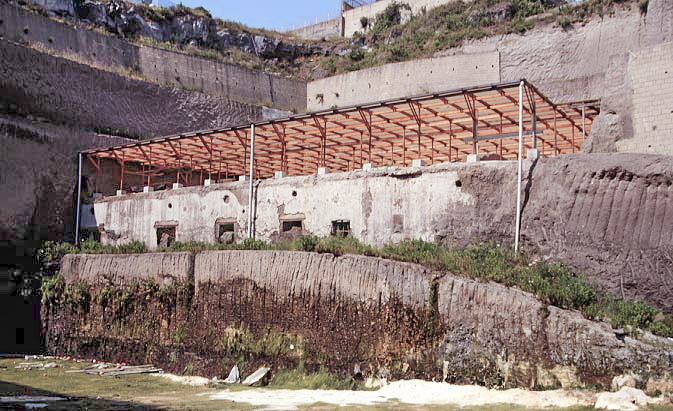
Photo: Lobufalo · CC BY-SA 3.0 · Wikimedia Commons
Vesuvius National Park is a national park in Italy. Vesuvius National Park was established in 1995. The free Lokali audio guide runs 6 minutes.
✓ Published October 2026 · how we write these guides
Visitor facts
| Lokali audio guide | 6 min · free |
|---|---|
| Type | National Park |
| Location | Metropolitan City of Naples, Italy |
| Coordinates | 40.8170, 14.4270 |
| Official website | parks.it |
| Languages | 50+, in the Lokali app |
The story
Listen to the ground under your shoes. On the upper slopes of Vesuvius, the path does not crunch like gravel. It shifts and slides, a dark mix of cinders and ash that gives a little with every step. The air smells faintly of dust and warm stone. Below you, the Bay of Naples opens out in a long blue curve, and the city spreads along the shore. You are walking on a volcano that is still active.
This is Vesuvius National Park, created in 1995 to protect the volcano and the land around it. The park is not a single mountain. It is a pair of shapes, one inside the other. The older, broken ridge to the north is Monte Somma, the remains of a much larger ancient volcano. The younger cone of Vesuvius grew inside its collapsed crater. Look across the landscape and you can often see the two outlines side by side.
Between them runs a long curved valley. Locals call parts of it the Valley of the Giant and the Atrium of the Horse. Lava from more recent eruptions has flowed into this gap many times. In places, the old flows are still visible as rough, dark tongues of rock. Some look almost fresh. Others are already softened by moss, grass, and small shrubs. The difference shows you how slowly life returns, decade by decade.
The eruption everyone knows came in the year 79 of the common era. A column of ash and pumice rose high into the sky, then collapsed in waves of superheated gas and debris. Pompeii and Herculaneum were buried. A young Roman writer, Pliny the Younger, watched from across the bay. His uncle, Pliny the Elder, sailed toward the danger to help and died on the shore. The nephew's letters survived, and they remain one of the earliest eyewitness accounts of a volcanic eruption.
Here is a detail many visitors miss. Volcanologists today use the word Plinian to describe explosive eruptions of that kind — tall columns, falling pumice, deadly flows. The name honours that young letter writer. So a Roman who simply described what he saw from a villa window gave science one of its standard terms. When you look out toward the bay, you are looking roughly along the line of his view.
The Roman disaster was not the end of the story. Vesuvius erupted again and again over the following centuries. In 1631, a violent eruption killed thousands of people in the towns around its base. That event pushed the authorities of Naples to think seriously about watching the mountain. Over time, the volcano became one of the most studied on Earth. It is also one of the most dangerous, because so many people live close to it.
That study has a home on these slopes. The Vesuvius Observatory was founded in 1841, and it is considered the oldest volcano observatory in the world. Scientists there began recording the mountain's moods long before modern instruments existed. Today, monitoring continues with seismic sensors, gas measurements, and satellite data. The calm you feel on the trail rests on constant, careful listening below the surface.
The most recent eruption came in 1944, in the middle of the Second World War. Allied forces had already arrived in the region. Lava destroyed parts of nearby villages, and falling ash and hot stones wrecked dozens of Allied aircraft parked at an airfield near the mountain. Since then, Vesuvius has been quiet. But quiet is not the same as finished. Emergency plans for the surrounding towns cover hundreds of thousands of people.
Now, a lighter story. In 1880, a funicular railway opened to carry visitors up the cone. To promote it, a Neapolitan song was written, called Funiculì, Funiculà. It became famous far beyond Italy, and many people still hum it without knowing it was once an advertisement. The railway itself did not survive the mountain's later activity. The song outlived the machine it was written to sell.
As you walk, notice the plants. In late spring, the slopes turn yellow with broom, a tough flowering shrub. The poet Giacomo Leopardi stayed near Vesuvius in the 1830s and wrote a famous poem about this plant. For him, the broom growing on the lava was a symbol of quiet courage — a small, fragile life holding on in a hostile place. Look closely at bare rock too. Pale grey-green lichen is often the first living thing to settle on cooled lava.
The fertile soil explains why people stayed. Volcanic ash breaks down into rich ground. On the lower slopes, farmers grow vines, apricots, and small tomatoes that are traditionally hung in clusters to keep through the winter. The local wine is called Lacryma Christi, the Tears of Christ. Legend has it that Christ wept over the beauty of the bay, and vines grew where his tears fell. It is folklore, not history, but you will hear it often.
The area's value has been recognised beyond Italy. Vesuvius and the surrounding land form part of a UNESCO biosphere reserve. That means the goal is not only to protect nature but to balance it with the people, farms, and towns that share this ground. Few protected landscapes sit so close to a major city. From the upper trail, you can see both worlds at once — wild slopes above, dense streets below.
Before you leave, stop for a moment near the rim, or wherever you are standing now. Feel the wind, often cooler than in the city. Watch for thin wisps of vapour rising from the crater walls on some days. Look down at the dark grit on your shoes. It came from inside the Earth. And as you walk back down, glance toward Naples, and think about the many people who live their whole lives in the shadow of this mountain.
Key facts
What to look for
Practical tips
Common questions
Is there a free audio guide to Vesuvius National Park?
Yes — the Lokali app narrates Vesuvius National Park free of charge in 50+ languages. The guide runs about 6 minutes, covers the history, what to look for on site and practical tips, and works offline once downloaded.
Where is Vesuvius National Park?
Vesuvius National Park is near Metropolitan City of Naples, Italy, at 40.8170, 14.4270. Tap the map link on this page for directions from where you are.
What is Vesuvius National Park known for?
Vesuvius National Park was established in 1995. The 79 CE eruption buried Pompeii and Herculaneum.
What should you look for at Vesuvius National Park?
The broken ridge of Monte Somma beside the cone. Dark tongues of old lava flows in the valley. Pale grey-green lichen growing on bare lava rock.
What should you know before visiting Vesuvius National Park?
Book your crater trail access ahead, especially in summer. Wear sturdy shoes with grip for loose volcanic gravel.
When is the best time to visit Vesuvius National Park?
Go early on clear days for the widest bay views.
On the map
Opens directions to Vesuvius National Park from your location.
More to see near Vesuvius National Park



Hear Vesuvius National Park in your language
The full story, narrated, in 50+ languages. Download it before you go and it plays offline, at your own pace, with no ticket and no tour group.