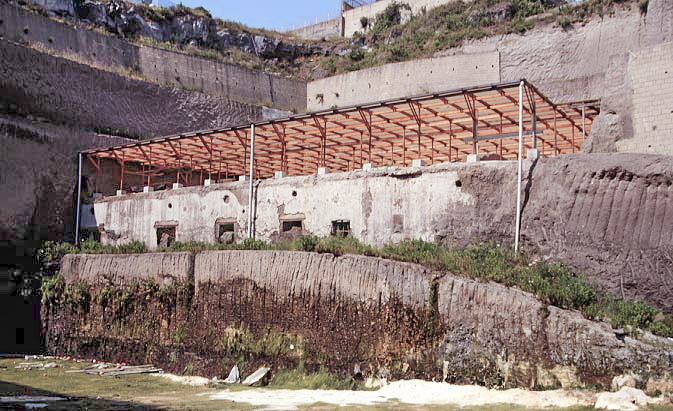
Villa of the Papyri
40.8067° N · 14.3456° E · Archaeological Site
Photo: http://wiki.epicurus.info/User:Erik_Anderson · CC BY-SA 3.0 · Wikimedia Commons
Villa of the Papyri is an ancient Roman villa in Ercolano, Italy. Buried by the eruption of Vesuvius in 79. The free Lokali audio guide runs 8 minutes.
✓ Published October 2026 · how we write these guides
Visitor facts
| Lokali audio guide | 8 min · free |
|---|---|
| Type | Archaeological Site |
| Location | Naples, Italy |
| Coordinates | 40.8067, 14.3456 |
| Languages | 50+, in the Lokali app |
The story
Stand still for a moment and listen. The traffic of Ercolano hums somewhere behind you, scooters and buses, the ordinary noise of a modern town. Under your feet, the ground is not really ground at all. It is hardened volcanic material, layer upon layer of it, laid down in a single catastrophe almost two thousand years ago. Somewhere below and beside you, inside that grey rock, lies one of the largest private houses of the Roman world. It also held the only library to survive from classical antiquity.
This is the Villa of the Papyri. It sits just outside the walls of ancient Herculaneum, the smaller and richer neighbour of Pompeii, on the slope that once ran down to the Bay of Naples. In Roman times this was a coast of luxury retreats. Wealthy families from Rome came here to escape the heat and noise of the capital. They built long terraces facing the sea, gardens full of statues, and rooms for reading and conversation. This villa was among the grandest of them all.
Then, in the year 79, Vesuvius erupted. You can see the mountain from many points nearby, its broad shoulders rising behind the town. At Herculaneum, the danger did not come as falling ash, as it did at Pompeii. It came as surges of superheated gas and debris that rushed down the slope. They buried the villa deeply and sealed it. The coastline itself moved outward. The sea that once lapped below the terraces now lies some distance away.
For more than sixteen centuries, the villa was forgotten. Its rediscovery began in 1750, under the Bourbon kings who ruled Naples. Workers digging wells and shafts struck marble and bronze. A Swiss military engineer named Karl Weber took charge of the work. He did not uncover the building from above. Instead, his men dug tunnels through the solid volcanic rock, working by lamplight, often in bad air, following walls and floors blindly in the dark.
Here is the first surprise. Weber drew careful plans of what his tunnellers found, room by room, garden by garden. Those plans became the main record of the villa for generations. They were so detailed that, in the twentieth century, the oil magnate J. Paul Getty used them as the model for his museum in Malibu, California. So if you have ever visited the Getty Villa above the Pacific, you have walked through an imagined version of the building that lies here, still mostly underground.
What did the tunnellers find? First, sculpture. They brought up a remarkable collection of bronze and marble figures from the gardens and colonnades. There were portrait busts of philosophers, poets and rulers. There were athletes, animals and deities. Among the bronzes are a seated Hermes, the messenger god, resting on a rock, and a pair of young runners, their bodies leaning forward as if waiting for a signal. Most of these works are now displayed in the National Archaeological Museum in the centre of Naples.
Then came the discovery that gave the villa its name. In one small room, the workers found black, lumpy objects. At first some of them were taken for lumps of charcoal, and a number were reportedly thrown away or burned. Only later did someone realise what they were. They were papyrus scrolls — books — carbonised by the heat of the eruption. Around 1,800 of them were eventually recovered. No other library from the ancient Greek and Roman world has come down to us in this way.
But a burnt scroll is a cruel thing. Touch it, and it crumbles. Over the following centuries, scholars tried many methods to open them. In the eighteenth century, a priest named Antonio Piaggio designed a machine that unrolled the scrolls very slowly, using threads and weights. It worked, but painfully, and many scrolls were damaged or destroyed in the attempts. Much of what was read turned out to be philosophy in Greek, a large part of it written by Philodemus.
Philodemus was a Greek philosopher of the Epicurean school, who lived in Italy in the first century before Christ. Epicureans taught that a good life comes from calm, friendship and freedom from fear, not from wealth or power. That gives the villa a quiet irony. A palace of marble and bronze held the writings of a thinker who praised simple pleasures. Who owned it? Many scholars link the villa to Lucius Calpurnius Piso, the father-in-law of Julius Caesar and a known patron of Philodemus. It is a strong theory, but it is still debated.
Now the second surprise, and it belongs to our own time. Hundreds of scrolls were never opened, because opening them would destroy them. In recent years, researchers have scanned some of these rolls with powerful X-rays and used computer analysis to find the faint traces of ink inside. In 2023, a student working on a public competition read a single Greek word from inside a sealed scroll. The word meant purple. Since then, whole passages have emerged. Texts unseen for nearly two thousand years are being read without unrolling a single page.
What can you actually see here? Be prepared: much of the villa remains buried, and the site is not regularly open to visitors. Excavations from above in the 1990s and 2000s exposed part of the building, including sections of a lower level that the Bourbon tunnellers never found. From the edges of the site, and on special openings, you can glimpse walls, floors and the sheer depth of rock that covered them. That depth is the real lesson. It shows how completely Vesuvius erased this coast.
To complete the picture, it helps to visit three places in Naples. The scrolls are kept in the National Library, inside the Royal Palace on Piazza del Plebiscito, where a dedicated papyrus workshop has worked on them for generations. The bronzes and marbles stand in the National Archaeological Museum. And the main excavations of Herculaneum are a short walk from here, with streets, houses and carbonised wood that show what daily life looked like around this villa.
There is also a question that keeps scholars awake. Was the library complete? Most of the recovered scrolls are Greek philosophy. Some researchers believe a Latin collection may still lie in unexcavated rooms, perhaps even works by authors lost to us today. Nobody knows. The villa has been explored in tunnels and in trenches, but never fully cleared. That uncertainty is part of what makes this place unlike any other ruin on the bay.
So take one more look around you. The apartment blocks, the narrow streets, the washing on the balconies — all of it rests on the same volcanic rock that covered the villa. Somewhere beneath this ordinary town, rooms still wait in darkness, perhaps with books still on their shelves. As you walk away, glance back toward Vesuvius. It is the mountain that destroyed this library. It is also the reason any of it survived.
Key facts
What to look for
Practical tips
Common questions
Is there a free audio guide to Villa of the Papyri?
Yes — the Lokali app narrates Villa of the Papyri free of charge in 50+ languages. The guide runs about 8 minutes, covers the history, what to look for on site and practical tips, and works offline once downloaded.
Where is Villa of the Papyri?
Villa of the Papyri is near Naples, Italy, at 40.8067, 14.3456. Tap the map link on this page for directions from where you are.
What is Villa of the Papyri known for?
Buried by the eruption of Vesuvius in 79. Rediscovered through tunnelling beginning in 1750.
What should you look for at Villa of the Papyri?
The deep wall of grey volcanic rock above the ruins. Exposed Roman floors far below the modern street level. Vesuvius rising behind the town on clear days.
What should you know before visiting Villa of the Papyri?
Check ahead for special openings; the site is rarely accessible. Pair this stop with the Herculaneum excavations nearby.
On the map
Opens directions to Villa of the Papyri from your location.
More to see in Naples


Hear Villa of the Papyri in your language
The full story, narrated, in 50+ languages. Download it before you go and it plays offline, at your own pace, with no ticket and no tour group.