
Photo: Wikimedia Commons contributor · CC BY-SA 2.5 · Wikimedia Commons
Castel Nuovo is a castle in Naples. Construction began around 1279 under Charles of Anjou. The free Lokali audio guide runs 7 minutes.
✓ Published October 2026 · how we write these guides
Visitor facts
| Lokali audio guide | 7 min · free |
|---|---|
| Type | Castle |
| Location | Naples, Italy |
| Coordinates | 40.8384, 14.2538 |
| Official website | comune.napoli.it |
| Languages | 50+, in the Lokali app |
The story
Stand still for a moment and listen. Behind you, scooters buzz across the wide square. Ahead, the ferry horns sound from the harbour. And in front of you, five great round towers of dark grey stone rise out of a deep, dry moat. The stone is rough and pitted. In the afternoon sun it turns warm and almost brown. This is Castel Nuovo, the New Castle. Most people in Naples simply call it the Maschio Angioino, the Angevin keep. It has watched this waterfront for more than seven centuries.
The name makes people smile. New? It looks anything but new. The answer is simple. When this fortress was begun in the late thirteenth century, Naples already had two older castles. One was Castel dell'Ovo, out on its little island by the sea. The other was Castel Capuano, closer to the old city. This one was the newcomer. The name stuck, and it never changed, even as the building grew older than almost everything around it.
The first builder was Charles of Anjou, a French prince who had taken control of southern Italy. The Angevins, as his family is called, wanted a royal seat close to the harbour. Work began around 1279, with French architects in charge. From here, the Angevin kings ruled a large kingdom. Naples became one of the great capitals of medieval Europe. The castle was its political heart — a palace, a fortress and a court all in one.
That court drew remarkable people. Under King Robert of Anjou, in the early fourteenth century, the painter Giotto came to Naples and worked inside the castle. He decorated the royal chapel with frescoes. Sadly, almost all of that work is lost today. Only small fragments of painted decoration survive inside. The poets Petrarch and Boccaccio also knew this court. It is strange to think of them walking through these gates, while today the trams pass outside.
Here is a moment most visitors never hear about. In 1294, a pope gave up his office inside this castle. His name was Celestine the Fifth, an elderly hermit who had been elected almost against his will. After only a few months, he resigned. It was an extremely rare event in the history of the Church. Soon afterwards, his successor was chosen here in Naples as well. These walls have seen decisions that shaped all of Christian Europe.
The castle you see today, however, is mostly not the Angevin building. In 1442, Alfonso of Aragon, a king from the Spanish side of the Mediterranean, conquered Naples. He rebuilt the fortress almost completely. The new design suited a new age of gunpowder and cannon. That is why the towers are round and thick. Curved walls deflect cannonballs better than flat ones. The heavy bases slope outward into the moat, built to absorb blows.
Now look between the two towers on the entrance side. Squeezed into that narrow space is something completely different — a tall triumphal arch of gleaming white marble. Against the dark stone, it almost glows. It celebrates Alfonso's victorious entry into the city. A team of sculptors worked on it over many years, among them Francesco Laurana. The arch borrows the language of ancient Roman monuments. It is one of the most important early Renaissance works in southern Italy.
Let your eyes travel up the arch, slowly. In the lower band, you can see a carved procession. The king rides in a chariot, surrounded by nobles, soldiers and musicians. Above that, there are statues of virtues in niches. And at the very top stands a figure of Saint Michael. It is a story told in stone, layer by layer, meant to be read from the ground by people walking past.
The castle also has its dark side, and some of it is legend. Locals tell the story of a crocodile that lived in a pit beneath the fortress. According to the tale, prisoners who vanished were fed to it. Some versions say the beast arrived by ship from Africa. There is no proof that any of this happened. But the dungeon known as the Crocodile Pit is real, and the story has been told in Naples for centuries.
One story, though, is real history. Inside is the great Hall of the Barons. In the 1480s, a group of powerful nobles plotted against King Ferrante, Alfonso's son. Ferrante invited them to a wedding celebration in this hall. During the feast, he had them arrested. Many were later executed. Look up when you stand inside. The vault rises into a huge star of stone ribs, designed by the Majorcan architect Guillem Sagrera. Today, the Naples city council meets beneath it.
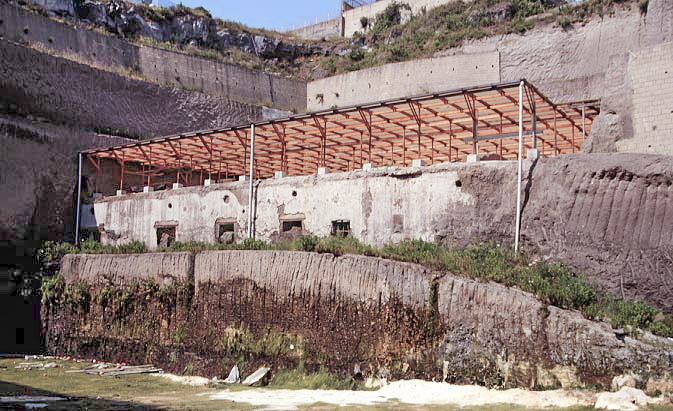
The castle holds another surprise below your feet. In one hall, the floor is made partly of glass. Underneath, you can see the remains of much older structures, including Roman ruins and early burials, uncovered during excavations. The upper floors house the city's civic museum. There you will find paintings, sculpture and silverwork, mostly from Naples and the south. From the higher rooms and terraces, you also get views out over the harbour and the square.
The area around the castle has changed many times. The large square in front, Piazza Municipio, was reshaped again in recent years. When workers dug the new metro station nearby, they found remains of the ancient port, including old wooden boats. So the ground here holds Greek, Roman, medieval and modern Naples all at once. Turn toward the sea and you can see the ferry terminal. Boats leave from there for Capri, Ischia and the Amalfi coast.
Before you walk away, take one last look at the towers. Notice how the dark volcanic stone meets the white marble. Notice the moat, the narrow windows, the swallows that circle the battlements in warm weather. The castle is no longer a seat of kings. It is a museum, a council hall and a backdrop for the city's daily rush. And as you cross the square, the harbour wind will follow you, just as it has followed everyone who has stood here.
Key facts
What to look for
Practical tips
Common questions
Is there a free audio guide to Castel Nuovo?
Yes — the Lokali app narrates Castel Nuovo free of charge in 50+ languages. The guide runs about 7 minutes, covers the history, what to look for on site and practical tips, and works offline once downloaded.
Where is Castel Nuovo?
Castel Nuovo is in Naples, Italy, at 40.8384, 14.2538. Tap the map link on this page for directions from where you are.
What is Castel Nuovo known for?
Construction began around 1279 under Charles of Anjou. Called New Castle to distinguish it from two older castles.
What should you look for at Castel Nuovo?
White marble triumphal arch squeezed between two dark towers. Carved royal procession band across the lower arch. Saint Michael statue standing at the very top.
What should you know before visiting Castel Nuovo?
Pair your visit with the harbour walk toward Castel dell'Ovo. Visit upper floors for views over the port and square.
When is the best time to visit Castel Nuovo?
Come in late afternoon when the stone turns warm.
On the map
Opens directions to Castel Nuovo from your location.
More to see in Naples



Hear Castel Nuovo in your language
The full story, narrated, in 50+ languages. Download it before you go and it plays offline, at your own pace, with no ticket and no tour group.