
Herculaneum
40.8061° N · 14.3475° E · Archaeological Site
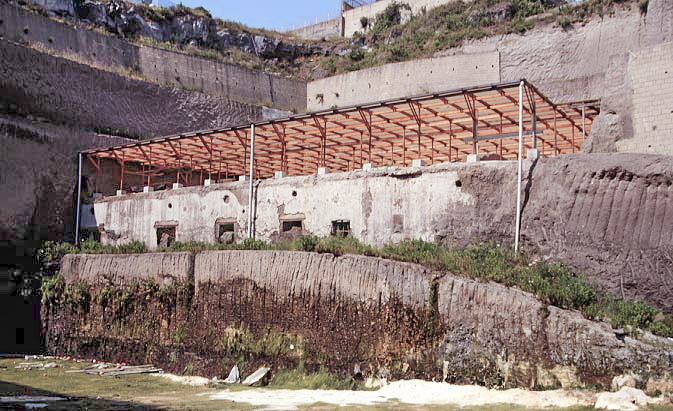
Photo: Diego Delso · CC BY-SA 4.0 · Wikimedia Commons
Herculaneum is a Roman town destroyed by eruption of Mount Vesuvius. Buried by the eruption of Mount Vesuvius in 79 CE. The free Lokali audio guide runs 7 minutes.
✓ Published October 2026 · how we write these guides
Visitor facts
| Lokali audio guide | 7 min · free |
|---|---|
| Type | Archaeological Site |
| Location | Naples, Italy |
| Coordinates | 40.8061, 14.3475 |
| Official website | ercolano.beniculturali.it |
| Languages | 50+, in the Lokali app |
The story
Stand at the railing above the excavations and look down. The ancient town lies in a deep pit, far below the street you just walked along. Above you, the apartment blocks of modern Ercolano crowd the edge, with laundry hanging from balconies. Below you, Roman rooftops and doorways sit in the sun. The two cities are stacked, one directly on top of the other. That vertical drop is your first lesson here. It shows how much volcanic material fell on this place.
The disaster came in 79 CE, when Mount Vesuvius erupted. You can see the mountain from here, to the northeast, its broad grey shape usually calm against the sky. Pompeii, further down the coast, was buried mostly by falling ash and pumice. Herculaneum met a different fate. Waves of superheated gas and volcanic debris, called pyroclastic surges, rushed down the slopes. Layer after layer, they sealed the town under roughly twenty metres of material that later hardened into rock.
That difference matters for what you are about to see. At Pompeii, the weight of falling pumice crushed many roofs. Here, the hot, dense flows filled the buildings and set around them. The result is a town where upper floors, wooden beams, and even doors survived. Many visitors arrive expecting a smaller copy of Pompeii. Instead, they find something more intimate — a place where you can still look up at a Roman balcony.
Legend has it that the hero Hercules founded the town, and that is where its name comes from. That story belongs to myth, not to the archaeological record. What we can say is that Herculaneum was a modest seaside town, much smaller than Pompeii. It sat on a ridge above the shore of the Bay of Naples. Wealthy Romans valued this coast for its views, its sea breezes, and its distance from the noise of the big cities.
The rediscovery began almost by accident in the early eighteenth century. Local people digging wells struck fragments of marble. Soon, the Bourbon rulers of Naples sent workers into the rock to search for treasure. They dug long tunnels, pulled out statues and paintings, and often left the buildings damaged behind them. This was treasure hunting more than science. Some of those old tunnels still run beneath parts of the town and the modern streets above.
Systematic open-air excavation came much later, in the twentieth century. The archaeologist Amedeo Maiuri led major work here from the 1920s onward, uncovering the streets and houses you can now walk through. Even so, only part of the ancient town has been exposed. Much of it still lies under the homes, shops, and roads of Ercolano. When you look at the high wall of rock at the edge of the site, you are looking at unexcavated Roman ground.
Walk down into the streets and notice the paving and the pavements. The stones are worn smooth. Water once ran through lead pipes under your feet, and fountains stood at street corners. Look at the doorways. In several houses, you can see dark, charred timber in the walls and lintels. This wood is carbonised — the heat turned it to charcoal but kept its shape. It is one of the rarest things in Roman archaeology, and here it is almost ordinary.
One house shows this especially well. In the House of the Wooden Partition, a folding wooden screen still stands between the courtyard and the inner room. Its panels are blackened, but you can still read their form and the fittings that held them. Elsewhere, archaeologists found carbonised beds, shelves, and even food. Take a moment at any of these. You are looking at furniture that a Roman family used on the morning of the eruption.
Now look for colour. Herculaneum keeps some of the brightest wall decoration in the region. In the House of Neptune and Amphitrite, a glass mosaic shows the sea god and his wife in deep blues and greens. The small tiles still catch the light when the sun reaches them. Nearby, the walls of a shop open onto the street, with storage jars on wooden shelves. Domestic life and commercial life sit side by side here, just as they do in Naples today.
Here is a surprise for many visitors. For a long time, people believed that almost everyone in Herculaneum escaped. Few bodies had been found in the town. Then, from the 1980s, excavators reached the ancient shoreline. Inside the arched boat sheds at the water's edge, they found the skeletons of around three hundred people. They had gathered there, perhaps waiting for rescue by sea. Today, the sea has moved far away, and these arches face dry ground.
Those skeletons changed what scholars know about ordinary Romans. Studies of bones and teeth have shown details about diet, health, injuries, and age. They show men, women, and children together. When you reach the old shoreline, pause there quietly. This is not a theatrical display. It is the place where the town's final hours are most clearly recorded.
The second surprise lies just outside the main site. A large seaside villa, now called the Villa of the Papyri, held a library of rolled papyrus scrolls. The eruption carbonised them into lumps that look like burnt logs. For centuries, attempts to unroll them destroyed many. In recent years, researchers have used advanced scanning and computer analysis to read words inside scrolls that are still closed. The villa was also the model for the Getty Villa in California.
Before you climb back up toward the street, turn and look at the whole scene once more. The Roman roofs below, the hardened volcanic rock around them, the modern balconies above, and Vesuvius on the horizon. Listen to the traffic and the voices of Ercolano drifting down. People still live, work, and hang their washing on top of this buried town. As you walk away, notice how close the mountain feels — and how ordinary the afternoon seems.
Key facts
What to look for
Practical tips
Common questions
Is there a free audio guide to Herculaneum?
Yes — the Lokali app narrates Herculaneum free of charge in 50+ languages. The guide runs about 7 minutes, covers the history, what to look for on site and practical tips, and works offline once downloaded.
Where is Herculaneum?
Herculaneum is near Naples, Italy, at 40.8061, 14.3475. Tap the map link on this page for directions from where you are.
What is Herculaneum known for?
Buried by the eruption of Mount Vesuvius in 79 CE. Sealed under roughly twenty metres of volcanic material.
What should you look for at Herculaneum?
Carbonised wooden screen in the House of the Wooden Partition. Blue and green glass mosaic of Neptune and Amphitrite. Arched boat sheds facing the vanished ancient shoreline.
What should you know before visiting Herculaneum?
Take the Circumvesuviana train to the Ercolano Scavi station. Pick up the site map before descending into the excavations.
When is the best time to visit Herculaneum?
Come early on summer days; the pit holds heat.
On the map
Opens directions to Herculaneum from your location.
More to see in Naples


Hear Herculaneum in your language
The full story, narrated, in 50+ languages. Download it before you go and it plays offline, at your own pace, with no ticket and no tour group.