
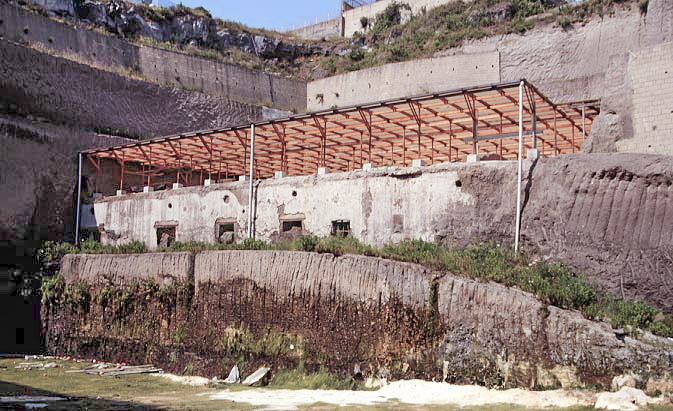
Photo: PaestumPaestum · CC BY-SA 4.0 · Wikimedia Commons
Castel dell'Ovo is a castle in Naples, Italy. The islet was called Megaride by ancient Greek settlers. The free Lokali audio guide runs 7 minutes.
✓ Published October 2026 · how we write these guides
Visitor facts
| Lokali audio guide | 7 min · free |
|---|---|
| Type | Castle |
| Location | Naples, Italy |
| Coordinates | 40.8283, 14.2477 |
| Languages | 50+, in the Lokali app |
The story
Listen first. Small waves slap against dark volcanic rock below the causeway. Fishing boats knock gently together in the little harbour. Somewhere above you, gulls call over the walls. The air smells of salt, warm stone, and coffee drifting from the waterfront cafés. You are walking out to sea on a narrow bridge of stone, and the fortress in front of you sits on its own small island, facing the open bay of Naples.
This is Castel dell'Ovo, the Castle of the Egg. It is the oldest standing castle in Naples, and its rock is where the city's story begins. The islet under your feet was once called Megaride by the ancient Greeks. Today a short causeway ties it to the Santa Lucia waterfront, but for most of its history it was a true island, cut off by the sea and easy to defend.
Legend has it that the siren Parthenope came here first. In one popular tale, she failed to lure the hero Ulysses with her song, and in her grief she drowned herself. Her body washed up on this shore. History tells a quieter version. Greek settlers from nearby Cumae founded a small town on the hill just behind you, and they named it Parthenope after the siren. Later, a new town grew beside it. They called it Neapolis, the new city. That name became Naples.
Many centuries after the Greeks, the Romans arrived with money and taste. In the first century before Christ, the wealthy general Lucius Licinius Lucullus built a grand villa here. Ancient writers remembered him for his feasts, his gardens, and his fish ponds. His estate spread across this rocky point and toward the hill above. It was a place for luxury, for long dinners with the sea at the door. Very little of that pleasure palace is visible now, but the rock still carries its memory.
Here is a detail most visitors walk past without knowing. In the year 476, the boy emperor Romulus Augustulus was removed from power. He is often called the last emperor of the Western Roman Empire. He was not killed. Instead, he was sent here, to the old villa of Lucullus, to live out his life in comfortable exile. So the end of Rome in the West, in a quiet way, played out on this small island in the Bay of Naples.
After Rome, monks came. Religious communities lived on the islet in the early Middle Ages, praying and working within the old walls. As you climb inside, you may pass rooms with old stone columns. Some of these spaces date back to those monastic centuries, when the island was a place of silence rather than soldiers. It is strange to imagine prayer and bells here, where cannons would later point out to sea.
Then the soldiers did arrive. In the twelfth century, the Normans, warriors whose ancestors came from northern France, took control of southern Italy. They turned the island into a real fortress. Later rulers, the Swabians from Germany and then the Angevins from France, used the castle too. It held royal treasure and, at times, important prisoners. But the Angevin kings eventually built a newer castle in the city, Castel Nuovo, and the royal court moved there.
Now, the egg. This is the story behind the name, and it is pure folklore. In the Middle Ages, people in Naples believed that the Roman poet Virgil was also a powerful magician. According to the tale, Virgil hid a magic egg inside a glass jar or cage, deep in the foundations of the castle. As long as the egg stayed whole, the fortress would stand, and so would Naples. If the egg ever broke, disaster would fall on the city.
The legend did not stay in storybooks. In the fourteenth century, part of the castle collapsed into the sea. Panic spread through the city. People feared the egg had broken. Queen Joanna the First, who ruled Naples at that time, is said to have declared that a new egg had been placed in the foundations, to calm her people. Whether she truly did it or not, the story shows how seriously Neapolitans took their castle and its strange protection.
The shape you see today comes mostly from later rebuilding. In the fifteenth century, the Aragonese kings from Spain reshaped many fortresses for the age of gunpowder. Thick, low walls replaced taller medieval towers, because tall towers fell easily to cannon fire. Look at the heavy, sloping masses of pale yellow tuff stone, a soft volcanic rock common around Naples. This is a fortress built to absorb blows, not to look delicate.
As you walk up the ramps toward the top terraces, take your time. The paths are steep and uneven in places, and the stone can be smooth underfoot. At the top, old cannons still sit along the walls. From here, the whole bay opens up. To the east, Mount Vesuvius rises over the water, the volcano that buried Pompeii. To the west, the green ridge of Posillipo curves along the coast. On a clear day, the islands of the bay appear as soft blue shapes on the horizon.
Back down at the foot of the castle, look at the little cluster of buildings around the harbour. This is the Borgo Marinari, the old sailors' quarter. Once it was home to fishermen. Today it is lined with restaurants and small boats, and in the evening the tables fill with families and couples. The castle is not a museum frozen in glass. It still hosts exhibitions and events, and it remains part of everyday life on the waterfront.
Before you leave, turn around once more and look back along the causeway toward the city. Behind you, the hills of Naples climb up from the sea, crowded with houses and church domes. You are standing on the exact spot where Greek sailors first stepped ashore, where a Roman general dined, where an emperor's reign quietly ended. Listen again to the water against the rocks. Somewhere beneath your feet, the old story says, an egg still keeps the city safe.
Key facts
What to look for
Practical tips
Common questions
Is there a free audio guide to Castel dell'Ovo?
Yes — the Lokali app narrates Castel dell'Ovo free of charge in 50+ languages. The guide runs about 7 minutes, covers the history, what to look for on site and practical tips, and works offline once downloaded.
Where is Castel dell'Ovo?
Castel dell'Ovo is in Naples, Italy, at 40.8283, 14.2477. Tap the map link on this page for directions from where you are.
What is Castel dell'Ovo known for?
The islet was called Megaride by ancient Greek settlers. Roman general Lucullus built a villa here in the first century BCE.
What should you look for at Castel dell'Ovo?
Old cannons still lining the upper ramparts. Pale yellow tuff stone in the thick sloping walls. Vesuvius rising across the water to the east.
What should you know before visiting Castel dell'Ovo?
Wear shoes with good grip for the steep stone ramps. Climb to the top terraces for the widest bay views.
When is the best time to visit Castel dell'Ovo?
Come near sunset for warm light on Vesuvius and the bay.
On the map
Opens directions to Castel dell'Ovo from your location.
More to see in Naples



Hear Castel dell'Ovo in your language
The full story, narrated, in 50+ languages. Download it before you go and it plays offline, at your own pace, with no ticket and no tour group.