
Photo: Kleuske · CC BY-SA 3.0 · Wikimedia Commons
Baiae is a human settlement in Bacoli, Metropolitan City of Naples, Campania, Italy. Baiae was a favourite Roman resort for the elite. The free Lokali audio guide runs 7 minutes.
✓ Published October 2026 · how we write these guides
Visitor facts
| Lokali audio guide | 7 min · free |
|---|---|
| Type | Archaeological Site |
| Location | Bacoli, Italy |
| Coordinates | 40.8167, 14.0697 |
| Languages | 50+, in the Lokali app |
The story
Start with the ground under your feet. It is warm here in places. Not from the sun, but from below. This whole stretch of coast sits inside the Campi Flegrei, the Phlegraean Fields, a wide volcanic area whose name means the burning fields. Steam rises from cracks in the earth nearby. The air can carry a faint smell of sulphur. And in front of you, the sea of the Bay of Pozzuoli lies flat and pale blue. That calm water is hiding something. A whole Roman town lies beneath it.
This is Baiae, today part of the town of Bacoli. Two thousand years ago, it was the place where Rome's richest families came to relax. Think of it as the ancient world's most fashionable seaside resort. Senators, generals and emperors built villas along this shore. They came for the mild climate, the views across the bay, and above all for the hot springs. The volcanic heat beneath the ground fed natural steam rooms and warm pools. The Romans turned that heat into luxury.
Ancient writers had strong opinions about Baiae. The philosopher Seneca wrote a letter describing it as a place of excess. He complained about drunken parties on the beach and boats full of noisy revellers. Cicero, the great orator, also mentioned the town's reputation for pleasure. Their criticism tells us something useful. If serious men felt the need to warn against Baiae, then many of their friends were clearly spending their summers here.
The town also has a darker side in the history books. The historian Tacitus describes how the emperor Nero plotted to kill his mother, Agrippina, near Baiae in the year 59. According to his account, Nero arranged a boat designed to collapse at sea. Agrippina survived the wreck and swam to shore. Soon afterwards, she was killed on Nero's orders. Some details of this story come only from Roman writers, so treat the small details with care. But the setting is this coastline.
Here is a fact many visitors miss. The emperor Hadrian, the man behind the famous wall across northern Britain, died at Baiae in the year 138. He was ill, and he came to this coast hoping the waters and the sea air would help him. They did not. So the ruler of the largest empire of his age spent his final days looking out at the same bay you can see now.
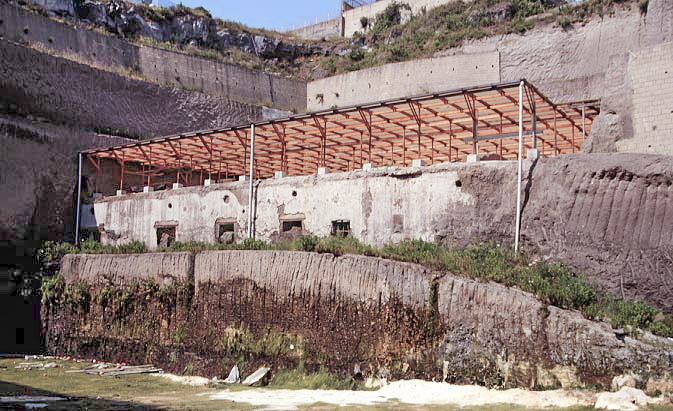
Now look at the terraces of the archaeological park on the hillside. The ruins climb the slope in levels, linked by stairs and corridors. For centuries, people gave these buildings grand names. One is called the Temple of Mercury. Others are known as the Temple of Venus and the Temple of Diana. But these names are later labels. Archaeologists now understand most of these structures as parts of large bath complexes and palace buildings, not temples at all.
The so-called Temple of Mercury is the one to find. It is a large round hall with a domed roof, open at the top. Water now covers its floor. This dome is older than the dome of the Pantheon in Rome, and it is one of the early large concrete domes of the Roman world. Roman builders used a local volcanic ash in their concrete. It helped the mixture set hard, even in damp conditions. That is one reason the dome still stands.
And here is the second surprise. The dome has remarkable acoustics. If you speak softly near the wall, a person on the other side of the hall may hear you clearly. Locals have long enjoyed testing this. Try it quietly with a companion. Then step into the centre and listen to how your voice changes. The sound bounces around the curved surface and returns to you. It is a small experiment, but it connects you directly to the people who stood here bathing.
So why is so much of Baiae underwater? The answer is a slow geological movement called bradyseism. The word comes from Greek and means slow earthquake. The ground in the Campi Flegrei rises and falls over time as pressure changes deep below. Over the centuries since the Roman period, this coast sank by several metres. Villas, streets, shops and harbour walls slipped beneath the sea. The town did not vanish in one night. It went down gradually.
Today that drowned town is protected as an underwater archaeological park. Divers and snorkellers can swim over mosaic floors, the bases of columns, and the outlines of rooms. For people who prefer to stay dry, glass-bottomed boats pass over the main sites. Looking down through the water, you can see the shapes of Roman buildings resting on the seabed. Fish move between walls where people once walked. It is a strange and quiet way to visit a city.
One of the most important underwater finds is a nymphaeum linked to the emperor Claudius. A nymphaeum was a decorated hall with water features and statues, used for dining and entertainment. Statues were recovered from the seabed, and several are now displayed in the archaeological museum inside the Aragonese castle on the headland above Baiae. Copies were placed underwater so divers can still see the room as a decorated space. The originals are in the castle, a short trip from here.
The castle itself is worth a moment of attention. It sits high on the promontory, built and rebuilt over the centuries to guard this part of the bay. From its walls, the view stretches across the water toward Pozzuoli. You can understand why the Romans chose this coast. The bay is sheltered. The land is fertile. The hills give protection. And the volcanic ground, for all its danger, gave them heat and the excellent building material they needed.
As you walk through the park, notice the details in the walls. Look for the neat diamond pattern of small stones, a Roman technique called opus reticulatum, which means net-like work. Look for thin red bricks laid in bands. Look for traces of plaster where colour once covered the rooms. Lizards rest on the warm stones. Pine trees and wild plants grow from old terraces. Nature has slowly moved back into these rooms of luxury.
Before you leave, stand still for a minute and look out at the water. Somewhere below that surface are floors where Roman feet once walked, rooms where people talked and ate and argued. The ground beneath you is still moving, very slowly, as it always has. The sea is quiet, and the stone is warm. As you walk away, notice the steam, the light on the bay, and the fact that this coast is still changing today.
Key facts
What to look for
Practical tips
Common questions
Is there a free audio guide to Baiae?
Yes — the Lokali app narrates Baiae free of charge in 50+ languages. The guide runs about 7 minutes, covers the history, what to look for on site and practical tips, and works offline once downloaded.
Where is Baiae?
Baiae is in Bacoli, Italy, at 40.8167, 14.0697. Tap the map link on this page for directions from where you are.
What is Baiae known for?
Baiae was a favourite Roman resort for the elite. Emperor Hadrian died at Baiae in 138.
What should you look for at Baiae?
The open-topped dome in the Temple of Mercury. Diamond-patterned opus reticulatum stonework in the walls. Faint steam rising from cracks in the ground.
What should you know before visiting Baiae?
Book a glass-bottomed boat to see the drowned town. Wear sturdy shoes for the steep park terraces.
When is the best time to visit Baiae?
Come in the morning for calmer, clearer water.
On the map
Opens directions to Baiae from your location.
More to see near Baiae


Hear Baiae in your language
The full story, narrated, in 50+ languages. Download it before you go and it plays offline, at your own pace, with no ticket and no tour group.