
Photo: AlexanderVanLoon · CC BY-SA 3.0 · Wikimedia Commons
Cumae is an ancient Roman city near Naples, Italy. Earliest Greek colony on the Italian mainland. The free Lokali audio guide runs 7 minutes.
✓ Published October 2026 · how we write these guides
Visitor facts
| Lokali audio guide | 7 min · free |
|---|---|
| Type | Archaeological Site |
| Location | Bacoli, Italy |
| Coordinates | 40.8486, 14.0536 |
| Official website | cir.campania.beniculturali.it |
| Languages | 50+, in the Lokali app |
The story
Start with the stone under your feet. It is soft and golden, a little gritty, and it crumbles at the edges like stale bread. This is tuff, a rock made from volcanic ash pressed solid over thousands of years. Above you, pines lean over the path, and the air smells of resin and dry earth. Somewhere beyond the trees, the sea moves against the shore. You are standing in Cumae, one of the oldest Greek footholds in all of Italy.
The story begins in the eighth century before Christ. Greek settlers came here from the island of Euboea, off the coast of mainland Greece. They had probably stopped first on the island of Ischia, which you may be able to see across the water on a clear day. Then they crossed to this hill above the shore. Scholars regard Cumae as the earliest Greek colony on the Italian mainland. Naples itself began later, as an offshoot of this place.
Here is a surprise most visitors miss. The letters you read every day may have passed through Cumae. The Euboean Greeks used their own version of the alphabet. Many historians believe the Etruscans, the powerful people of central Italy, learned to write from contacts like these. The Romans then took their letters from the Etruscans. So there is a reasonable line from this hilltop to the words on your phone screen... a quiet thought for such a quiet place.
The landscape around you is part of the Phlegraean Fields. The name comes from a Greek word for burning. This whole area is volcanic. The ground rises and falls slowly over the decades, and hot springs and craters lie scattered across the coast. For the ancient Greeks and Romans, a land like this felt close to the world of the gods — and close to the world of the dead.
That belief brings us to the Sibyl. In ancient tradition, a Sibyl was a woman who spoke prophecies, inspired by the god Apollo. The Sibyl of Cumae was the most famous of them all in the Roman world. People said she lived in a cave on this hill. Pilgrims came to ask her questions about war, love, and fate. Her answers, according to the stories, were often hard to understand.
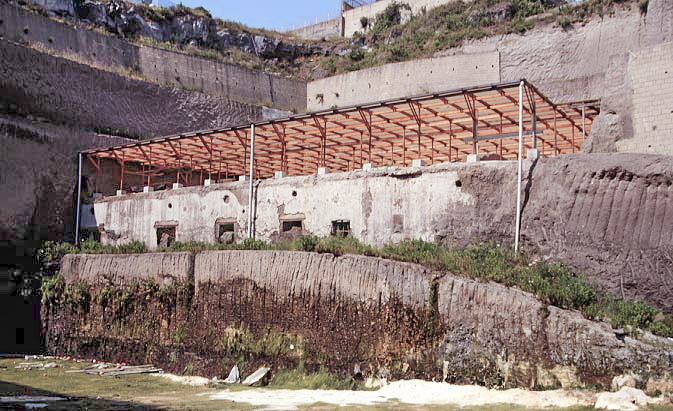
Now walk toward the long tunnel cut into the rock. Locals call it the Cave of the Sibyl. It is a straight passage, more than a hundred metres long, with a striking shape. The walls lean inward toward the top, making a tall trapezoid. Openings along one side let in blades of light from the hillside. At the far end, a small chamber waits in the shadow. The archaeologist Amedeo Maiuri cleared this passage in 1932, and he connected it with the Sibyl.
Be honest with yourself as you walk it, though. Archaeologists still debate what the tunnel really was. Some see a sacred space for oracles. Others think it was a military passage, part of the defences of the hill. It may have been reshaped several times over the centuries. Either way, the effect is real. Your footsteps echo, the light shifts in stripes across the floor, and the temperature drops a little as you go deeper.
The Roman poet Virgil made this place immortal. In his epic, the Aeneid, the hero Aeneas lands near Cumae after fleeing the fall of Troy. He climbs to the temple of Apollo and asks the Sibyl for help. She leads him down into the underworld, through an entrance near Lake Avernus, a crater lake just a short distance from here. Virgil also tells the legend that Daedalus, the inventor who flew on wings of wax, landed at Cumae and built a temple to Apollo.
Another legend gives the Sibyl a sad fate. The god Apollo offered her a wish, so the tale goes. She asked to live as many years as the grains of sand she held in her hand. But she forgot to ask for youth. She grew older and smaller, century after century. In one Roman story, by the writer Petronius, she hangs in a jar, and when children ask her what she wants, she says she wants to die. Poets have returned to that image ever since.
Cumae was also a place of real battles. In the late sixth century before Christ, the city fought off an Etruscan attack on land. Then in 474 BC, a fleet from the Greek city of Syracuse, in Sicily, helped Cumae defeat the Etruscans at sea, just off this coast. The victors sent captured bronze helmets as offerings to the sanctuary at Olympia in Greece. One of them survives today, inscribed with a dedication. Rome later absorbed Cumae, and Roman tradition says that Tarquin the Proud, the last king of Rome, died here in exile.
Now climb the path to the acropolis, the high citadel of the town. Here stood two great temples. The lower one is usually linked to Apollo. The upper one is traditionally called the Temple of Jupiter. As you climb, you will pass Roman walls of brick and stone, laid over older Greek foundations. In late antiquity, both temples were turned into Christian churches. Look for traces of that change, including what scholars identify as a baptismal font in the upper building.
The town did not survive the Middle Ages. Over time it became a refuge for raiders, and in the early thirteenth century forces from Naples destroyed it. The settlement never truly returned. That is why the hill feels so open today. There is no modern town on top of the ruins, only grass, broken columns, wild herbs, and the wind. Lizards run across the warm stones. In spring, wildflowers grow between the blocks.
From the top, take a moment to look outward. The coast curves away along the Gulf, and on clear days the islands sit low on the horizon. Imagine the first Greek ships pulling onto that beach, almost three thousand years ago. Think of the pilgrims climbing toward Apollo, and of Virgil's hero searching for the door to the dead. As you walk back down through the pines, listen to your steps on the soft yellow stone. It is the same rock the Sibyl's tunnel was cut from... and it still holds the warmth of the afternoon.
Key facts
What to look for
Practical tips
Common questions
Is there a free audio guide to Cumae?
Yes — the Lokali app narrates Cumae free of charge in 50+ languages. The guide runs about 7 minutes, covers the history, what to look for on site and practical tips, and works offline once downloaded.
Where is Cumae?
Cumae is near Bacoli, Italy, at 40.8486, 14.0536. Tap the map link on this page for directions from where you are.
What is Cumae known for?
Earliest Greek colony on the Italian mainland. Founded by settlers from Euboea, eighth century before Christ.
What should you look for at Cumae?
Trapezoid-shaped walls leaning inward inside the Sibyl's tunnel. Side openings casting stripes of light across the tunnel floor. Roman brickwork layered over older Greek stone foundations.
What should you know before visiting Cumae?
Wear sturdy shoes for uneven tuff paths and steps. Walk the Sibyl's tunnel first, before groups arrive.
On the map
Opens directions to Cumae from your location.
More to see near Cumae


Hear Cumae in your language
The full story, narrated, in 50+ languages. Download it before you go and it plays offline, at your own pace, with no ticket and no tour group.