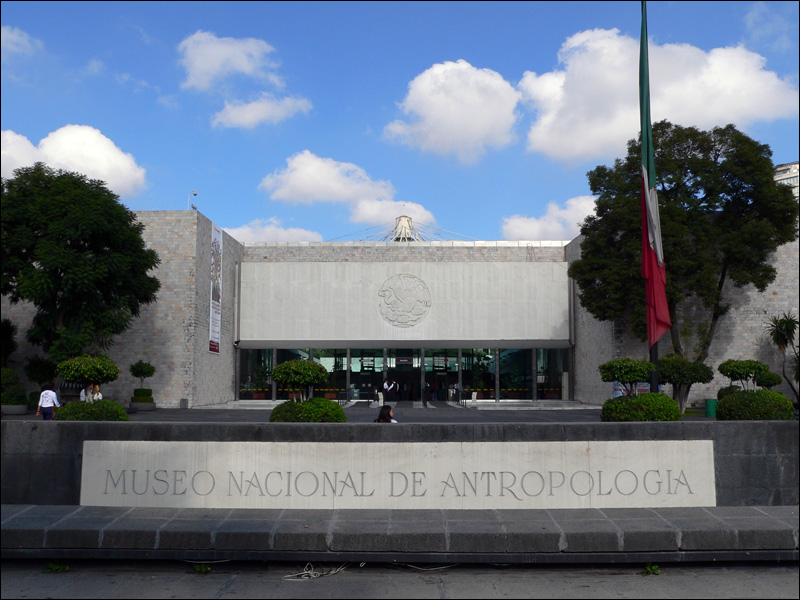
National Museum of Anthropology
19.4271° N · 99.1838° W · Museum
National Museum of Anthropology is a museum in Mexico City, Mexico. Mexico City's premier anthropological museum, housing the world's finest collection of pre-Columbian artifacts. Most visitors spend 3–4 hours here. The free Lokali audio guide runs 3 minutes.
✓ Verified August 2026 · how we write these guides
Visitor facts
| Time needed | 3–4 hours |
|---|---|
| Lokali audio guide | 3 min · free |
| Type | Museum |
| Best for | Editors' pick |
| Location | Mexico City, Mexico |
| Coordinates | 19.4271, -99.1838 |
| Languages | 45, in the Lokali app |
The story
The National Museum of Anthropology is both a museum and a statement about Mexican cultural identity. The current building opened on 17 September 1964 in Chapultepec Park, inaugurated by President Adolfo Lopez Mateos. INAH describes it as Mexico's most emblematic museum and one of the world's leading museums of its kind.
Pedro Ramirez Vazquez was commissioned as architect. The official INAH account stresses that the project was not conceived as a simple storehouse of artifacts but as part of Mexico's cultural heritage. Stone, scale, courtyards, and water all help the modern building speak to pre-Hispanic architectural memory.
The plan is organized around archaeology and ethnography. INAH describes 22 permanent galleries and temporary exhibition rooms, with ground-floor archaeology galleries moving from the first settlers through major Mesoamerican cultures, and upper areas addressing the living Indigenous cultures of Mexico.
This guide should avoid treating the museum as only Aztec or only Maya. Its deeper value is comparative: it shows many Indigenous worlds, different regions, different languages, and the long continuity between ancient objects and living communities.
The National Museum of Anthropology is easy to misread as only an archaeology museum. Its official identity is broader: it brings together archaeological and ethnographic interpretation, linking ancient civilizations with living Indigenous cultures. That continuity is essential to a respectful guide.
The 1964 building by Pedro Ramirez Vazquez was designed as a national cultural statement in Chapultepec Park. Its scale, courtyard, galleries, and famous central umbrella structure create a ceremonial rhythm before visitors even reach the objects. The architecture frames the museum as a place of national memory.
Avoid treating all pre-Hispanic cultures as one story. The museum's strength is regional and cultural variety: Mexica, Maya, Oaxaca, Gulf Coast, West Mexico, northern cultures, and ethnographic galleries each require separate attention. A good main text prepares visitors to notice difference rather than collapse everything into a single ancient Mexico.
The most accurate tone is one of continuity, not disappearance. Many objects are ancient, but the communities, languages, techniques, and ritual worlds connected to them are not simply gone. That is why the museum remains important for identity as well as scholarship.
Key facts
What to look for
Practical tips
Common questions
How long do you need at National Museum of Anthropology?
Plan 3–4 hours. That is the time most visitors spend at National Museum of Anthropology. The free Lokali audio guide adds about 3 minutes of narration you can listen to as you walk, so it fits inside your visit rather than adding to it.
Is there a free audio guide to National Museum of Anthropology?
Yes — the Lokali app narrates National Museum of Anthropology free of charge in 50+ languages. It covers the history, what to look for on site and practical tips, and it works offline once downloaded.
Where is National Museum of Anthropology?
National Museum of Anthropology is in Mexico City, Mexico, at 19.4271, -99.1838. Tap the map link on this page for directions from where you are.
What should you know before visiting National Museum of Anthropology?
Do not treat all objects as Aztec; read the cultural attribution carefully.
What is National Museum of Anthropology known for?
The current museum opened on 17 September 1964.
What is the best time to visit National Museum of Anthropology?
Visit the Aztec Hall early morning before crowds arrive.
On the map
Opens directions to National Museum of Anthropology from your location.
More to see in Mexico City


Hear National Museum of Anthropology in your language
The full story, narrated, in 50+ languages. Download it before you go and it plays offline, at your own pace, with no ticket and no tour group.