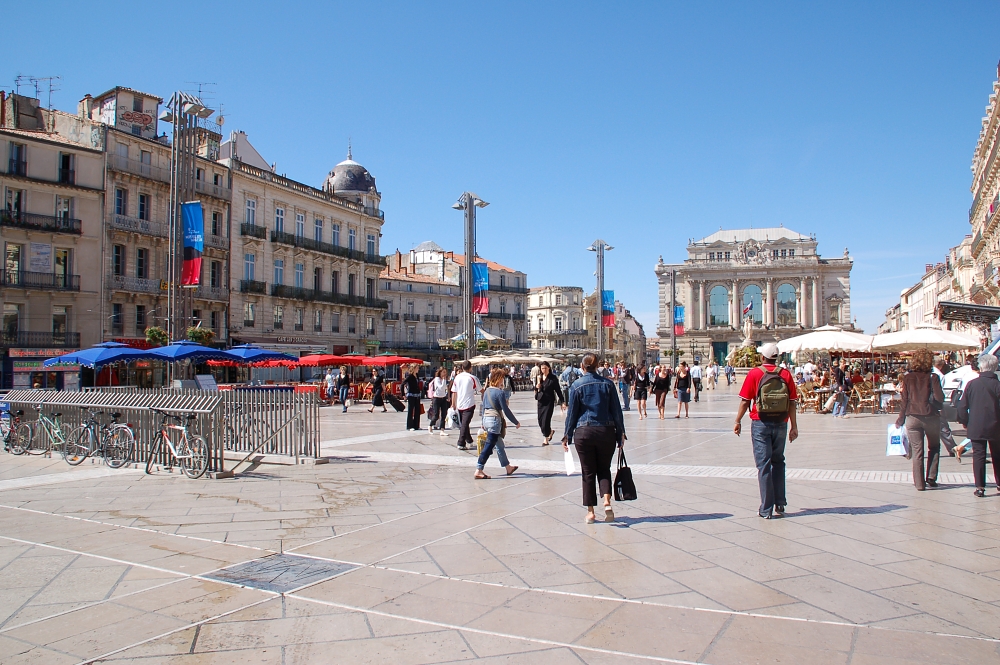
Place de la Comédie is the grand civic heart of Montpellier, ringed by neoclassical buildings and the ornate Opéra Comédie. It is in Montpellier, France. Most visitors spend 30–45 min here. The free Lokali audio guide runs 5 minutes.
✓ Verified August 2026 · how we write these guides
Visitor facts
| Time needed | 30–45 min |
|---|---|
| Lokali audio guide | 5 min · free |
| Type | Square |
| Best for | Editors' pick |
| Location | Montpellier, France |
| Coordinates | 43.6108, 3.8767 |
| Languages | 45, in the Lokali app |
The story
Walk into the open square and feel the space widen around you. The ground is smooth pale stone, polished by countless feet. Cafes spread their tables along the edges. People cross in every direction, in no hurry. This is the Place de la Comedie, the great central square of Montpellier, and for many visitors it is where the city truly begins.
The square is large, covering some eighteen thousand square meters. That size makes it one of the biggest pedestrian spaces in Europe. No cars cross it. The whole expanse belongs to people on foot. Stand near the middle and turn slowly in a circle. The buildings frame the sky, and the openness gives the heart of the city room to breathe. On a sunny day the whole square seems to fill with light.
Local people have a fond nickname for this place. They call it the egg, because of its rounded, oval shape. Once you know this, you start to see it everywhere. The square is not a sharp rectangle but a gentle curve, a smooth shell of stone. The name is old, and it has stuck through many changes to the buildings around it.
The story of the square began around 1755. Before that, the city's old fortifications stood on this ground. As Montpellier grew and felt safer, the heavy walls came down. In their place rose this grand open space, a symbol of the city's wealth and confidence in the eighteenth and nineteenth centuries. Prosperity, not defense, shaped what you see today.
Many of the buildings around the edge share a single elegant style. Their facades echo the grand boulevards of Paris, with tall windows and ordered stone fronts. The effect is calm and unified. Your eye is not pulled in a dozen directions. Instead the whole rim of the square works together, like a single room with the sky for a ceiling.
At one end stands the opera house, the Opera Comedie. It is an Italian-style theater that opened in 1888. Look up at its grand front, with its columns and carved details. This building holds a small surprise in its history. It was the first public building in Montpellier to use electric light, and from here the new lighting slowly spread across the city. Imagine the wonder of those first bright evenings.
Now find the fountain near the center, the Fountain of the Three Graces. The three figures stand together in white marble, calm and graceful. They represent three goddesses from ancient myth, linked to splendor, joy, and good cheer. The sculptor Etienne d'Antoine created the work in 1773. For many years it has been a favorite meeting point in the city.
There is a twist worth knowing about these three figures. The version you see in the open square is a careful replica, placed here in 1989. The original marble was growing fragile in the open weather. To protect it, the city moved it indoors. The true, older statue now rests inside the opera house, sheltered from the rain and sun.
The statue has wandered over the years. It was first set up in 1797, and since then it has moved more than once around the city. Each move tells a small story of changing taste and changing streets. Today the graceful copy holds the central spot, while the fragile original keeps quiet watch from within the theater walls nearby.
Take a seat at one of the cafes and order a coffee. From a chair at the edge, the whole square becomes a slow show. Watch how people meet, embrace, and part. Watch children chase pigeons across the stone. The Place de la Comedie is not a place to rush through. It is a place to sit and simply observe. Order a coffee, lean back, and let an hour pass without a plan.
As the day turns to evening, the square changes again. The light softens and the stone glows warm. Streetlamps come on around the rim. Musicians sometimes play, and their notes drift across the open space. The same ground that once held city walls now holds music and laughter. Few places show so clearly how a city can change its purpose. What once kept enemies out now draws friends together.
Before you leave, stand once more at the center, beside the three calm figures. Feel the size of the space and the steady movement around you. This square has been the meeting place of Montpellier for more than two centuries. Whatever brought you here, you are now part of its long, daily gathering. Then choose a street, and walk on.
Key facts
What to look for
Practical tips
Common questions
How long do you need at Place de la Comédie?
Plan 30–45 min. That is the time most visitors spend at Place de la Comédie. The free Lokali audio guide adds about 5 minutes of narration you can listen to as you walk, so it fits inside your visit rather than adding to it.
Is there a free audio guide to Place de la Comédie?
Yes — the Lokali app narrates Place de la Comédie free of charge in 50+ languages. It covers the history, what to look for on site and practical tips, and it works offline once downloaded.
Where is Place de la Comédie?
Place de la Comédie is in Montpellier, France, at 43.6108, 3.8767. Tap the map link on this page for directions from where you are.
What should you know before visiting Place de la Comédie?
Take a café table to watch the crowd.
What is Place de la Comédie known for?
Square laid out around 1755 over old fortifications.
What is the best time to visit Place de la Comédie?
Arrive at dusk when the square's cream-coloured facades glow warm.
On the map
Opens directions to Place de la Comédie from your location.
Reference
More to see in Montpellier

Hear Place de la Comédie in your language
The full story, narrated, in 50+ languages. Download it before you go and it plays offline, at your own pace, with no ticket and no tour group.