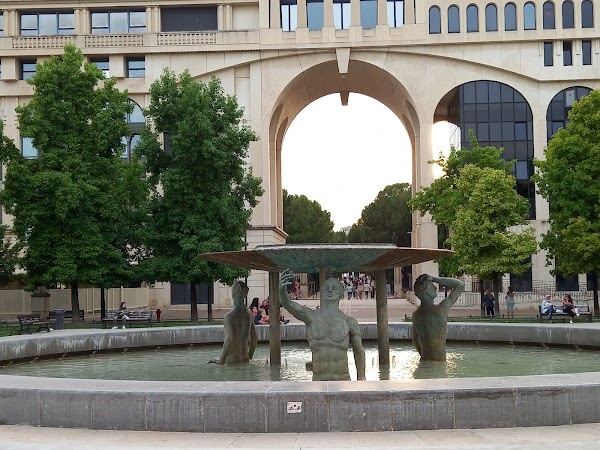
Quartier Antigone
43.5974° N · 3.8892° E · Neighborhood
Quartier Antigone is a postmodern residential and commercial quarter designed by Ricardo Bofill in the 1980s, featuring pastel-coloured buildings, columned arcades, and geometric plazas. It is in Montpellier, France. Most visitors spend 40–50 min here. The free Lokali audio guide runs 5 minutes.
✓ Verified August 2026 · how we write these guides
Visitor facts
| Time needed | 40–50 min |
|---|---|
| Lokali audio guide | 5 min · free |
| Type | Neighborhood |
| Best for | Local life |
| Location | Montpellier, France |
| Coordinates | 43.5974, 3.8892 |
| Languages | 45, in the Lokali app |
The story
Stand at the edge of Antigone and look down its long central line. The pale stone stretches away from you, warm in the southern sun. Columns rise on either side in steady rows. Pediments crown the rooftops far ahead. The scale feels larger than ordinary life, and that is exactly what the architect intended. Take a slow breath and let your eye travel the full length before you walk.
This district sits just east of Montpellier's old center. It rises on ground that once held the Joffre military barracks. For many years, soldiers drilled here behind high walls, closed off from the town. Then the city chose to grow toward the river Lez, and this old military land became the route. Where there were once gates and fences, there is now a wide public stage open to everyone.
The plan came from a Catalan architect named Ricardo Bofill. He began the design in 1978. The mayor of that time, Georges Freche, wanted something bold for Montpellier, a gesture that would carry the city into the future. Bofill answered with the columns and arches of the ancient world, built far larger than anyone expected. He did not copy antiquity quietly. He made it loud.
Construction started in 1983. Over the following years the district spread across about thirty-six hectares. That makes it one of the largest single projects Bofill's studio ever completed in France. Walk it from one end to the other and you feel that size in your legs and your eyes. The axis simply keeps going, square after square, like a piece of music repeating its theme.
Look closely at the buildings around you. The pediments, the pilasters, and the heavy cornices all come from classical architecture. Bofill took these old shapes and enlarged them to a giant scale. Apartments hide behind facades that look like temples. Ordinary family homes wear the dress of palaces. A balcony here may belong to someone's kitchen, even though it sits within a grand colonnade.
The whole layout follows a system of proportion called the golden ratio. The widths of the squares, the spacing of the streets, and the details of the facades all answer to it. You may not notice the mathematics directly as you walk. But the sense of balance is there, quietly guiding your eye from one point to the next. Order is the hidden rule of this place.
As you move along the axis, watch for the sculptures. Antigone holds copies of famous works from Greece and Rome. There is a version of the Victory of Samothrace, her stone wings spread wide. There is the Discobolus, the discus thrower, caught forever mid-turn. These figures place you among echoes of the ancient world, set down in the middle of a modern neighborhood.
The materials reward a slow and patient look. Much of the surface is precast concrete, carefully shaped and colored to suggest warm cut stone. Run your eye along a single column from its base to its top. The illusion is deliberate and skilled. Bofill wanted the district to feel timeless, as if it had always stood here, rather than new and raw.
When Antigone first appeared, not everyone admired it. Some found it strange, even theatrical, too much like a film set. But over time the district won people over. Families moved into the apartments. Cafes opened under the shaded arcades. Children learned to cross these squares on their way to school. The grand stage slowly became a place of simple daily life.
Keep walking east and the central axis leads you toward the river. At the far end stands a large curved building that frames the water and the open sky beyond. Turn around, and the same straight line runs back toward the old city and the covered shopping center. The district was built to join those two worlds, the medieval core and the modern riverside.
In 2018 part of Antigone received a national label for remarkable contemporary architecture. It was a clear sign that the early doubt had turned, over the decades, into respect. What once seemed like a risky experiment now counts among the city's notable modern spaces. People come simply to walk it and to photograph its long, theatrical views.
Stand still for a moment before you move on. Listen to the footsteps on the stone and the soft murmur of the squares. This is a place that borrowed the language of empires in order to house ordinary days. In that quiet meeting of the grand and the simple, Antigone settles into its own steady calm. Then walk on, and let the columns carry you forward.
Key facts
What to look for
Practical tips
Common questions
How long do you need at Quartier Antigone?
Plan 40–50 min. That is the time most visitors spend at Quartier Antigone. The free Lokali audio guide adds about 5 minutes of narration you can listen to as you walk, so it fits inside your visit rather than adding to it.
Is there a free audio guide to Quartier Antigone?
Yes — the Lokali app narrates Quartier Antigone free of charge in 50+ languages. It covers the history, what to look for on site and practical tips, and it works offline once downloaded.
Where is Quartier Antigone?
Quartier Antigone is in Montpellier, France, at 43.5974, 3.8892. Tap the map link on this page for directions from where you are.
What should you know before visiting Quartier Antigone?
Walk the full central axis from city to river.
What is Quartier Antigone known for?
Designed by Catalan architect Ricardo Bofill from 1978.
What is the best time to visit Quartier Antigone?
Walk through in late morning when the arcades cast sharp shadows and the colour palette—peach, blue, ochre—feels intentional rather than whimsical.
On the map
Opens directions to Quartier Antigone from your location.
Reference
More to see in Montpellier


Hear Quartier Antigone in your language
The full story, narrated, in 50+ languages. Download it before you go and it plays offline, at your own pace, with no ticket and no tour group.