Promenade du Peyrou
43.6140° N · 3.8797° E · Viewpoint
Promenade du Peyrou is a broad elevated terrace and gardens built in the 17th century, commanding views across Montpellier to the Cévennes mountains. It is in Montpellier, France. Most visitors spend 45–60 min here. The free Lokali audio guide runs 5 minutes.
✓ Verified August 2026 · how we write these guides
Visitor facts
| Time needed | 45–60 min |
|---|---|
| Lokali audio guide | 5 min · free |
| Type | Viewpoint |
| Best for | Photography |
| Location | Montpellier, France |
| Coordinates | 43.6140, 3.8797 |
| Languages | 45, in the Lokali app |
The story
Climb the last steps and the view opens suddenly before you. You stand on a wide stone terrace, high above the rooftops of Montpellier. The wind moves a little freer up here. On a clear day the land rolls away toward distant hills, and sometimes toward the sea. This is the Promenade du Peyrou, the high garden terrace at the western edge of the old city.
The promenade was first laid out in 1689. From the beginning it was meant as a grand walk, a place where the people of the city could stroll and take the air. Its terraces step down the slope in calm, ordered levels. Even now, more than three centuries later, that simple purpose holds. People come here to walk slowly and to breathe. On warm evenings the whole terrace fills with the soft sound of footsteps.
At the entrance stands Montpellier's own triumphal arch, the Porte du Peyrou. It was built in 1691, designed by the architect Francois d'Orbay, who had worked on the great palace of Versailles. The arch is heavy and proud. In 1715, carved panels were added to its stone, showing scenes that glorified the long reign of King Louis the Fourteenth.
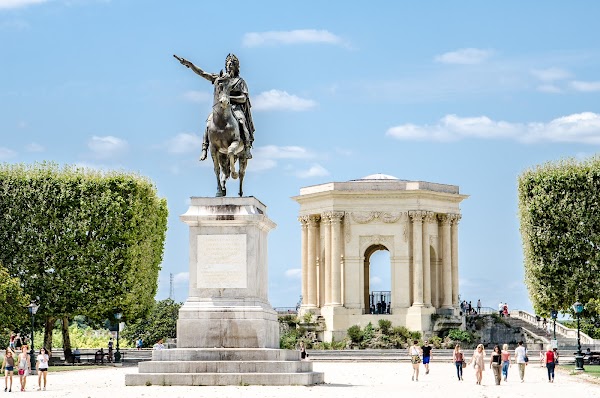
Walk through the arch and toward the center of the terrace. There you will find a bronze figure on horseback, the equestrian statue of Louis the Fourteenth. The king sits calm and commanding above the crowd. The statue was raised here in 1718, a clear sign of royal power set at the high point of the city for all to see.
This statue, however, has a dramatic past. During the French Revolution, on the first of October, 1792, the figure was pulled down. It was broken into pieces and sent away to Lyon, where the metal was melted to make cannon. For about half a century, the empty base waited. The proud king was simply gone from his hilltop.
The statue you see now is a later replacement. It was quietly set in place on the twenty-ninth of August, 1838, after that long absence. The return was handled with care, in calmer times. Stand before the horse and rider and remember that this bronze is a second act, a restoration of an image that the city once tore down in anger.
Now walk to the far end of the terrace, where an elegant little building waits. This is the water tower, a graceful stone pavilion ringed with columns. It is not just decoration. It marks the end of a long aqueduct that carried fresh water into the city, supplying the many fountains in the streets below. Beauty and use meet in one structure. The pavilion looks like a small temple, yet it served a very practical need.
Look out beyond the water tower and you can trace the line of the aqueduct itself. Its tall arches march across the low ground toward the horizon. The Saint-Clement aqueduct carries water from a source about fourteen kilometers away. Work on it began in 1753. The double row of arches is one of the finest sights at the Peyrou.
The garden reached its finished form in 1774, completed by the architect Jean Giral. That year also marked the start of a new reign in France. So the terrace, in its final shape, sits at a hinge of history. It was built to honor one age of kings, even as another was quietly beginning to slip away.
Take a slow walk along the upper level now. The plane trees give patches of shade. Benches line the path, inviting you to rest. Below, the city spreads out in tiled roofs and church towers. This is one of the best places in Montpellier to understand how the old town sits within its landscape, gathered on its gentle hill. From up here the church towers seem close enough to touch.
On many days the Peyrou is calm and unhurried. Couples walk arm in arm. Older residents sit and talk in the shade. Sometimes a market or a small event fills part of the terrace with voices. But even then the place keeps its dignity. It was built for the long, easy walk, and that spirit has never quite left it.
Before you go, find a spot at the railing and look out one last time. Feel the open air and the long view. Behind you stand the arch, the king, and the quiet water tower. Below you lies the city they were built to crown. The Promenade du Peyrou has watched over Montpellier for centuries, and for a moment, now, it lets you watch too. Take that wide view with you as you head back down into the streets.
Key facts
What to look for
Practical tips
Common questions
How long do you need at Promenade du Peyrou?
Plan 45–60 min. That is the time most visitors spend at Promenade du Peyrou. The free Lokali audio guide adds about 5 minutes of narration you can listen to as you walk, so it fits inside your visit rather than adding to it.
Is there a free audio guide to Promenade du Peyrou?
Yes — the Lokali app narrates Promenade du Peyrou free of charge in 50+ languages. It covers the history, what to look for on site and practical tips, and it works offline once downloaded.
Where is Promenade du Peyrou?
Promenade du Peyrou is in Montpellier, France, at 43.6140, 3.8797. Tap the map link on this page for directions from where you are.
What should you know before visiting Promenade du Peyrou?
Come for sunset views over the city.
What is Promenade du Peyrou known for?
Promenade first laid out in 1689.
What is the best time to visit Promenade du Peyrou?
Walk the length at late afternoon when light softens the stone and the city spreads below in gold.
On the map
Opens directions to Promenade du Peyrou from your location.
Reference
More to see in Montpellier


Hear Promenade du Peyrou in your language
The full story, narrated, in 50+ languages. Download it before you go and it plays offline, at your own pace, with no ticket and no tour group.