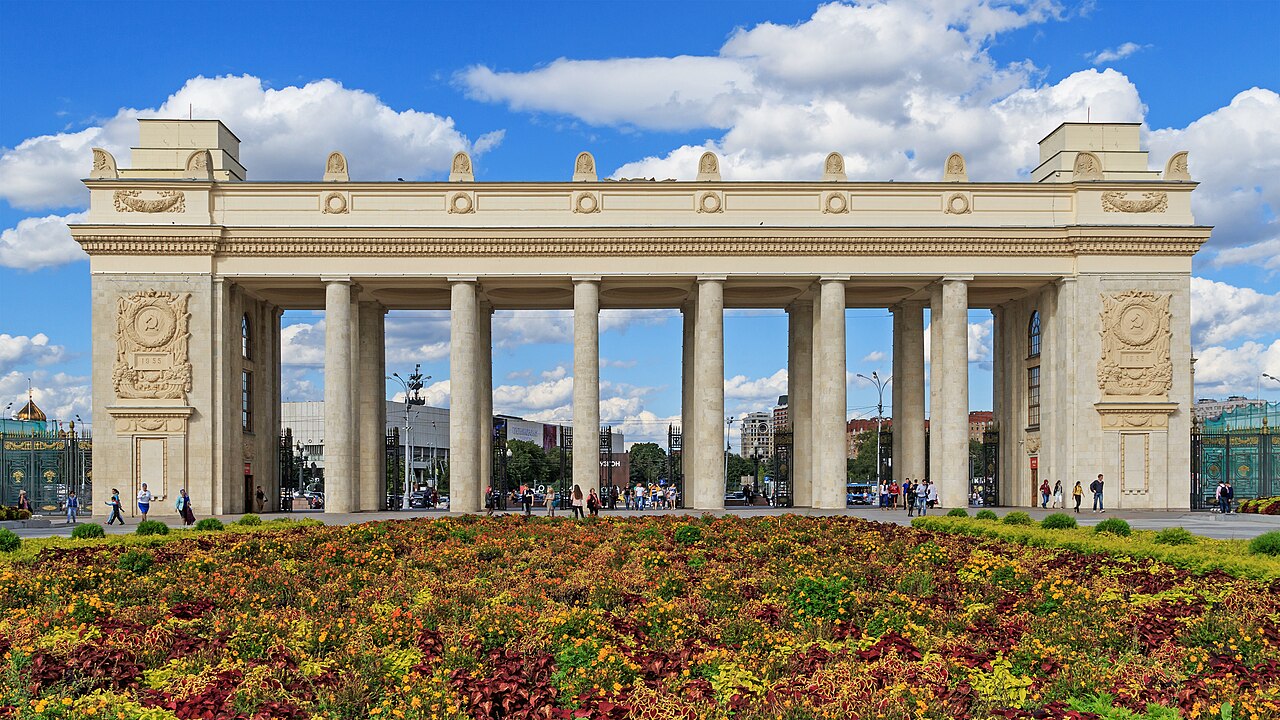
Gorky Park is a park in Moscow, Russia. Opened in 1928 as Soviet Union's first recreation park. Named after writer Maxim Gorky in the early Soviet period. Most visitors spend 1-2 hours here. The free Lokali audio guide runs 6 minutes.
✓ Verified October 2026 · how we write these guides
Visitor facts
| Time needed | 1-2 hours |
|---|---|
| Lokali audio guide | 6 min · free |
| Type | Park |
| Best for | Families |
| Location | Moscow, Russia |
| Coordinates | 55.7304, 37.6019 |
| Languages | 45, in the Lokali app |
The story
The crunch of gravel underfoot, the low hum of conversation in a dozen languages, the scent of linden trees in summer or the sharp bite of frost in winter — Gorky Park announces itself through the senses before you even see the grand entrance gates. This is Moscow's green lung, a ribbon of parkland stretching along the Moskva River, where locals and visitors alike come to breathe, to skate, to argue over chess, to simply exist away from the density of the city.
The park opened in 1928, one of the Soviet Union's first purpose-built recreation grounds. It was named after Maxim Gorky, the writer whose stories of working-class life aligned neatly with the ideology of the new state. The original vision was bold — a People's Park, a laboratory for collective leisure, where citizens could row on the river, attend open-air concerts, ride fairground attractions, and absorb culture in carefully curated doses. For decades, it delivered exactly that: a place where Young Pioneers marched in formation, where propaganda loudspeakers mixed with the screech of roller coasters, where the state's vision of joyful socialism played out in real time.
By the late Soviet years, Gorky Park had settled into a kind of shabby comfort — peeling paint on the rides, overgrown flowerbeds, a faint sense of neglect. The nineteen-nineties brought chaos: makeshift beer tents, unlicensed vendors, a Wild West atmosphere that mirrored the country's broader upheaval. Then, in 2011, the city undertook a radical redesign. Out went the rusting carousels and concrete eyesores. In came clean pathways, outdoor yoga, free Wi-Fi, contemporary art installations, and a skating rink that in winter becomes one of Europe's largest. The transformation was controversial — some mourned the loss of Soviet kitsch, others celebrated the arrival of breathable, world-class public space.
Today, the park runs for nearly three kilometres along the river, broken into distinct zones. Near the main entrance, broad alleys lined with benches and food kiosks give way to open lawns where people picnic, play volleyball, or simply sprawl in the sun. In summer, the Neskuchny Garden at the southern end offers shade under ancient oaks, and the air smells of damp earth and river water. In winter, the central pond freezes into a vast skating surface, and the park fills with the scrape of blades on ice, the glow of string lights, the steam rising from cups of mulled wine.
The Garage Museum of Contemporary Art sits at the park's heart, a white Brutalist structure renovated by Rem Koolhaas. It is one of Russia's most ambitious contemporary art venues, hosting exhibitions that range from Russian avant-garde retrospectives to cutting-edge international installations. Even if you do not step inside, the building itself — all clean lines and industrial materials — signals the park's current identity: post-Soviet, cosmopolitan, unapologetically modern.
Walk south from the museum and you reach the Neskuchny Garden, the oldest section of the park. This was once the private estate of a nineteenth-century industrialist, and it retains a wilder, more intimate character — narrow paths, overgrown hedges, the crumbling remains of a small palace. In summer, theatre troupes perform here, and the sound of actors' voices drifts through the trees. The garden feels like a secret, even though thousands pass through it every week.
The riverbank is where the park breathes widest. In warm months, paddleboards and kayaks dot the water, and the embankment fills with runners, cyclists, and couples leaning against the railing to watch the sun set behind the city skyline. In winter, the river steams in the cold, and the embankment becomes a wind tunnel — bundle up if you walk it then.
Gorky Park is not a museum, not a monument. It is a living, working space, shaped and reshaped by the people who use it. On any given afternoon, you will see teenagers skateboarding near the entrance, elderly women feeding sparrows, office workers eating lunch on the grass, tourists photographing the Shukhov Tower visible in the distance. The park absorbs all of it without fuss.
The best times to visit depend on what you want. Summer weekends are crowded but electric — live music, outdoor film screenings, pop-up markets. Weekday mornings are quieter, almost meditative. Winter evenings, when the skating rink glows under lights and the air smells of roasted chestnuts, carry a particular magic. Spring and autumn offer the park at its most painterly — cherry blossoms in April, golden leaves in October, the light slanting low through the trees.
As you leave, notice the rhythm of the place. The way people move through it, the way the park adapts to the season, the way it holds space for a city of twelve million without collapsing under the weight. Gorky Park is not trying to be anything other than what it is — a place to pause, to breathe, to remember that cities need emptiness as much as they need buildings.
Key facts
What to look for
Practical tips
Common questions
How long do you need at Gorky Park?
Plan 1-2 hours. That is the time most visitors spend at Gorky Park. The free Lokali audio guide runs 6 minutes and is made to listen to while you walk.
Is there a free audio guide to Gorky Park?
Yes — the Lokali app narrates Gorky Park free of charge in 50+ languages. No ticket, tour group or subscription, and it works offline once downloaded.
Where is Gorky Park?
Gorky Park is in Moscow, Russia, at 55.7304, 37.6019. Tap the map link on this page for directions.
What should you know before visiting Gorky Park?
Visit weekday mornings for quieter, more meditative atmosphere
What is Gorky Park known for?
Opened in 1928 as Soviet Union's first recreation park
What is the best time to visit Gorky Park?
Visit weekday mornings for quieter, more meditative atmosphere
On the map
Opens directions to Gorky Park from your location.
More to see in Moscow


Hear Gorky Park in your language
The full story, narrated, in 50+ languages. Download it before you go and it plays offline, at your own pace, with no ticket and no tour group.