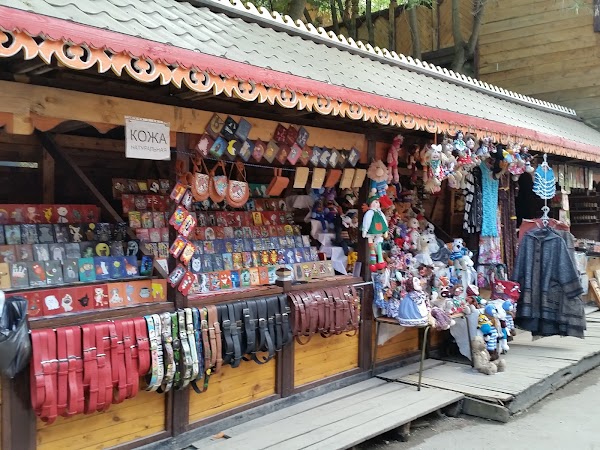
Izmailovsky Market is a market in Moscow, Russia. Market began in early two thousands after Soviet collapse. Located near sixteenth-century Romanov hunting estate. Most visitors spend 1-2 hours here. The free Lokali audio guide runs 6 minutes.
✓ Verified October 2026 · how we write these guides
Visitor facts
| Time needed | 1-2 hours |
|---|---|
| Lokali audio guide | 6 min · free |
| Type | Market |
| Best for | Authentic finds |
| Location | Moscow, Russia |
| Coordinates | 55.7965, 37.7515 |
| Languages | 45, in the Lokali app |
The story
The air smells of varnished wood and old wool, a faint metallic tang of brass mixing with the earthy scent of aged paper. Izmailovsky Market spreads before you in a riot of color and texture — striped awnings, stacked matryoshka dolls in descending rows, Soviet badges glinting under canvas roofs. This is Moscow's largest flea and souvenir market, a sprawling open-air bazaar that feels part theatre set, part archaeological dig through twentieth-century Russia.
The market sits near the grounds of the old Izmailovo Estate, a royal hunting lodge that once belonged to the Romanov tsars. The estate itself dates back to the sixteenth century, though the market is a much younger invention — it began in the early two thousands, after the Soviet collapse left thousands of families selling heirlooms to make ends meet. What started as a desperate Sunday scramble evolved into this permanent bazaar, a place where nostalgia became commerce and the past turned into something you could carry home in a canvas bag.
Walk deeper and the stalls multiply into a labyrinth. Vendors sit behind tables piled with military medals, enamel pins bearing Lenin's profile, vintage cameras with cracked leather cases. You will find hand-painted lacquer boxes from Palekh, their lids depicting fairy tales in miniature — firebirds and snow maidens rendered in gold leaf on black. Nearby, a seller unfolds Soviet-era propaganda posters, their bold red graphics still sharp after decades rolled in a basement. Much of it is genuine, some of it skillfully aged reproductions. The line between artifact and replica blurs here, and most vendors will tell you honestly which is which if you ask.
The market's architecture leans into fantasy. Wooden towers with onion domes rise at intervals, painted in cheerful blues and greens, their carved eaves mimicking the traditional Russian teremok style — fairy-tale cottages blown up to market-hall scale. These structures were built deliberately whimsical, a kind of theme-park Russianness designed to frame the goods. It works. The effect is less authentic historical quarter, more a stage set where the props happen to be real.
Among the matryoshkas and amber jewelry, you will stumble on odder finds. A entire stall devoted to vintage gramophones, their brass horns tarnished to a soft green. Another selling only samovars, the ornate tea urns stacked three high, some still bearing dents from decades of use. There are fur hats in every style — ushankas with red stars, Cossack papakhas in black sheepskin, even a few moth-eaten bearskins that look like they walked out of a Tolstoy novel. The vendors are often the original owners or their children, and if you show genuine interest, stories spill out — a medal earned in the war, a camera smuggled from East Germany, a samovar that survived the siege of Leningrad.
The market is busiest on weekends, when tour buses unload and the aisles thicken with visitors. Weekday mornings are quieter, the vendors more willing to talk, the haggling slower and friendlier. Prices are negotiable almost everywhere — the first number quoted is rarely the final one. Even if you are not buying, the rhythm of the place rewards wandering. You will hear a dozen languages in ten minutes, smell roasting nuts from a corner cart, watch a babushka in a floral headscarf rearrange her display of Soviet children's books with the care of a museum curator.
Not everything here is old. Craftspeople sell new work alongside the antiques — hand-carved wooden spoons, embroidered linens, painted eggs in the Fabergé style. A few stalls specialize in amber from the Baltic coast, the stones ranging from pale honey to deep cognac, some with insects frozen mid-flight inside. The quality varies wildly. If you are serious about a purchase, take your time, compare across vendors, and do not be shy about inspecting the goods closely. The sellers expect it.
Beyond the main market halls, smaller sections sprawl into adjacent lots. One corner is dedicated entirely to military surplus — helmets, gas masks, belt buckles stamped with hammers and sickles. Another focuses on religious icons, both antique and freshly painted, the saints gazing out from gold-leaf backgrounds with expressions of serene melancholy. A third area sells musical instruments — balalaikas with triangular bodies, accordions that wheeze softly when a vendor demonstrates a tune. The market has no fixed map, and sections shift with the seasons, but that is part of the charm. Getting lost here is the point.
The light changes as the day wears on. Morning sun slants low through the awnings, casting long shadows across the cobblestones. By afternoon, the market takes on a warmer glow, the wood and brass catching the light, the colors deepening. If you are here in winter, snow dusts the domes and the vendors huddle in thick coats, their breath visible in the cold air. The market stays open year-round, though the crowds thin dramatically when temperatures drop below freezing.
As you make your way toward the exit, the noise of the market softens behind you — the haggling voices, the clink of metal on metal, the rustle of paper and fabric. You are left with the weight of whatever you have chosen to carry away, and the quiet sense that you have walked through a museum where everything is for sale and nothing is quite what it seems. The past here is not preserved behind glass. It is handled, bartered over, wrapped in newspaper, and taken home.
Key facts
What to look for
Practical tips
Common questions
How long do you need at Izmailovsky Market?
Plan 1-2 hours. That is the time most visitors spend at Izmailovsky Market. The free Lokali audio guide runs 6 minutes and is made to listen to while you walk.
Is there a free audio guide to Izmailovsky Market?
Yes — the Lokali app narrates Izmailovsky Market free of charge in 50+ languages. No ticket, tour group or subscription, and it works offline once downloaded.
Where is Izmailovsky Market?
Izmailovsky Market is in Moscow, Russia, at 55.7965, 37.7515. Tap the map link on this page for directions.
What should you know before visiting Izmailovsky Market?
Visit weekday mornings for quieter browsing and better conversations
What is Izmailovsky Market known for?
Market began in early two thousands after Soviet collapse
What is the best time to visit Izmailovsky Market?
Visit weekday mornings for quieter browsing and better conversations
On the map
Opens directions to Izmailovsky Market from your location.
More to see in Moscow


Hear Izmailovsky Market in your language
The full story, narrated, in 50+ languages. Download it before you go and it plays offline, at your own pace, with no ticket and no tour group.