
Kropotkinskaya Metro Station
55.7453° N · 37.6037° E · Tourist Attraction
Photo: A.Savin · FAL · Wikimedia Commons
Kropotkinskaya Metro Station is a Moscow Metro station. Opened in 1935 on Moscow's first metro line. The free Lokali audio guide runs 7 minutes.
✓ Published October 2026 · how we write these guides
Visitor facts
| Lokali audio guide | 7 min · free |
|---|---|
| Type | Tourist Attraction |
| Location | Moscow, Russia |
| Coordinates | 55.7453, 37.6037 |
| Languages | 50+, in the Lokali app |
The story
Stand still on the platform for a moment. Feel the cool air move past as a train pulls away into the tunnel. The noise fades, and the hall goes quiet. Look up. There are no chandeliers here and no hanging lamps. Instead, a soft, even glow spreads across the vaulted ceiling. It seems to come from nowhere at all. This is Kropotkinskaya, one of the oldest stations of the Moscow Metro. Its light is the first thing to understand.
Look at the tops of the columns. Each column widens as it rises, opening like the head of a flower or the capital of an ancient temple. Hidden inside those flared tops are the lamps. Their light shines upward, hits the pale ceiling, and falls back down onto the platform. The design hides the light source completely. Most people walk straight through without noticing how the trick works. Now that you know, you will see it in every glance upward.
The station opened in 1935, as part of the very first line of the Moscow Metro. That line is the one shown in red on today's maps. It ran under the centre of the city and carried the hopes of a young Soviet state. The metro was meant to be more than transport. It was a public statement. Ordinary workers would ride to their jobs through halls finished like palaces. Kropotkinskaya was one of the first of those halls.
The architects were Alexei Dushkin and Yakov Lichtenberg. Dushkin later became one of the most respected names in Soviet metro design. He went on to create other well-known stations in this system. Here, at the start of his career, his approach was already clear. He used few decorations, clean lines, and careful control of light. The result feels calm rather than crowded. Compared with some later stations full of mosaics and bronze, this hall is restrained.
The station did not always carry this name. When it opened, it was called Dvorets Sovetov, which means Palace of Soviets. The name pointed to a building that was supposed to rise just above your head. That building was planned as the tallest structure in the world, crowned by an enormous statue of Lenin. The station was designed as its grand underground entrance. It was a doorway to a future that the city expected to see within a few years.
To make room for that palace, something had to go first. On the site stood the Cathedral of Christ the Saviour, a huge Orthodox church built in the nineteenth century. In 1931, the authorities demolished it with explosives. Work on the foundations of the new palace began. Then came delays, design changes, and finally the Second World War. Steel from the site was reportedly taken for wartime needs. The palace was never built. The station kept its hopeful name for many years anyway.
In 1957, the station was renamed Kropotkinskaya. The new name honours Peter Kropotkin, a nineteenth-century thinker who was born in Moscow. Here is the surprise. Kropotkin was a prince by birth, from an old noble family. Yet he became one of the best-known anarchists in the world. He argued that cooperation, not competition, drives the success of living things. He spent decades in exile in Western Europe before returning to Russia late in his life.
The nearby street was also named after Kropotkin during the Soviet period. In the early 1990s, that street went back to its older name, Prechistenka. Many Moscow stations changed their names in those years too. This one did not. So today the station carries the name of a street that no longer uses it. That small mismatch is a quiet record of how the city layers its history. One name changes, and another stays behind.
Look down at the columns again, closer this time. They are faced with light marble, cool and smooth to the touch. The surfaces are faceted rather than perfectly round, so the light falls differently on each face. Notice how the platform feels wide and open. The station sits fairly close to the surface, not deep underground. Because of that, the ceiling does not have to carry a heavy load. That allowed the architects to keep the hall light and airy.
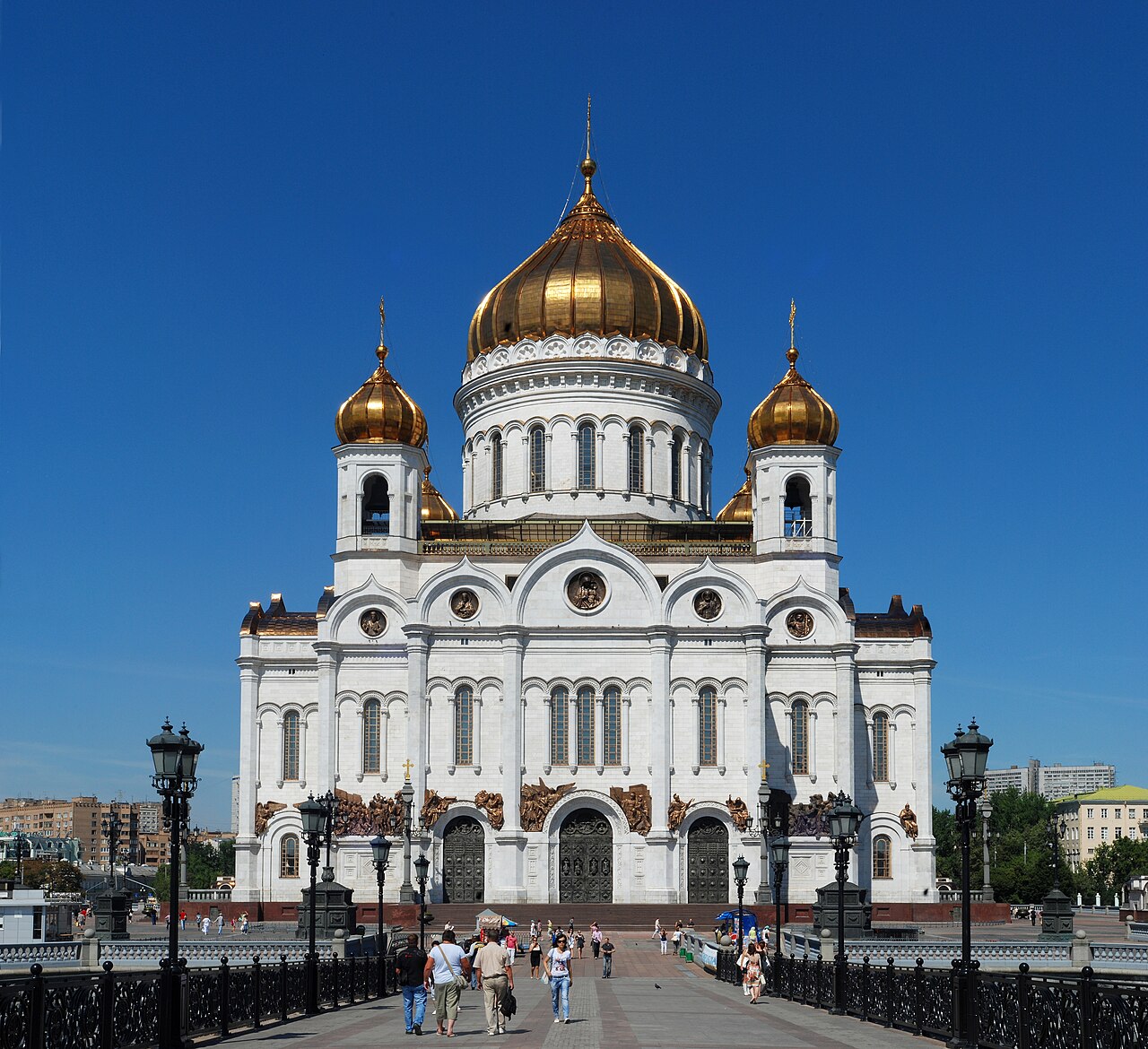
When you go up to the street, the story above ground continues. Close to the station, the Cathedral of Christ the Saviour stands again. After the palace project died, the empty foundation pit became a large open-air swimming pool called Moskva. For decades, Muscovites swam there all year round, even in winter, with steam rising off the heated water. In the 1990s, the pool was closed, and the cathedral was rebuilt on its original site.
Think about that sequence for a moment. A cathedral, then a hole for a palace, then a public pool, then a cathedral once more. And beneath it all, this quiet station has stayed almost the same. Trains have run through it through every one of those changes. Few places in Moscow show the turns of the twentieth century so clearly in one small area. The station is a fixed point while the city above kept changing its mind.
The neighbourhood around the exits is worth a walk. Gogolevsky Boulevard begins nearby, a green strip with benches and old trees, part of the ring of boulevards that wraps the old centre. Volkhonka Street leads toward the Pushkin State Museum of Fine Arts, one of the city's major art collections. Prechistenka runs off to the southwest, lined with old mansions. The Kremlin is also within walking distance. This station is a practical starting point for a day on foot.
Before you leave, stand at one end of the platform and look down its full length. Watch the rows of columns repeat into the distance. Notice how the light stays even from one end to the other, with no bright spots and no dark corners. Listen as the next train arrives, the doors open, and the crowd moves. Then the hall empties and goes quiet again. Take one last look at those glowing column tops as you walk toward the stairs.
Key facts
What to look for
Practical tips
Common questions
Is there a free audio guide to Kropotkinskaya Metro Station?
Yes — the Lokali app narrates Kropotkinskaya Metro Station free of charge in 50+ languages. The guide runs about 7 minutes, covers the history, what to look for on site and practical tips, and works offline once downloaded.
Where is Kropotkinskaya Metro Station?
Kropotkinskaya Metro Station is in Moscow, Russia, at 55.7453, 37.6037. Tap the map link on this page for directions from where you are.
What is Kropotkinskaya Metro Station known for?
Opened in 1935 on Moscow's first metro line. Designed by architects Alexei Dushkin and Yakov Lichtenberg.
What should you look for at Kropotkinskaya Metro Station?
Hidden lamps glowing inside the flared column tops. Faceted marble surfaces catching light at different angles. The pale vaulted ceiling reflecting light back down.
What should you know before visiting Kropotkinskaya Metro Station?
Visit outside rush hours to see the hall nearly empty. Stand at a platform end for the longest column view.
On the map
Opens directions to Kropotkinskaya Metro Station from your location.
More to see in Moscow



Hear Kropotkinskaya Metro Station in your language
The full story, narrated, in 50+ languages. Download it before you go and it plays offline, at your own pace, with no ticket and no tour group.