
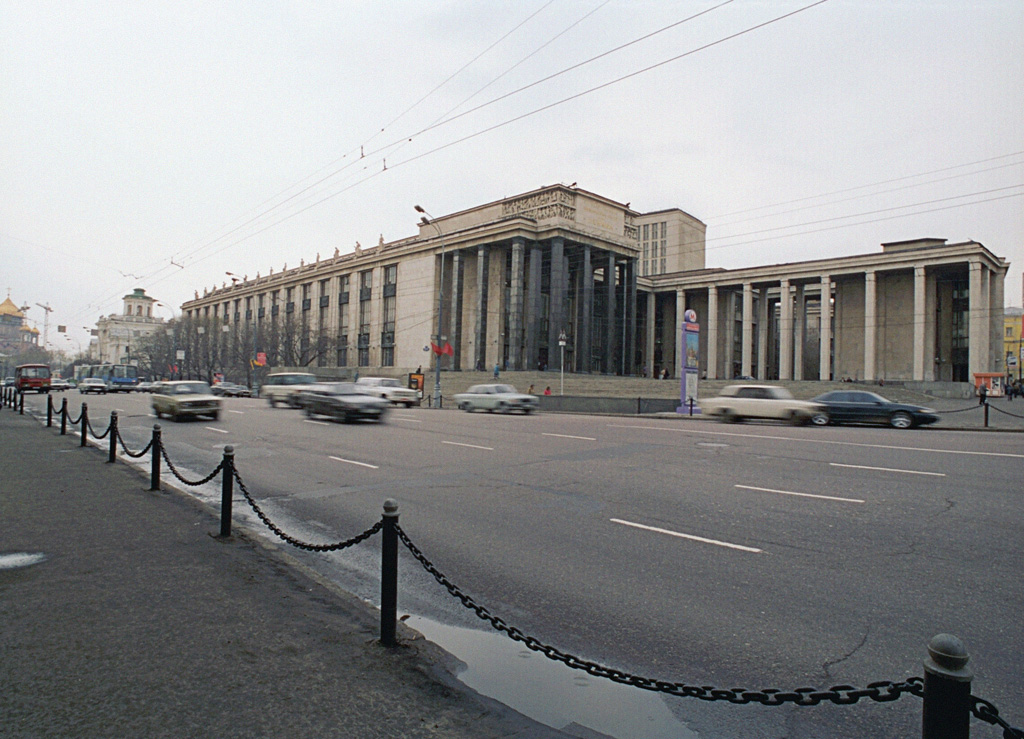
Pushkin State Museum of Fine Arts
55.7470° N · 37.6060° E · Museum
Photo: user:Ghirlandajo · CC BY-SA 3.0 · Wikimedia Commons
Pushkin State Museum of Fine Arts is a museum of European art in Moscow. Opened in 1912 as the Alexander III Museum. The free Lokali audio guide runs 7 minutes.
✓ Published October 2026 · how we write these guides
Visitor facts
| Lokali audio guide | 7 min · free |
|---|---|
| Type | Museum |
| Location | Moscow, Russia |
| Coordinates | 55.7470, 37.6060 |
| Official website | arts-museum.ru |
| Languages | 50+, in the Lokali app |
The story
Stand at the foot of the steps for a moment. Above you, a row of tall white columns holds up a quiet triangle of stone. Behind you, the traffic of Volkhonka Street runs past, and the golden domes of the Cathedral of Christ the Saviour catch the light nearby. The steps are wide and shallow, and the stone underfoot feels cool. The building looks like a Greek temple. In a way, that was the plan.
This is the Pushkin State Museum of Fine Arts. Here is the first surprise. The poet Alexander Pushkin has almost nothing to do with it. He never saw it, never wrote about it, and died decades before its first stone was laid. The museum took his name in 1937, the hundredth anniversary of his death. The name honours Russian culture as a whole. It does not tell you what is inside.
The real father of this building was a scholar named Ivan Tsvetaev. He was a professor of classical art at Moscow University in the late nineteenth century. He had a practical problem. His students studied Greek and Roman sculpture from small photographs and drawings. Most of them would never travel to Athens, Rome or Florence. So Tsvetaev dreamed of bringing those masterpieces to Moscow, at full size, as plaster casts. A teaching museum, open to everyone.
Tsvetaev had an idea, but he needed money. He found it in Yuri Nechaev-Maltsov, a wealthy industrialist whose family fortune came from glass and crystal factories. He paid for a large share of the construction, including the white marble that faces the building. Tsvetaev, meanwhile, spent years writing letters and lobbying officials. The architect was Roman Klein, who also designed other public buildings across Moscow. Together they built something new for the city — a palace for art that ordinary students could enter.
The museum opened in 1912, after many years of work. At first it carried the name of Emperor Alexander the Third. Tsvetaev lived to see the opening, but only just. He died the following year. And here is a detail many visitors miss. His daughter was Marina Tsvetaeva, one of the great Russian poets of the twentieth century. She grew up with this museum as a family project. Later, she wrote with deep feeling about her father and his long struggle to build it.
Now look again at the portico. The columns are Ionic. That means their tops curl into soft spiral scrolls, like rolled paper. Classical Greek temples used this style, and the architect borrowed it on purpose. The building announces its subject before you even open the door. Inside, the halls follow the history of art in order — from ancient Egypt, through Greece and Rome, to medieval Europe and the Renaissance. Walking through it feels like walking through time.
Two rooms show Tsvetaev's original vision most clearly. The first is the Greek Courtyard, filled with plaster copies of ancient sculpture. The second is the Italian Courtyard, built to echo a Renaissance palace. Here you will find a full-size cast of Michelangelo's David. Standing beneath him, you feel the real scale of the statue. The figure rises far above your head. Light falls from the glass roof above, soft and even, much as Klein intended.
It is easy to dismiss plaster casts as copies. But many of these casts are now historic objects in their own right. Some were made more than a century ago, directly from the original stones. Since then, weather, pollution and war have damaged several of those originals. In some cases, a cast here preserves surface detail that the original has lost. The copies have become a kind of memory.
The museum did not stay a hall of copies. Over the twentieth century, real masterpieces arrived. One early treasure was a large Egyptian collection gathered by the scholar Vladimir Golenishchev. It includes painted portraits from the Fayum region of Roman Egypt — faces of real people, painted on wood, looking straight at you across two thousand years. After the Russian Revolution, paintings from great private collections also came here, including Dutch, Italian and French works.
Here is a second surprise, and a dramatic one. For decades, the museum kept a secret in its storerooms. In the 1800s, the German archaeologist Heinrich Schliemann dug at the site he believed was ancient Troy. He found a hoard of gold jewellery and called it the Treasure of Priam. It went to Berlin. At the end of the Second World War, it disappeared. Only in the 1990s did Russia confirm that the gold was here in Moscow. It is now on display, and its ownership is still debated.
One woman shaped the modern museum more than anyone. Irina Antonova became director in 1961 and led the museum for more than fifty years. She brought major international exhibitions to Moscow during the Soviet era, when such loans were rare. With the pianist Sviatoslav Richter, she founded a music festival called December Nights. Concerts still take place among the paintings. If you visit in winter, you may hear a piano somewhere in the halls.
Today the main building is the heart of a wider museum quarter. Nearby buildings hold other parts of the collection, including French Impressionist and Post-Impressionist paintings — works by Monet, Cézanne, Matisse and Picasso. Many of them came from two famous Moscow merchant collectors, Sergei Shchukin and Ivan Morozov. Collections move between buildings and exhibitions change, so it is worth checking which halls are open on the day you visit.
Before you go inside, or as you leave, pause again on these steps. Look up at the scrolls on top of the columns, and the white marble a little grey from city air. Think of Tsvetaev, writing letter after letter, so that a student without money could stand in front of David. The museum still does what he wanted. As you walk away down Volkhonka Street, notice how the classical columns sit among the city's domes and traffic — a small Greek temple, built in Moscow for anyone who climbs the steps.
Key facts
What to look for
Practical tips
Common questions
Is there a free audio guide to Pushkin State Museum of Fine Arts?
Yes — the Lokali app narrates Pushkin State Museum of Fine Arts free of charge in 50+ languages. The guide runs about 7 minutes, covers the history, what to look for on site and practical tips, and works offline once downloaded.
Where is Pushkin State Museum of Fine Arts?
Pushkin State Museum of Fine Arts is in Moscow, Russia, at 55.7470, 37.6060. Tap the map link on this page for directions from where you are.
What is Pushkin State Museum of Fine Arts known for?
Opened in 1912 as the Alexander III Museum. Named after the poet Pushkin only in 1937.
What should you look for at Pushkin State Museum of Fine Arts?
Ionic scrolls curling atop the portico's white columns. Full-size plaster cast of Michelangelo's David. Glass roof softening the light over the courtyards.
What should you know before visiting Pushkin State Museum of Fine Arts?
Start in the Italian Courtyard to feel the David's scale. Check which nearby buildings hold the Impressionist paintings.
On the map
Opens directions to Pushkin State Museum of Fine Arts from your location.
More to see in Moscow


Hear Pushkin State Museum of Fine Arts in your language
The full story, narrated, in 50+ languages. Download it before you go and it plays offline, at your own pace, with no ticket and no tour group.