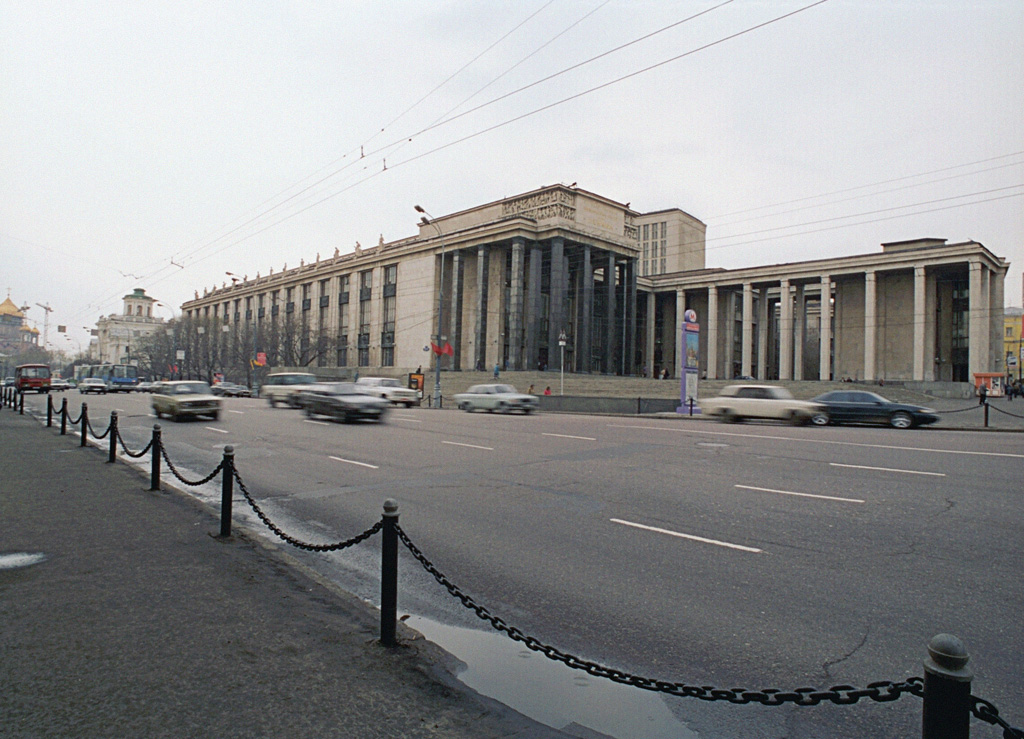
Russian State Library
55.7517° N · 37.6090° E · Tourist Attraction
Photo: Valeriy Shustov / Валерий Шустов · CC BY-SA 3.0 · Wikimedia Commons
Russian State Library is a national public library in Moscow, Russia. Renamed Russian State Library in 1992 after the Soviet era. The free Lokali audio guide runs 7 minutes.
✓ Published October 2026 · how we write these guides
Visitor facts
| Lokali audio guide | 7 min · free |
|---|---|
| Type | Tourist Attraction |
| Location | Moscow, Russia |
| Coordinates | 55.7517, 37.6090 |
| Official website | rsl.ru |
| Languages | 50+, in the Lokali app |
The story
Stand for a moment at the foot of the steps and look up. Dark stone pillars rise in a long, square-cut row. They are tall, plain and close together, like the spines of books on a very large shelf. Traffic runs along the avenue behind you, and the Kremlin walls are only a short walk away. Yet the building in front of you is not a palace or a church. It is a library, and it is one of the largest libraries in the world.
This is the Russian State Library. Many Muscovites still call it by an older, friendlier name: the Leninka. For most of the twentieth century it was the Lenin State Library of the Soviet Union. It received its current name in 1992, after the Soviet Union came to an end. The old name has not fully gone away. The metro station under your feet is still called Biblioteka imeni Lenina, which means the Library named after Lenin.
The story of the library did not start here, and it did not start in Moscow. It began with a private collection in Saint Petersburg. Count Nikolai Rumyantsev was a statesman and a passionate collector in the early nineteenth century. He gathered books, manuscripts, maps, coins and many other objects. After his death, his collection became the Rumyantsev Museum. In 1862 the museum moved from the imperial capital to Moscow, and that move is the true beginning of this library.
In Moscow, the collection needed a home, and it found a very elegant one. Turn and look across the street, up the slope toward the Kremlin. On the hill stands a white neoclassical mansion with a round tower on its roof. This is Pashkov House. It was built in the late eighteenth century for a wealthy family, and its design is often attributed to the architect Vasily Bazhenov. The Rumyantsev collection moved into this house, and the library still uses it today.
Here is a detail that many visitors miss. Pashkov House and the large building in front of you belong to the same institution. Most people take photos of the white mansion as a separate landmark. They do not realise that it is the old heart of the library. The mansion stands on a hill, so it looks toward the Kremlin across the valley. From its terrace, the view of the red walls and golden domes is one of the classic views of central Moscow.
By the early twentieth century, the collection had grown far too large for one mansion. After the 1917 revolution, the new Soviet state wanted a national library that showed its ambitions. A design competition took place in the late 1920s. The architects Vladimir Shchuko and Vladimir Gelfreikh won it. Construction began in the following decade and went on for many years. The building you see now is the result of that long project.
Look carefully at the facade. The style sits between two worlds. The square pillars recall a classical temple, but they have no decorative capitals and no curls of stone. Everything is simplified and made heavy. Above and between the pillars you can find sculpted portraits of scientists and writers. These figures were chosen to show the library as a home for all human knowledge, not only for Russian books. Try to recognise a few faces as you walk along.
Now look past the main facade, toward the back of the complex. A tall, narrow block rises above the rest. It has rows of small windows and almost no decoration. This is the book stack, the storage tower where most of the collection lives. Readers do not walk freely among these shelves. Instead, they order books from the reading rooms, and staff bring the volumes out from the stacks. The tower is, in a sense, the real library. The grand rooms are only its front door.
The size of the collection is hard to imagine. The library holds tens of millions of items. These include books, journals, newspapers, maps, music scores, dissertations and rare manuscripts. For a long time, publishers in the country have sent copies of their work here by law. This is called legal deposit. It means that the shelves grow every single day. A book printed far away in Siberia can end up in this tower, a short walk from the Kremlin.
In front of the main entrance, you will see a seated bronze figure. He leans forward slightly, and his shoulders look tired. This is the writer Fyodor Dostoevsky. The statue was placed here in the late 1990s. Some Muscovites love it, and others find it gloomy. Either way, it fits the place. Dostoevsky wrote long, searching novels about faith, guilt and human freedom. He is a fitting guard for a building full of other people's thoughts.
Here is a second surprise. This library is not only a monument. It is a working library, and it is busy. Students, historians and researchers come here every day to read. Anyone who wants to use the reading rooms needs a reader's card, and the library issues these cards to adult visitors. So the people climbing these steps with laptops and folders are not tourists. They are the regular readers of the Leninka, continuing a habit that is now more than a century old.
The area around the library has its own character. You are at a crossing of old streets. One leads west toward the Arbat district, with its old houses and cafes. Another runs along the Kremlin toward the Manege and Red Square. Below you, several metro lines meet in a large underground hub. All day long, people pour up from the stations and spread out across the square. The library stands at the centre of this movement, calm and still.
It is worth thinking about what this building has seen. It was planned by a young revolutionary state, built through hard decades, and renamed after that state ended. Through all these changes, its main task stayed the same. It collected, stored and lent out the written word. Governments changed its name and its symbols. But the readers kept coming, and the shelves kept filling.
Before you walk on, look once more at the dark pillars and the quiet figure of Dostoevsky. Then glance up the hill at the white mansion with its round tower. Two buildings, two centuries, one library. Somewhere in that tall stack behind the facade, a staff member is probably carrying a book to a reader right now. As you leave, listen to the traffic and the footsteps around you... and remember the silence of the reading rooms inside.
Key facts
What to look for
Practical tips
Common questions
Is there a free audio guide to Russian State Library?
Yes — the Lokali app narrates Russian State Library free of charge in 50+ languages. The guide runs about 7 minutes, covers the history, what to look for on site and practical tips, and works offline once downloaded.
Where is Russian State Library?
Russian State Library is in Moscow, Russia, at 55.7517, 37.6090. Tap the map link on this page for directions from where you are.
What is Russian State Library known for?
Renamed Russian State Library in 1992 after the Soviet era. Grew from Count Nikolai Rumyantsev's private collection.
What should you look for at Russian State Library?
Tall square pillars of dark stone along the main facade. Sculpted portraits of scientists and writers on the facade. Seated bronze Dostoevsky statue in front of the entrance.
What should you know before visiting Russian State Library?
Bring your passport if you want a reader's card. Walk up the slope to see Pashkov House up close.
When is the best time to visit Russian State Library?
Visit on a weekday to see regular readers arriving.
On the map
Opens directions to Russian State Library from your location.
More to see in Moscow


Hear Russian State Library in your language
The full story, narrated, in 50+ languages. Download it before you go and it plays offline, at your own pace, with no ticket and no tour group.