
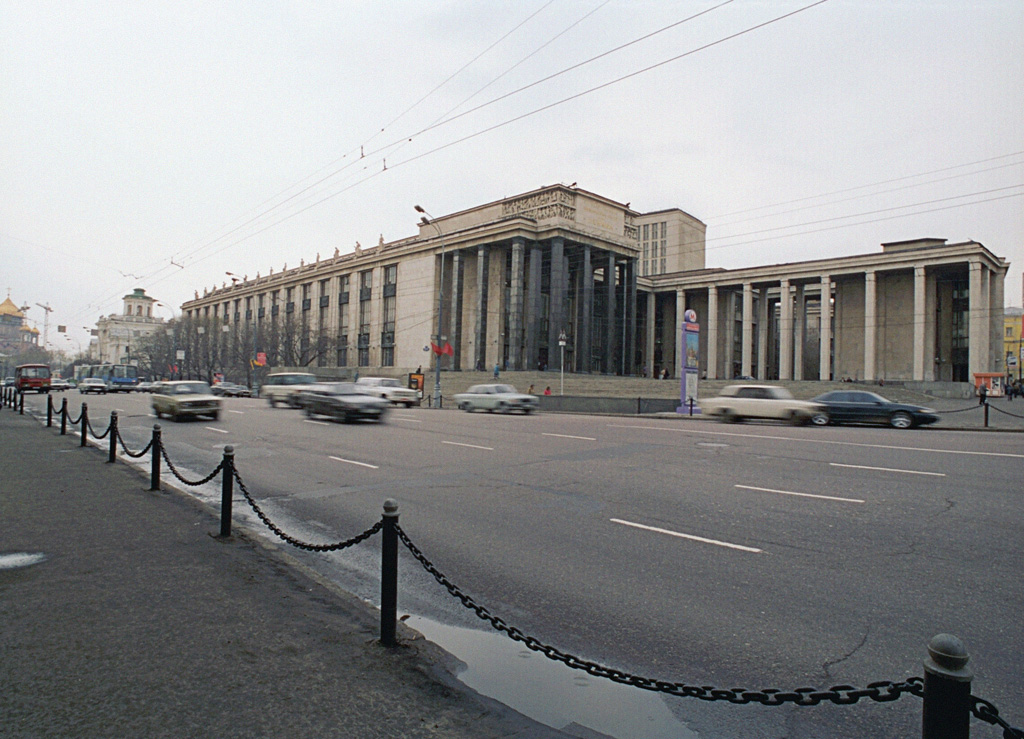
Photo: Florstein (Telegram:WikiPhoto.Space) · CC BY-SA 4.0 · Wikimedia Commons
Arbatskaya is a Moscow Metro station on the Arbatsko-Pokrovskaya Line. Moscow has two separate stations named Arbatskaya. The free Lokali audio guide runs 7 minutes.
✓ Published October 2026 · how we write these guides
Visitor facts
| Lokali audio guide | 7 min · free |
|---|---|
| Type | Tourist Attraction |
| Location | Moscow, Russia |
| Coordinates | 55.7522, 37.6061 |
| Languages | 50+, in the Lokali app |
The story
Listen first. A low rumble grows somewhere beneath your feet. Then a rush of warm air pushes along the platform and carries the faint, dry smell of rubber and machine oil. Overhead, bronze chandeliers hang in a long row, and their light falls on white stucco and polished stone. You are standing in Arbatskaya, one of the most richly decorated stations in the Moscow Metro. It is also, in a strange way, a station born from a war.
The first thing to know is that Moscow has two stations called Arbatskaya. They stand close together, but they belong to different lines and different eras. One serves the light blue Filyovskaya line and sits only a short way below the street. The other serves the dark blue Arbatsko-Pokrovskaya line and lies deep underground. Many visitors never realise there are two. If you are under the grand chandeliers, you are in the deep station, the younger of the pair.
The older station dates from 1935, the year the Moscow Metro first opened to passengers. It was part of the original network, one of the earliest underground railways in the Soviet Union. That line ran close to the surface, built using shallow methods that dug down from the street. This made construction faster. It also left the tunnels exposed. During the Second World War, that weakness became very clear.
In 1941, German bombing raids struck Moscow, and a bomb damaged the shallow tunnel near this part of the city. The lesson was hard and simple. Shallow tunnels could not protect the trains, and they could not protect the people. So after the war, planners decided to build a new, deep line along a similar route. The deep Arbatskaya opened in 1953. It was designed not only to move commuters, but also to serve as a shelter if war ever came again.
That double purpose shapes everything around you. The station sits far below the surface, so the escalator ride down is long. Take a moment on the way back up to notice how the walls slide past, and how the air changes as you rise. Down here, the thick layers of earth and concrete were meant to absorb danger. Up above, the city goes about its normal day, unaware of the depth beneath it.
And yet nothing about this hall feels like a bunker. That is the first surprise. The early 1950s were the height of a style often called Stalinist architecture, a grand, decorative manner that used classical forms to express the confidence of the state. Station designers of that period treated the metro as an underground palace for ordinary workers. Here, that idea reaches full expression. The ceiling curves in a broad vault, and every surface carries ornament.
Look up at the ceiling. Raised plaster patterns run along its length, with garlands, flowers and wreaths framed in panels. The chandeliers hang beneath them, heavy and elaborate, each one a small sculpture of metal and glass. Then look at the arches along the sides of the hall. Their edges are trimmed with more moulded decoration, and the stone below has a warm, reddish tone. The overall effect is soft and rich, closer to a theatre lobby than a railway.
The hall is also very long. Walk from one end to the other and you will feel it. This length gave the designers a stage for repetition. Arch follows arch, chandelier follows chandelier, and the eye is drawn steadily down the platform. Stand near the middle and look along the axis. The rhythm of light and shadow makes the hall seem to stretch even further than it does. It is one of the best views in the entire metro.
Now think about the other Arbatskaya, the shallow one. Its above-ground entrance hall still stands on Arbatskaya Square, and it holds the second surprise. The building is shaped like a five-pointed star. From the street, you see a low, reddish pavilion and might not notice anything unusual. But seen from above, on a map or in an aerial photograph, the star is clear. It was a bold piece of symbolism, set right into the fabric of the city.
Above you, the neighbourhood carries its own long story. The name Arbat is old, and historians still discuss its origins. One common explanation links it to an Arabic or Turkic word, perhaps brought by traders on the routes into medieval Moscow. Whatever its source, the name came to describe a whole district west of the Kremlin. For centuries, it was a quarter of craftsmen, then of nobility, and later of writers, artists and musicians.
The street called the Old Arbat begins close to these stations. In the 1980s, it became a pedestrian street, and today it is lined with shops, cafés and painted façades. Street musicians and portrait artists often work along it. Nearby, on the square, you may see the Khudozhestvenny cinema, one of the oldest cinemas in the city. When you climb out of the metro, the noise of traffic and voices returns all at once, a sharp contrast to the hush of the deep hall.
One more thing is worth noticing before you leave. This station is still a working part of daily life. Commuters walk briskly past the chandeliers without looking up. Students check their phones. An older woman may pause on a bench at the edge of the platform. For them, this palace is simply the way to work. That ordinary use is part of its character. The decoration was made for everyday people, and everyday people still fill it.
So take a last look along the hall. Notice the curve of the vault, the glow of the chandeliers, the reddish stone of the arches. Feel the next rush of warm air as a train approaches, and hear the doors slide open. Somewhere above you, the star-shaped pavilion and the old streets of the Arbat are waiting. As you ride the long escalator back towards daylight, remember how deep you have been, and why.
Key facts
What to look for
Practical tips
Common questions
Is there a free audio guide to Arbatskaya?
Yes — the Lokali app narrates Arbatskaya free of charge in 50+ languages. The guide runs about 7 minutes, covers the history, what to look for on site and practical tips, and works offline once downloaded.
Where is Arbatskaya?
Arbatskaya is in Moscow, Russia, at 55.7522, 37.6061. Tap the map link on this page for directions from where you are.
What is Arbatskaya known for?
Moscow has two separate stations named Arbatskaya. The shallow Filyovskaya line station opened in 1935.
What should you look for at Arbatskaya?
Bronze chandeliers hanging in a long row overhead. Raised plaster garlands and wreaths on the vaulted ceiling. Reddish stone facing on the arches along the hall.
What should you know before visiting Arbatskaya?
Visit outside rush hour to see the hall without crowds. Stand mid-platform to photograph the long row of chandeliers.
When is the best time to visit Arbatskaya?
Visit outside rush hour to see the hall without crowds.
On the map
Opens directions to Arbatskaya from your location.
More to see in Moscow



Hear Arbatskaya in your language
The full story, narrated, in 50+ languages. Download it before you go and it plays offline, at your own pace, with no ticket and no tour group.