
Biblioteka Imeni Lenina
55.7522° N · 37.6086° E · Tourist Attraction
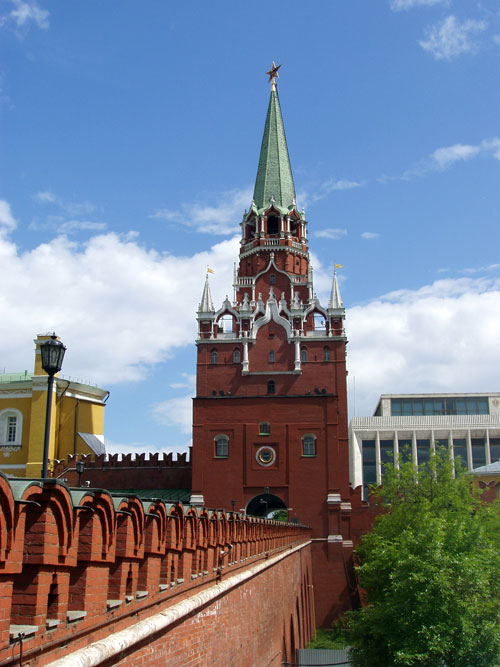
Photo: A.Savin · CC BY-SA 3.0 · Wikimedia Commons
Biblioteka Imeni Lenina is a Moscow Metro station. The collection began with Count Nikolai Rumyantsev's private library. The free Lokali audio guide runs 6 minutes.
✓ Published October 2026 · how we write these guides
Visitor facts
| Lokali audio guide | 6 min · free |
|---|---|
| Type | Tourist Attraction |
| Location | Moscow, Russia |
| Coordinates | 55.7522, 37.6086 |
| Official website | nashemetro.ru |
| Languages | 50+, in the Lokali app |
The story
Stand on the wide stone steps for a moment and listen. Traffic hums along the avenue behind you. The Kremlin walls glow red a short walk away. In front of you rises a long, sober facade of pale stone and dark pillars. Students with backpacks pass through the doors. Older readers carry folders under their arms. Somewhere inside, millions of books wait in silence.
This is the Russian State Library. Muscovites still call it by its old name, the Lenin Library, or simply Leninka. The metro station under your feet still carries the name too. It is one of the largest libraries in the world. Its collections hold books, newspapers, maps, manuscripts and music scores in many languages. For generations, this building has been the place where Russian scholarship happens.
The story begins not with Lenin, but with a count. In the early nineteenth century, Count Nikolai Rumyantsev was a diplomat and a passionate collector. He gathered rare books, manuscripts, coins and ethnographic objects. After his death, his collection became a public museum in Saint Petersburg. Then, in 1862, the whole collection moved to Moscow. The Rumyantsev Museum became the seed from which this library grew.
In Moscow, the museum found a home in a grand white mansion on the hill nearby. That building is Pashkov House. Look up and to the side, toward the Kremlin, and you may see its rounded tower above the trees. It was built in the late eighteenth century for a wealthy family. Tradition links its design to the architect Vasily Bazhenov, though the attribution is not fully documented. Today, Pashkov House still belongs to the library.
After the 1917 revolution, the new Soviet state made the collection national. In 1925, it was renamed in honour of Vladimir Lenin, who had died the year before. The collection grew fast. Libraries of noble estates, churches and private owners flowed into it. The old mansion could no longer hold everything. The country needed a much bigger building, and a much bigger idea of what a library could be.
That bigger idea is the building in front of you. It was designed by Vladimir Shchuko and Vladimir Gelfreikh. Construction began at the end of the 1920s and continued in stages for decades. The style is often called Soviet neoclassicism — classical columns and proportions, but stripped down and severe. It sits between two worlds. It is not quite the old imperial style, and not quite the bold avant-garde experiments of the early Soviet years.
Look closely at the upper facade. Here is a detail many visitors walk past. A row of bronze portrait medallions runs along the wall. They show great scientists and writers from many eras and countries. Among them are figures such as Archimedes, Copernicus, Galileo, Newton and Darwin. Russian names stand beside them — the scientist Mikhail Lomonosov, the poet Alexander Pushkin, the novelist Leo Tolstoy. The message is clear. This building presents itself as heir to all of human knowledge.
Now look at the dark pillars of the entrance portico. They are tall and square, and their darker stone makes a strong contrast with the pale walls. Above them stand sculpted figures. Together, the pillars and figures make the entrance feel almost like a temple. And that was the point. In the Soviet vision, reading was a public duty, and the library was a place of worship for science and education.
Here is a second surprise. The seated bronze figure on the square in front of the library is not Lenin. It is the writer Fyodor Dostoevsky, author of Crime and Punishment. The statue was installed in the late 1990s, after the Soviet era ended. He sits hunched and thoughtful, almost uncomfortable. Many people find this pose very fitting. A troubled novelist now guards a library named for a revolutionary.
In 1992, after the Soviet Union collapsed, the library received its current official name: the Russian State Library. The old name never really disappeared from daily speech. And the change of name did not change its role. It remains the national library of Russia, together with the great national library in Saint Petersburg. By law, publishers send copies of new books here, so the collection keeps growing every year.
Behind the main facade, you cannot see the heart of the building from the street. A tall book-storage tower rises within the complex. Inside, the stacks hold the bulk of the collection. Readers do not usually walk among the shelves. Instead, they order books, and staff bring them from storage to the reading rooms. The large main reading hall, with its long rows of desks and green lamps, has a calm, almost ceremonial atmosphere.
The library is not a museum. It is a working institution. To read inside, you need to register as a reader, and that requires an identity document. Many visitors are content simply to explore the exterior, the square and the view toward the Kremlin. But if you have time and the right papers, sitting in a reading room among quiet scholars gives a very different sense of Moscow.
Think about the location for a moment. On one side stand the Kremlin and the Alexander Garden. On another runs Vozdvizhenka Street, one of the old roads leading west from the centre. Up the hill is Pashkov House. Below is a busy metro hub where several lines meet. The library sits at a crossroads of power, transport and memory — exactly where a capital would want to place its books.
Before you walk on, look once more at the facade. Find the bronze faces of the scientists and writers. Notice the steps worn smooth by many readers. Glance at Dostoevsky, still lost in thought. Then turn toward the Kremlin towers and the white mansion on the hill. Behind these walls, millions of pages rest in quiet order — while the city moves past, just a few steps away.
Key facts
What to look for
Practical tips
Common questions
Is there a free audio guide to Biblioteka Imeni Lenina?
Yes — the Lokali app narrates Biblioteka Imeni Lenina free of charge in 50+ languages. The guide runs about 6 minutes, covers the history, what to look for on site and practical tips, and works offline once downloaded.
Where is Biblioteka Imeni Lenina?
Biblioteka Imeni Lenina is in Moscow, Russia, at 55.7522, 37.6086. Tap the map link on this page for directions from where you are.
What is Biblioteka Imeni Lenina known for?
The collection began with Count Nikolai Rumyantsev's private library. The Rumyantsev Museum moved to Moscow in 1862.
What should you look for at Biblioteka Imeni Lenina?
Bronze portrait medallions of scientists along the upper facade. Tall dark square pillars framing the main entrance portico. Sculpted figures standing above the portico columns.
What should you know before visiting Biblioteka Imeni Lenina?
Bring an identity document if you want a reader's card. Combine your visit with a walk to Pashkov House.
On the map
Opens directions to Biblioteka Imeni Lenina from your location.
More to see in Moscow



Hear Biblioteka Imeni Lenina in your language
The full story, narrated, in 50+ languages. Download it before you go and it plays offline, at your own pace, with no ticket and no tour group.