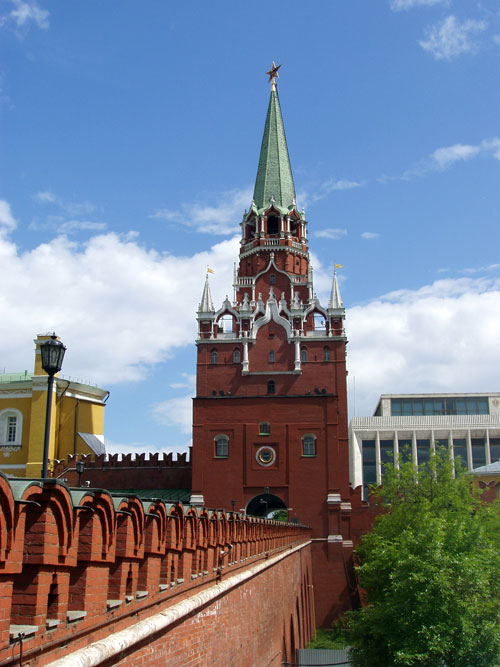
Photo: Presidential Press and Information Office · CC BY 4.0 · Wikimedia Commons
Troitskaya Tower is a tower in Moscow Kremlin. Tallest of the Kremlin's twenty towers, about eighty metres. The free Lokali audio guide runs 7 minutes.
✓ Published October 2026 · how we write these guides
Visitor facts
| Lokali audio guide | 7 min · free |
|---|---|
| Type | Tower |
| Location | Moscow, Russia |
| Coordinates | 55.7522, 37.6146 |
| Languages | 50+, in the Lokali app |
The story
Listen first. Beneath your feet, the paving slopes gently upward toward the red brick wall. Around you there are voices in a dozen languages, the shuffle of a queue, and somewhere behind the trees of the Alexander Garden, the low murmur of traffic. Ahead, a tall red tower rises in stages, each one narrower than the last, until it ends in a glass star high above the crowd. This is the Troitskaya Tower, the Trinity Tower, and for most visitors it is the front door to the Moscow Kremlin.
The Kremlin wall has twenty towers, and this one is the tallest. With its star, it stands roughly eighty metres high. That height was not an accident. This side of the fortress faced the Neglinnaya River, and a gate here needed to be strong, visible, and hard to approach. Today the tower seems to rise straight out of a calm green garden. Five centuries ago, the view from here was water, mud, and defensive ditches.
The tower was built at the very end of the fifteenth century, in the 1490s. The work belonged to a wider project under Grand Prince Ivan the Third. He invited Italian builders to Moscow to replace the old white stone walls with brick. The architect most often linked to this tower is an Italian master known in Russian sources as Aloisio. If the battlements on the wall look familiar, that is because they are. Those swallowtail merlons, the notched tops of the wall, are a design from northern Italy.
Here is the first surprise. The tower you see today is really two buildings from two different eras. The lower part, the heavy square body, is the Italian fortress work of the 1490s. The tall, tiered top with its white stone details came almost two centuries later, in the 1680s. By then, cannons had made towers like this less useful for war. So Moscow began to dress its fortress up. The Kremlin towers gained tented roofs, and they became symbols of power as much as defences.
The name has also changed over time. The tower had several names before it settled on Troitskaya in the middle of the seventeenth century. The name comes from the Trinity Compound, a Moscow residence of the Trinity Lavra of Saint Sergius. That great monastery stands north of the city, and its compound once stood just inside these walls. So the tower takes its name from a neighbour that no longer exists. Many old place names in Moscow work this way. They keep the memory of buildings that disappeared long ago.
Now turn around and look at the bridge you are standing on, or will soon cross. This is the Trinity Bridge, a long stone ramp that links the tower to the small white gatehouse behind you. That smaller tower is the Kutafya Tower. It is the only surviving outer gate tower of the Kremlin, and it once guarded the far end of the bridge. Between the two towers, the bridge once crossed the open Neglinnaya River. Archers could fire on anyone who tried to come over it.
And here is the second surprise. The river is still there. In the early nineteenth century, the Neglinnaya was enclosed in an underground pipe. The Alexander Garden was then laid out on top of the old riverbed. So the green lawns on either side of you are a covered river valley. When you walk across the Trinity Bridge, you are walking over a stream that has run in darkness for about two hundred years.
The tower has seen dramatic arrivals. In 1812, when Napoleon's army occupied Moscow, most accounts say the French emperor entered the Kremlin through this gate. The occupation was short and destructive. When the French withdrew, they tried to blow up parts of the fortress, and several towers were badly damaged. This one survived. Much of the restoration and the new garden below came in the years after the war, as the city rebuilt itself.
Look up again at the very top. The red star is made of ruby-coloured glass and it is lit from inside, so it glows at night. Stars replaced the double-headed eagles on the main Kremlin towers in the 1930s, after the Soviet government decided the imperial symbol had to go. The first stars were metal with stones. They were later replaced with the glass stars you see now. The stars can turn in the wind, so they meet strong gusts edge-on and not flat-on.
The tower also has a darker past below ground. Its lower levels go deep, and historians record that the basement rooms were once used as a prison. It is a strange thought as you stand in a queue for a museum ticket. The same thick walls that now hold back nothing more than city noise once held people inside them. Fortresses always carry this double life. They protect the people inside, and they also confine.
When you pass through the gate, notice how the space changes. The passage is deep and shaded, and the sound of the crowd closes in around you for a moment. Then you come out into the open Kremlin grounds. Directly ahead stands a large modern building of glass and pale stone. This is the State Kremlin Palace, a Soviet concert hall from the 1960s. Its clean lines next to medieval brick show how many different eras share this small hilltop.
Beyond that, the paths lead toward the cathedrals, the great bell tower, and the old squares of the fortress. But it is worth pausing here before you hurry on. Most visitors treat this tower as an entrance and never look at it again. Yet it holds the whole story of the Kremlin in one structure. There is the Italian fortress base, the decorative top of the seventeenth century, the scars of 1812, and the Soviet star.
So before you move on, take one more look. Follow the red brick from the ground to the white stone trim, and then to the glass star. Listen to the garden behind you, where a river still runs underground. When you leave the Kremlin later today, you may come back out across this same bridge. Look back over your shoulder then. In the late light, the brick turns a deeper red, and the tower seems to stand guard over the garden once again.
Key facts
What to look for
Practical tips
Common questions
Is there a free audio guide to Troitskaya Tower?
Yes — the Lokali app narrates Troitskaya Tower free of charge in 50+ languages. The guide runs about 7 minutes, covers the history, what to look for on site and practical tips, and works offline once downloaded.
Where is Troitskaya Tower?
Troitskaya Tower is in Moscow, Russia, at 55.7522, 37.6146. Tap the map link on this page for directions from where you are.
What is Troitskaya Tower known for?
Tallest of the Kremlin's twenty towers, about eighty metres. Built in the 1490s under Ivan the Third.
What should you look for at Troitskaya Tower?
Swallowtail battlements copied from northern Italian fortresses. Kutafya Tower guarding the far end of the bridge. White stone trim on the upper tiered levels.
What should you know before visiting Troitskaya Tower?
Book Kremlin tickets in advance to shorten the wait. Expect airport-style security screening before the gate.
When is the best time to visit Troitskaya Tower?
Arrive early morning to avoid the longest queues.
On the map
Opens directions to Troitskaya Tower from your location.
More to see in Moscow


Hear Troitskaya Tower in your language
The full story, narrated, in 50+ languages. Download it before you go and it plays offline, at your own pace, with no ticket and no tour group.