
Photo: Olga-lisenkova · CC BY-SA 4.0 · Wikimedia Commons
State Kremlin Palace is a palace in Tverskoy District, Russia. It is in Moscow, Russia. Opened in 1961 for a Communist Party congress. The free Lokali audio guide runs 6 minutes.
✓ Published October 2026 · how we write these guides
Visitor facts
| Lokali audio guide | 6 min · free |
|---|---|
| Type | Palace |
| Location | Moscow, Russia |
| Coordinates | 55.7514, 37.6156 |
| Official website | kremlinpalace.org |
| Languages | 50+, in the Lokali app |
The story
Stand still for a moment and look at the glass. In its tall panes you can see the Kremlin itself: old towers, a gilded dome, the shifting Moscow sky. Behind you the brick walls are centuries old. In front of you is something built in a few hurried seasons of the twentieth century. The two worlds meet right here, on the paving stones under your feet, and they do not quite agree with each other.
This is the State Kremlin Palace. It is the one large modern building inside the Kremlin walls. Almost everything else around you, the cathedrals, the bell tower, the palaces of the tsars, belongs to earlier centuries. This building belongs to the Soviet 1960s. It was designed to make a statement about a new era. Today it is mostly a place for ballet, concerts, and big public celebrations.
The palace opened in 1961. Its original name was the Kremlin Palace of Congresses. It was built for the twenty-second congress of the Communist Party of the Soviet Union. A congress was a huge gathering of party delegates from across the country. The leadership under Nikita Khrushchev needed a hall large enough to hold them all. The answer was this building, and it was put up remarkably quickly for a project of its size.
The design team was led by the architect Mikhail Posokhin. Look at the facade. Slim vertical pylons of pale marble run from the ground almost to the roofline. Between them sit long strips of glass. There is very little decoration. This was a deliberate choice. Under Khrushchev, Soviet architecture turned away from the heavy, ornamented style of the Stalin years. Clean lines and modern materials were meant to show progress and efficiency.
Here is something most visitors miss. The building is far bigger than it looks. Much of its volume lies below the level of the ground you are standing on. The builders dug deep into the Kremlin hill. They did this so the roofline would stay low and would not tower over the historic churches and towers nearby. What you see from outside is only part of the structure. Inside, the auditorium drops well beneath the surface.
That auditorium is enormous. It seats about six thousand people. For decades it was one of the largest theatre halls in the country. At the party congresses, delegates filled every row. Leaders spoke from the stage beneath a giant emblem. Votes were taken by a show of hands, and the result was rarely in doubt. Whole policies, and sometimes whole political careers, were announced in this room.
The building also had a second life almost from the start. Party congresses happened only every few years. The rest of the time, the great hall stood ready for performances. For many years the Bolshoi Theatre used it as an extra stage. Opera and ballet reached audiences far larger than the Bolshoi's own historic hall could hold. Ordinary Muscovites came here to see dancers they might otherwise never have seen.
The palace did not arrive without a cost. To clear space for it, older structures inside the Kremlin were taken down. Historians and architects still argue about this. Some see the building as a bold piece of modernism. Others see an intrusion into one of the most important historic ensembles in Russia. Both views are worth keeping in mind as you look at it. The glass and marble are elegant, but they also mark a loss.
After the end of the Soviet Union, the building needed a new identity. In 1992 it received the name it carries today, the State Kremlin Palace. The congresses were gone. The stage remained. Today the palace hosts ballet, concerts, festivals, and award ceremonies. It is also home to a ballet company known as the Kremlin Ballet. On some evenings, the sound of an orchestra replaces the speeches of the past.
The palace has one tradition that families in Moscow know well. Around New Year, the building hosts large festive shows for children, built around a decorated New Year tree. In Russia, New Year is the main winter holiday, with gifts and a figure called Grandfather Frost. For many children, a trip to the Kremlin tree celebration is a special memory. So this political building also became a place of childhood excitement.
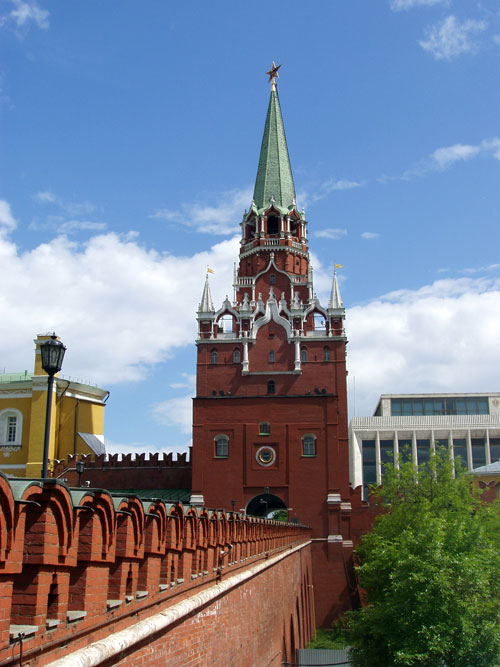
Now turn a little and look around the palace. Just beyond it rises the Trinity Tower, one of the tallest towers in the Kremlin wall. Its gate is the usual entrance for visitors coming to performances here. Nearby stands the long yellow Arsenal building, much older than the palace. Notice how the palace keeps its height modest beside them. That low roofline is the hidden basement doing its quiet work.
If you come in the evening, the effect changes completely. The lights come on inside, and the glass walls glow. From outside you can see into the foyers, where people gather before a show. The building looks lighter at night, almost transparent. In daylight, it reflects the old Kremlin. After dark, it shows its own interior instead. Both views are worth a pause.
As you stand here, think about the different crowds this pavement has seen. Party delegates in dark suits, carrying papers and voting cards. Ballet lovers in their best clothes. Excited children holding their parents' hands at New Year. Tourists like you, looking up at the marble pylons. The building has changed its purpose more than once. Its shape has stayed almost exactly the same.
Before you walk on, look once more into the glass. Find the reflection of a tower or a dome in it. There, in a single pane, the medieval Kremlin and the Soviet Kremlin sit side by side. Then step away and notice how quickly the palace fades behind the older buildings. That was the plan all along — a large building, kept deliberately quiet, in the heart of an ancient fortress.
Key facts
What to look for
Practical tips
Common questions
Is there a free audio guide to State Kremlin Palace?
Yes — the Lokali app narrates State Kremlin Palace free of charge in 50+ languages. The guide runs about 6 minutes, covers the history, what to look for on site and practical tips, and works offline once downloaded.
Where is State Kremlin Palace?
State Kremlin Palace is in Moscow, Russia, at 55.7514, 37.6156. Tap the map link on this page for directions from where you are.
What is State Kremlin Palace known for?
Opened in 1961 for a Communist Party congress. Originally called the Kremlin Palace of Congresses.
What should you look for at State Kremlin Palace?
Slim white marble pylons between tall glass panes. Old towers and domes reflected in the facade glass. The Trinity Tower rising just beyond the palace.
What should you know before visiting State Kremlin Palace?
Bring photo ID for Kremlin security checks. Arrive early, as security lines grow before evening shows.
When is the best time to visit State Kremlin Palace?
Arrive early, as security lines grow before evening shows.
On the map
Opens directions to State Kremlin Palace from your location.
More to see in Moscow


Hear State Kremlin Palace in your language
The full story, narrated, in 50+ languages. Download it before you go and it plays offline, at your own pace, with no ticket and no tour group.