
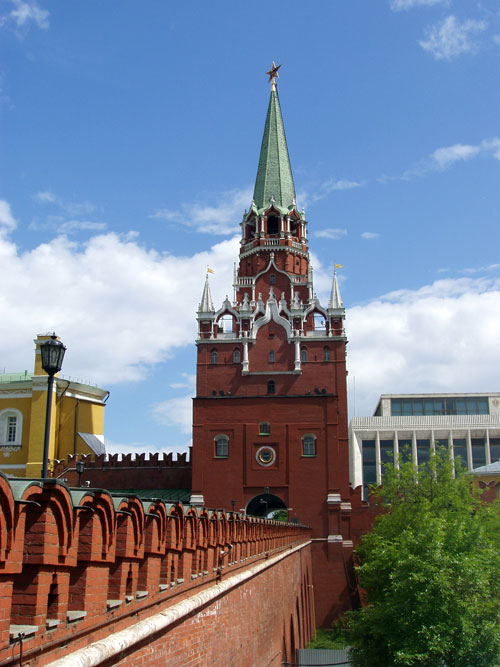
Photo: Service photographique du Kremlin · CC BY 4.0 · Wikimedia Commons
Amusement Palace is a palace in Tverskoy District, Russia. It is in Moscow, Russia. Built in the 1650s for boyar Ilya Miloslavsky. The free Lokali audio guide runs 7 minutes.
✓ Published October 2026 · how we write these guides
Visitor facts
| Lokali audio guide | 7 min · free |
|---|---|
| Type | Palace |
| Location | Moscow, Russia |
| Coordinates | 55.7513, 37.6144 |
| Languages | 50+, in the Lokali app |
The story
Stand still for a moment near the Trinity Gate and listen. Footsteps echo off old brick, and somewhere behind you a guard's boots strike the stone. Look toward the Kremlin wall, and you will find a compact building with white carved window frames and a small dome on its roof. It does not compete with the golden cathedrals. It waits quietly at the edge of the fortress. This is the Amusement Palace, known in Russian as the Poteshny Palace.
The name sounds playful, and that is the first surprise. Most buildings in the Kremlin were made for power, prayer, or defence. This one carries a name tied to entertainment and diversion. To understand why, we need to go back to the middle of the seventeenth century. Moscow then was a city of wood, bells, and muddy lanes. Inside these walls, the royal court lived by strict ritual and religious custom.
The palace was built around the early 1650s for Ilya Miloslavsky, a powerful boyar. A boyar was a member of the old Russian aristocracy, just below the tsar himself. Miloslavsky had a special advantage at court. His daughter Maria married Tsar Alexei Mikhailovich, the father of Peter the Great. So the man who lived here was the tsar's father-in-law. A private stone house inside the Kremlin was a rare privilege, and it showed how close he stood to the throne.
Look at the building's proportions. It is not wide or grand. It rises in several stories, with chambers stacked one above another. In old Moscow, stone houses for nobles often followed this pattern. The upper floors held living rooms and chapels, while lower spaces served storage and household work. Stone was expensive and valued, because fire swept through wooden Moscow again and again. A brick house was a statement of wealth and of a wish to last.
Now find the small dome on the roof. It marks a house church, a private chapel built into the palace itself. Wealthy Russian families often had their own place of prayer under the same roof. For a family this close to the tsar, daily worship was part of public life as well as private faith. The chapel is small, but it gives the building its silhouette. Without it, the palace would look almost like a merchant's house.
After Miloslavsky died in the late 1660s, the house passed to the royal household. Here the story takes its unexpected turn. Under Tsar Alexei, the Russian court began to experiment with theatre. This was new and even controversial in a deeply religious society. In the 1670s, the palace became a venue for court amusements, and it took its lasting name from them. The word poteshny comes from the idea of fun, play, and spectacle.
Pause on that thought for a second. Russian court theatre, in its earliest form, has a link to this modest building. Performances at that time were a novelty brought in under foreign influence. Many churchmen viewed such shows with suspicion. Yet the tsar enjoyed them. So within the same fortress that held the patriarch's chambers and the great cathedrals, there was also a room for plays and entertainment. The Kremlin was never only solemn.
Over the following centuries, the palace changed many times. When Peter the Great moved the capital to Saint Petersburg in the early eighteenth century, the Kremlin lost much of its daily court life. Buildings here were rebuilt, repurposed, or neglected. The Amusement Palace survived, but with new uses and repeated repairs. Its facade today shows layers from different periods. The carved white stone around the windows recalls the old Muscovite style, which loved decoration on plain brick walls.
The twentieth century brought the building's darkest chapter. After the government moved to Moscow in 1918, Soviet leaders took apartments inside the Kremlin. Joseph Stalin and his family lived in the Amusement Palace for a time. In November 1932, his wife, Nadezhda Alliluyeva, died here by her own hand after a quarrel. Stalin later moved to other quarters. It is a sobering fact to hold while you look at a building named for amusement.
Today the palace serves official Kremlin purposes, and its interiors are not usually open to visitors. So your experience here is from the outside, and that is enough. Notice how it sits pressed close to the wall, near the Trinity Tower. Across from it rises the State Kremlin Palace, a large glass and concrete hall from the Soviet era. The contrast is sharp. Within a few steps, you can see three centuries of very different ideas about power.
Take a closer look at the windows. Each one has its own frame of carved stone, rather than a simple opening in the wall. Seventeenth century builders in Moscow treated windows almost like jewellery for a building. Patterns of columns, small arches, and decorative tops break up the flat surface. In soft light, the shadows in these carvings become deeper. On a grey day, the white details stand out clearly against the darker brick.
Think, too, about the people who passed this spot. Boyars in long robes and fur hats. Servants carrying firewood and water. Actors preparing for a court performance. Later, Soviet officials with briefcases, and guards on patrol. The Trinity Gate has long been one of the main ways into the Kremlin. So this palace has watched a steady stream of arrivals for more than three hundred years. Very few of those people would have looked at it twice.
Before you move on, step back a little and take in the whole scene. The red wall, the tower above you, the small dome, the carved windows. Listen again to the footsteps and the voices of other visitors. This palace is easy to miss, and that is part of its character. As you walk deeper into the Kremlin, toward the cathedrals and bells, remember this small house. It held a family close to the throne, a stage for early plays, and a private tragedy... all behind these quiet walls.
Key facts
What to look for
Practical tips
Common questions
Is there a free audio guide to Amusement Palace?
Yes — the Lokali app narrates Amusement Palace free of charge in 50+ languages. The guide runs about 7 minutes, covers the history, what to look for on site and practical tips, and works offline once downloaded.
Where is Amusement Palace?
Amusement Palace is in Moscow, Russia, at 55.7513, 37.6144. Tap the map link on this page for directions from where you are.
What is Amusement Palace known for?
Built in the 1650s for boyar Ilya Miloslavsky. Miloslavsky was father-in-law of Tsar Alexei Mikhailovich.
What should you look for at Amusement Palace?
Small dome marking the private house church on the roof. Carved white stone frames around each window. Palace walls pressed close against the Kremlin fortifications.
What should you know before visiting Amusement Palace?
Enter through the Trinity Gate to pass right by it. View it from outside, since interiors are usually closed.
When is the best time to visit Amusement Palace?
Come on a bright morning for the clearest facade details.
On the map
Opens directions to Amusement Palace from your location.
More to see in Moscow



Hear Amusement Palace in your language
The full story, narrated, in 50+ languages. Download it before you go and it plays offline, at your own pace, with no ticket and no tour group.