
Kremlin Arsenal
55.7533° N · 37.6167° E · Tourist Attraction
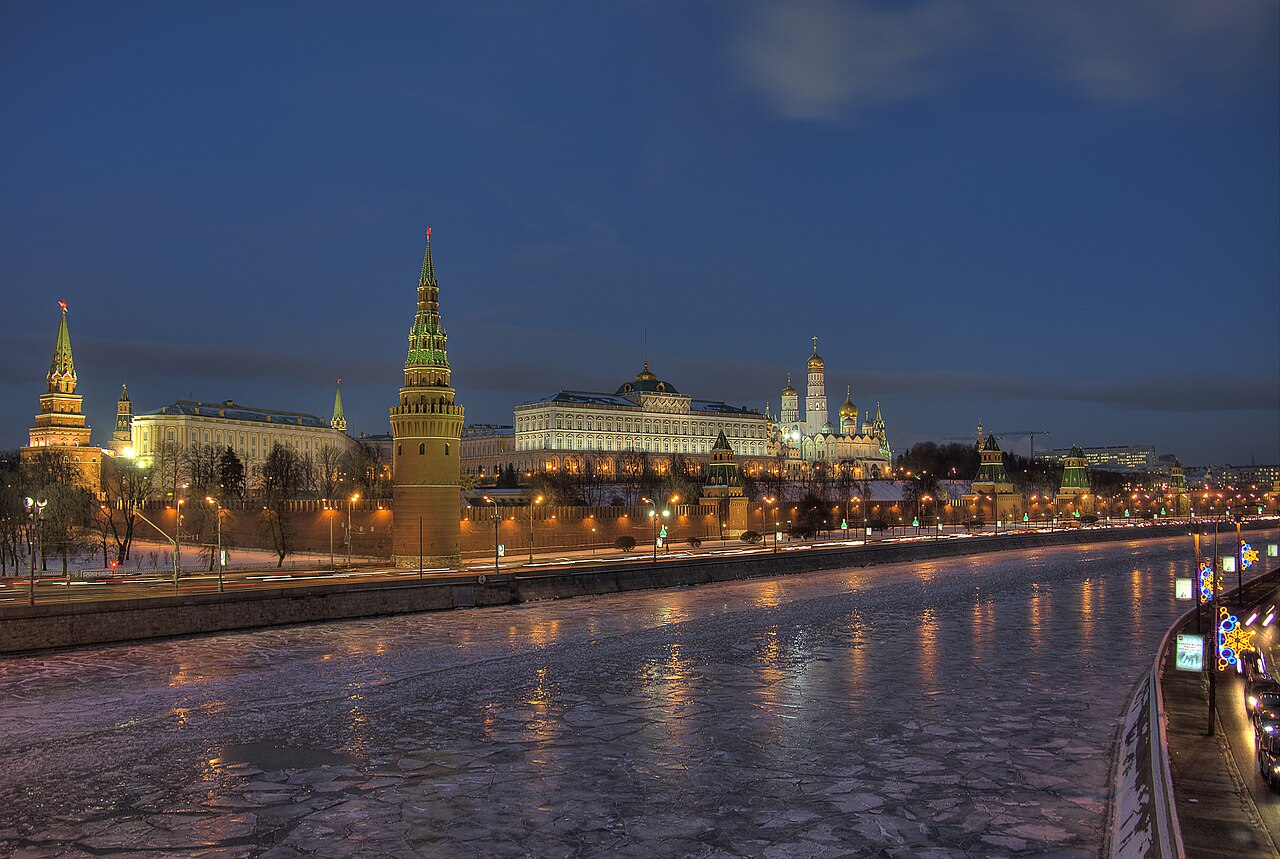
Photo: Ministry of Defence of the Russian Federation · CC BY 4.0 · Wikimedia Commons
Kremlin Arsenal is a historical building in the Moscow Kremlin. Peter the Great ordered the Arsenal built in 1701. The free Lokali audio guide runs 7 minutes.
✓ Published October 2026 · how we write these guides
Visitor facts
| Lokali audio guide | 7 min · free |
|---|---|
| Type | Tourist Attraction |
| Location | Moscow, Russia |
| Coordinates | 55.7533, 37.6167 |
| Languages | 50+, in the Lokali app |
The story
Listen for the gravel and stone under your shoes, and the sudden quiet as the noise of the city drops away behind the Kremlin wall. Ahead of you runs a long, low building. Its walls are a soft ochre-yellow, trimmed with white. Its windows sit in small pairs, deep in the masonry. Along its foot, rows of dark cannon barrels rest on their carriages. This is the Kremlin Arsenal, and it is one of the longest buildings inside these walls.
The Arsenal sits in the northern corner of the Kremlin, between the Trinity Tower and the Nikolskaya Tower. If you came in through the Trinity Gate, as most visitors do, it was on your left almost at once. From above, the building forms a large irregular four-sided shape around an inner courtyard. Its outer walls follow the line of the old fortress wall. So the Arsenal is part store, part barrier, pressed against the medieval defences of the city.
The story begins with Peter the Great. In 1701, early in his long war with Sweden, Peter ordered a new arsenal to be built here. Russia had just lost many guns in battle, and the young tsar wanted one central place to make, store and display weapons. He also wanted something more. Peter planned the building as a kind of museum of military glory, a place to keep trophies from his victories. That idea still shapes what you see outside today.
Building the Arsenal took a very long time. Work stopped and started for decades, because money and labour went first to the war and then to Peter's new capital, Saint Petersburg. The building was finished only in the 1730s, long after Peter's death. Then, in 1737, a great fire swept through the Kremlin and badly damaged it. For many years after that, the Arsenal stood partly in ruins in the heart of the old capital.
Repairs came in the second half of the eighteenth century. The architect Matvey Kazakov, who also designed the Senate building nearby, was involved in the restoration. Look at how plain the walls are. There are no columns, no domes and no gilded crosses. The beauty here is in the rhythm: long lines of paired windows, broad flat walls, and a heavy gateway in the middle. It is a working building that also wants to look serious and strong.
Now comes the darkest chapter. In 1812, Napoleon's army occupied Moscow. When the French withdrew in October, they tried to blow up parts of the Kremlin. Charges went off under several towers and walls, and the Arsenal was badly hit. A large part of the building collapsed. For Muscovites who came back to their burned city, the broken Arsenal was one of many wounds. Rebuilding took years, and the work was completed in the 1820s.
Here is the first detail many visitors miss. Many of the cannons lined up along the walls are not Russian at all. After the war of 1812, the Russian army collected hundreds of guns left behind by Napoleon's forces as they retreated. These trophies came from France and from the many states that marched with the French. They were brought here and placed along the Arsenal, just as Peter had once imagined. A defeated army's weapons became a monument to its defeat.
Take a closer look at the barrels. You may see different shapes, sizes and decorations. Some carry cast coats of arms, monograms or inscriptions. Some have handles shaped like dolphins, a common design for bronze guns of that era. Older Russian cannons also stand here, some from the seventeenth century. Together they form a quiet open-air collection of artillery from several countries. Each barrel was once hauled across Europe by horses and men.
The second surprise is about the building itself. Most visitors expect to go inside, but you cannot. The Arsenal is not a museum. It belongs to the working part of the Kremlin, connected to the guard and the state offices around Senate Square. For a long time it has been used by the Kremlin Regiment, the unit that guards this fortress. So the courtyard behind those walls stays closed. You can only study the Arsenal from outside, as a facade and a story.
The twentieth century also left its mark here. During the revolutionary fighting in Moscow in 1917, the Kremlin became a battleground, and the Arsenal saw bloodshed. Soldiers died in and around this building in those days. Memorial plaques on the walls remember the dead. They are easy to walk past, so look for them along the facade. They are a reminder that the Arsenal was not only a store of weapons. It was also a place where people lost their lives.
Stand back and look at how the Arsenal fits into the space around it. Across the square is the yellow and white Senate building, with its green dome. Nearby rise the red brick walls and towers of the old fortress. The Arsenal uses the same calm colours as the Senate, so the two buildings feel like a pair. Together they turn this corner of the Kremlin into a formal government square, very different from the cathedrals further south.
Notice the light, too. On a clear morning, the low sun falls across the long walls, and the window frames throw small shadows. On a grey day, the ochre turns softer, and the dark cannons stand out sharply against it. In winter, snow gathers on top of the barrels and along the gun carriages. The building changes mood with the weather, but it never looks hurried or decorative. It stays steady, almost stern.
Before you move on, stand still for a moment beside the cannons. Look along the line of barrels as it stretches away towards the corner of the wall. Three centuries of history meet here: Peter's ambition, the fire, Napoleon's explosions, the revolution, and the guards who still work behind these windows. As you walk on towards the cathedrals, glance back once. The long yellow wall, the paired windows and the silent guns will still be there, keeping their watch over the Kremlin.
Key facts
What to look for
Practical tips
Common questions
Is there a free audio guide to Kremlin Arsenal?
Yes — the Lokali app narrates Kremlin Arsenal free of charge in 50+ languages. The guide runs about 7 minutes, covers the history, what to look for on site and practical tips, and works offline once downloaded.
Where is Kremlin Arsenal?
Kremlin Arsenal is in Moscow, Russia, at 55.7533, 37.6167. Tap the map link on this page for directions from where you are.
What is Kremlin Arsenal known for?
Peter the Great ordered the Arsenal built in 1701. Construction was finished only in the 1730s.
What should you look for at Kremlin Arsenal?
Small paired windows set deep into the ochre walls. Dolphin-shaped handles cast on some bronze cannon barrels. Coats of arms and monograms on trophy guns.
What should you know before visiting Kremlin Arsenal?
Enter by the Trinity Gate to reach the Arsenal quickly. Plan to view it from outside; the interior is closed.
When is the best time to visit Kremlin Arsenal?
Visit on a clear morning for low light on the facade.
On the map
Opens directions to Kremlin Arsenal from your location.
More to see in Moscow



Hear Kremlin Arsenal in your language
The full story, narrated, in 50+ languages. Download it before you go and it plays offline, at your own pace, with no ticket and no tour group.