
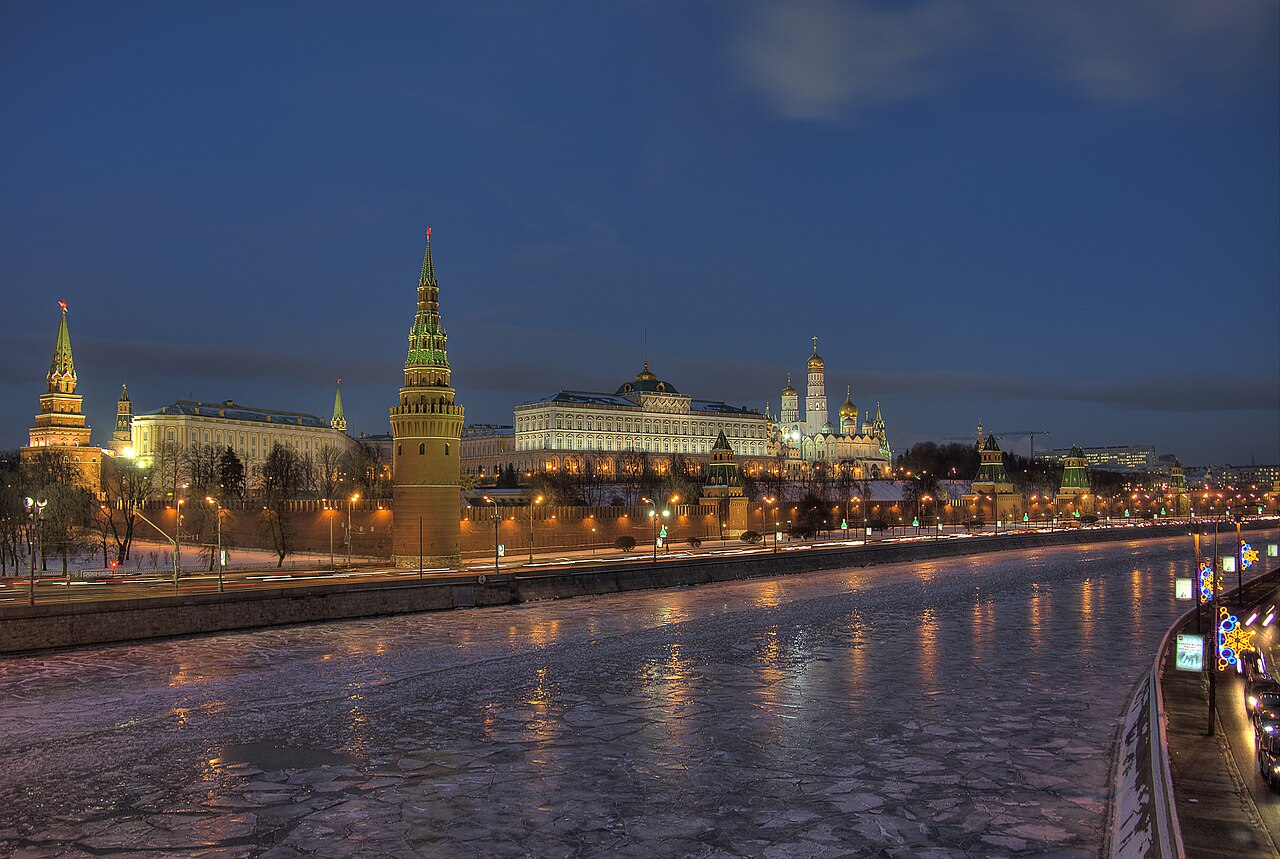
Photo: Presidential Press and Information Office · CC BY 4.0 · Wikimedia Commons
Kremlin Senate is a palace. It is in Moscow, Russia. Designed by architect Matvey Kazakov under Catherine the Great. The free Lokali audio guide runs 7 minutes.
✓ Published October 2026 · how we write these guides
Visitor facts
| Lokali audio guide | 7 min · free |
|---|---|
| Type | Palace |
| Location | Moscow, Russia |
| Coordinates | 55.7532, 37.6186 |
| Official website | kreml.ru |
| Languages | 50+, in the Lokali app |
The story
Stand still for a moment and listen. Inside the Kremlin walls the noise of the city falls away. You hear footsteps on paving stones, a guard's whistle somewhere across the square, and the wind moving over the green dome ahead of you. The building under that dome is pale yellow, trimmed in white, and calm in its proportions. It does not look like the centre of a state. Yet for more than a century, this is where Russia has been run.
This is the Kremlin Senate. It was built in the late eighteenth century, during the reign of Catherine the Great. Its architect was Matvey Kazakov, a Moscow-born builder who shaped much of the city's classical look. Work began in the 1770s and ran for about a decade. Catherine wanted a dignified home for the Moscow branch of the Governing Senate, the highest body of law and administration in her empire. She also wanted a statement in stone about a new, ordered, European style of rule.
Look at the style first. Kazakov worked in neoclassicism, a manner that borrows from ancient Greece and Rome. You can see it in the clean columns, the flat wall surfaces, and the strict symmetry. There is no onion dome here, no painted tile, none of the swirling ornament of older Russian churches nearby. The contrast is deliberate. In Catherine's era, this sober order of columns stood for reason, law, and the Enlightenment ideas she admired.
Now here is something most visitors never realise. From the ground, the building looks like a long, regular block. From above, it is a triangle. Kazakov had an awkward plot, squeezed between the old Arsenal and buildings that already stood in this corner of the fortress. Instead of fighting the space, he filled it. The three wings form a triangle around inner courtyards. At one corner, facing the Kremlin wall and Red Square beyond, sits the great round hall under the dome.
That dome is the heart of the design. Beneath it lies a large circular hall, today known as the Catherine Hall, used for state ceremonies. In Kazakov's time, a dome of this size over a secular building was ambitious. Legend has it that doubters warned it would collapse. One popular tale says Kazakov climbed up and stood under the dome as the scaffolding came down, to prove his faith in his own work. It is a good story, but treat it as Moscow folklore, not documented history.
For its first century and more, the Senate was a place of courts, clerks, and paper. Moscow was no longer the capital. Since the early eighteenth century, power had sat in Saint Petersburg. So this building served the old capital's administration, and later its courts. It was handsome, respected, and somewhat quiet. Nobody walking past in the nineteenth century would have guessed what was coming.
Everything changed in 1918. The new Bolshevik government moved the capital from Petrograd back to Moscow, and Vladimir Lenin took offices inside this building. His working study and a modest apartment were on an upper floor. From these rooms the young Soviet state was directed through civil war and famine. After his death, the rooms were kept as a memorial for decades. In the 1990s, their furnishings were moved to the Lenin museum at Gorki, outside Moscow.
Joseph Stalin also worked here. For much of his long rule, his office was inside the Senate, and many of the most important decisions of the Soviet period were taken within these yellow walls. That includes decisions of the Second World War. It is a strange thought. The building's calm, rational exterior stands in sharp contrast to the hard history made inside it. The architecture did not change. The power behind the windows did.
Here is the second detail worth holding on to. Look up at the flagpole on the dome. On the evening of 25 December 1991, the red Soviet flag on this pole was lowered for the last time. The white, blue, and red Russian tricolour was raised in its place. That simple change of cloth marked the end of the Soviet Union. Television cameras broadcast it around the world, and the dome of this building became part of one of the century's defining images.
Today the Senate is the main working residence of the President of Russia. That is why you cannot go inside, and why the square around it is closed to visitors. Guards watch the painted lines on the pavement closely. If someone steps too far, a short whistle usually follows. The building remains what Catherine intended: a working seat of government, not a museum. You are looking at an office, not a monument.
There are two good ways to see it. Inside the Kremlin, from the open visitor areas, you can view the long main facade across the restricted square. Notice the rhythm of the windows and the central portico. Then, later, walk out to Red Square. Look over the red brick wall, just behind the Lenin Mausoleum. The green dome rises above the battlements there, close to the Senate Tower, which takes its name from this building.
Take a moment to compare the materials around you. The Kremlin walls and towers are dark red brick, built by Italian masters centuries earlier. The cathedrals carry gold and white stone. The Senate, by contrast, is stuccoed and painted in soft ochre with white details. It is the colour of classical Moscow, the city of noble mansions that Kazakov helped to build. In low evening light, the yellow walls turn warm, almost honey-coloured.
So before you move on, look once more at the dome and the flag above it. A building made for Catherine's clerks became the desk of revolution, then the office of a superpower, and now the seat of a modern presidency. The walls stayed the same. The meaning inside them changed again and again. As you walk away, listen for the whistle of the guards and the wind over the green roof. The building is still at work behind those windows.
Key facts
What to look for
Practical tips
Common questions
Is there a free audio guide to Kremlin Senate?
Yes — the Lokali app narrates Kremlin Senate free of charge in 50+ languages. The guide runs about 7 minutes, covers the history, what to look for on site and practical tips, and works offline once downloaded.
Where is Kremlin Senate?
Kremlin Senate is in Moscow, Russia, at 55.7532, 37.6186. Tap the map link on this page for directions from where you are.
What is Kremlin Senate known for?
Designed by architect Matvey Kazakov under Catherine the Great. Built in the late eighteenth century in neoclassical style.
What should you look for at Kremlin Senate?
The green dome rising above the red Kremlin wall. Flagpole on the dome where the Soviet flag came down. Soft ochre walls with crisp white classical trim.
What should you know before visiting Kremlin Senate?
View the dome from Red Square, behind the Lenin Mausoleum. Stay behind painted lines; guards enforce the restricted square.
When is the best time to visit Kremlin Senate?
Visit in late afternoon for warm light on the facade.
On the map
Opens directions to Kremlin Senate from your location.
More to see in Moscow


Hear Kremlin Senate in your language
The full story, narrated, in 50+ languages. Download it before you go and it plays offline, at your own pace, with no ticket and no tour group.