
Moscow Conservatory
55.7561° N · 37.6043° E · Tourist Attraction
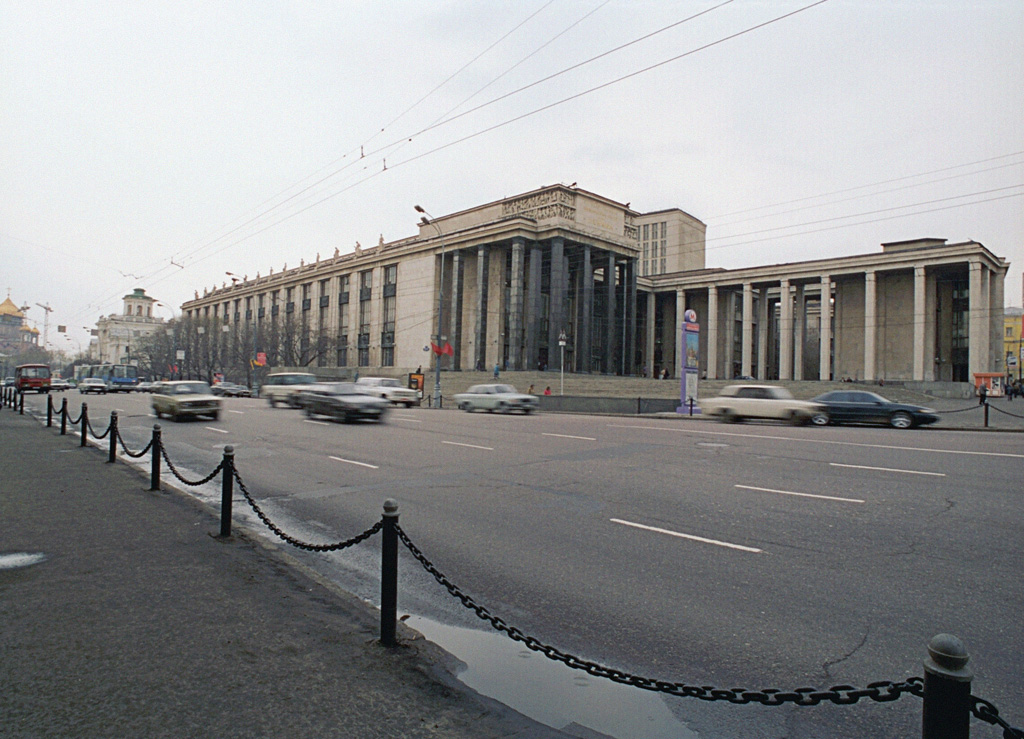
Photo: A.Savin · FAL · Wikimedia Commons
Moscow Conservatory is a higher musical education institution in Moscow. Founded in 1866 by pianist Nikolai Rubinstein. The free Lokali audio guide runs 6 minutes.
✓ Published October 2026 · how we write these guides
Visitor facts
| Lokali audio guide | 6 min · free |
|---|---|
| Type | Tourist Attraction |
| Location | Moscow, Russia |
| Coordinates | 55.7561, 37.6043 |
| Official website | mosconsv.ru |
| Languages | 50+, in the Lokali app |
The story
Stand still for a moment on Bolshaya Nikitskaya Street. Listen past the traffic. On many days, a thin thread of sound drifts from an open window above you. A violin repeats the same four bars. A piano stops, restarts, and stops again. This is the sound of practice, the patient, unglamorous work behind every concert. It has filled this corner of central Moscow for well over a century. You are standing outside the Moscow Conservatory.
The building in front of you is pale and calm, with a curved courtyard that opens toward the street. It does not shout for attention. There are no gold domes here and no towering spire. Yet for many musicians around the world, this address carries more weight than almost any palace in Russia. Students arrive from across the country, and from far beyond it, carrying instrument cases and hope in roughly equal measure.
The story begins in 1866. That year, the pianist and conductor Nikolai Rubinstein founded the conservatory. His brother Anton had already opened Russia's first conservatory in Saint Petersburg a few years earlier. The two brothers were both celebrated performers, and there was a quiet rivalry between the two cities. Moscow did not want to stay in the shadow of the imperial capital. A serious school of music became a matter of civic pride.
Here is the first surprise. One of the very first teachers was a young man few people knew at the time. His name was Pyotr Ilyich Tchaikovsky. He taught harmony and music theory here for more than a decade, from the school's opening until the late 1870s. He marked student exercises and complained about the workload in his letters. Only later did the world know him as the composer of Swan Lake and the great symphonies.
Today the conservatory carries his name. And in the courtyard, he is still here — in bronze. The seated figure of Tchaikovsky was designed by the sculptor Vera Mukhina, best known for the giant steel Worker and Kolkhoz Woman statue. She died before it was finished, and the monument was unveiled in the 1950s. Look at the raised hand. It is caught halfway through a gesture, as if he is shaping a phrase in the air.
The list of students who passed through these doors reads like a concert programme. Sergei Rachmaninoff studied here in the late nineteenth century. So did Alexander Scriabin, a composer obsessed with colour and mysticism. The two young men were classmates and graduated around the same time. Rachmaninoff went on to fill concert halls in Europe and America. Scriabin went on to write music so strange that some listeners still struggle to describe it.
Now look toward the main entrance. Behind it lies the Great Hall, which opened at the very start of the twentieth century. Musicians speak about its acoustics with real affection. Sound here is warm and clear, and a single quiet note on a piano can reach the back rows. Many performers say the hall feels intimate despite its size. Countless recordings have been made inside, capturing that particular resonance.
Inside the Great Hall, large painted portraits of composers look down from the walls. Bach, Mozart, and Beethoven share the space with Russian masters such as Glinka and Tchaikovsky. According to a story often told by guides here, several of the original foreign faces were replaced during the Soviet era with Russian composers. It is a small detail, but it shows how even a concert hall could carry the politics of its time.
Above the stage stands the organ. It was built by the French workshop of Aristide Cavaillé-Coll, one of the most respected organ builders of the nineteenth century. His instruments are known for their rich, orchestral tone. Few visitors expect to find a piece of French craftsmanship at the heart of a Russian music school. When the organ plays at full power, the sound fills the hall and you can feel it through the floor.
Here is the second surprise. In 1958, at the height of the Cold War, this hall hosted the first International Tchaikovsky Competition. Everyone expected a Soviet pianist to win. Instead, the prize went to a tall young Texan named Van Cliburn. Audiences here loved him, and he returned to the United States a national hero. For a few weeks, music crossed a border that politics kept firmly shut. The competition still returns to these halls.
The conservatory is not only the Great Hall. The building also holds the Small Hall, used for chamber music and solo recitals, and other performance spaces across the complex. On any given evening, you might find a famous orchestra in one room and a nervous student giving an exam recital in another. Both are part of daily life here. Concerts by students are often the most honest and exciting events in the building.
The surrounding street is worth your attention too. Bolshaya Nikitskaya is one of the old radial streets running out from the Kremlin. It is lined with mansions, small theatres, and churches. Musicians spill out of the conservatory doors at all hours, still talking about tempo and fingering. Nearby cafés fill with students during breaks. If you walk slowly, you will notice that the whole neighbourhood moves at the pace of rehearsal schedules.
Before you leave, turn back to the courtyard once more. Look at Tchaikovsky's bronze hand, still raised. Listen again for the windows above. Somewhere inside, a student is playing the same passage for the twentieth time today. Maybe one day that passage will be heard in a concert hall far from Moscow. For now, it belongs to this street, this moment, and to you, standing here and listening.
Key facts
What to look for
Practical tips
Common questions
Is there a free audio guide to Moscow Conservatory?
Yes — the Lokali app narrates Moscow Conservatory free of charge in 50+ languages. The guide runs about 6 minutes, covers the history, what to look for on site and practical tips, and works offline once downloaded.
Where is Moscow Conservatory?
Moscow Conservatory is in Moscow, Russia, at 55.7561, 37.6043. Tap the map link on this page for directions from where you are.
What is Moscow Conservatory known for?
Founded in 1866 by pianist Nikolai Rubinstein. Tchaikovsky taught harmony here for over a decade.
What should you look for at Moscow Conservatory?
Tchaikovsky's bronze hand raised mid-gesture in the courtyard. Composer portraits lining the walls of the Great Hall. The French-built Cavaillé-Coll organ above the stage.
What should you know before visiting Moscow Conservatory?
Book a student recital for an intimate, low-key concert. Reserve Great Hall seats early for major competition weeks.
When is the best time to visit Moscow Conservatory?
Arrive early to explore the courtyard before the doors open.
On the map
Opens directions to Moscow Conservatory from your location.
More to see in Moscow


Hear Moscow Conservatory in your language
The full story, narrated, in 50+ languages. Download it before you go and it plays offline, at your own pace, with no ticket and no tour group.