
Russian Institute of Theatre Arts
55.7544° N · 37.6032° E · Tourist Attraction
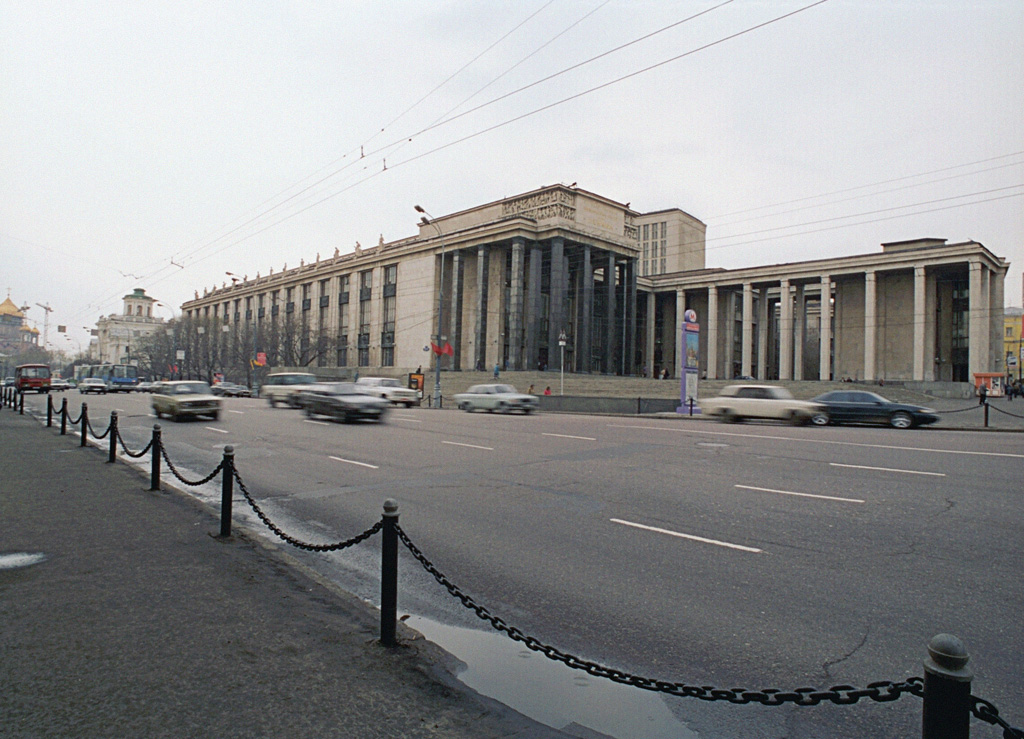
Photo: A.Savin · CC BY-SA 3.0 · Wikimedia Commons
Russian Institute of Theatre Arts is a Russian academy of theater and arts. It is in Moscow, Russia. The school's history begins in 1878 as a music school. The free Lokali audio guide runs 6 minutes.
✓ Published October 2026 · how we write these guides
Visitor facts
| Lokali audio guide | 6 min · free |
|---|---|
| Type | Tourist Attraction |
| Location | Moscow, Russia |
| Coordinates | 55.7544, 37.6032 |
| Official website | gitis.net |
| Languages | 50+, in the Lokali app |
The story
Listen for a moment. Somewhere behind these windows, a voice is running scales. Another is reading a line of verse, stopping, and reading it again, a little differently. On a quiet day you can hear it from the pavement. This is the sound of a building whose whole purpose is rehearsal: actors, directors, dancers and designers learning their craft one repeated phrase at a time.
You are standing outside the Russian Institute of Theatre Arts. Most Russians do not use that long name. They call it GITIS, an abbreviation from its Soviet-era title, the State Institute of Theatre Arts. Say "GITIS" to a theatre lover anywhere in the Russian-speaking world, and they will know exactly what you mean. It is one of the oldest and largest theatre schools in the country.
The school sits in a small side lane in the centre of Moscow, close to Bolshaya Nikitskaya Street and not far from the Arbat district. Take a look at the lane itself. It is narrow and calm, a sharp contrast to the wide avenues only a few minutes away. Students cluster near the entrance between classes. Some carry dance bags. Some carry scripts covered in pencil notes. Some are still in rehearsal clothes.
The story of the institution begins in 1878. At that time it was not a theatre school at all. It started as a private music school, founded by the pianist and conductor Pyotr Shostakovsky. Over the following years it grew and changed its identity. It became a school connected to the Moscow Philharmonic Society, and drama joined music on the timetable. That shift turned out to be very important for Russian theatre.
Here is the first surprise for many visitors. One of the teachers in that drama department was Vladimir Nemirovich-Danchenko. A few years later, he co-founded the Moscow Art Theatre with Konstantin Stanislavski. That theatre changed how actors around the world approach a role. And several of Nemirovich-Danchenko's students from this school went with him. Among them were the actress Olga Knipper, who later married the writer Anton Chekhov, and Vsevolod Meyerhold, who became one of the boldest stage directors of the twentieth century.
Think about that for a second. Some of the people who first performed Chekhov's plays at the Moscow Art Theatre learned their early technique within this institution. When you hear about "Russian acting" or "the method" in film schools today, part of that long line of influence runs back to the classrooms connected to this address.
After the revolution of 1917, the school was reorganised several times. In the Soviet period it took the name GITIS, and for many years it also carried the name of Anatoly Lunacharsky, the first Soviet commissar for education and culture. After the collapse of the Soviet Union, the school became the Russian Academy of Theatre Arts. Later it took its current name, the Russian Institute of Theatre Arts. Through every change of name, the short word GITIS stayed in everyday use.
So what actually happens inside? Far more than acting lessons. The institute trains directors, actors for drama and for musical theatre, choreographers, stage designers, producers and theatre critics. That last group surprises people. Here, writing about theatre is treated as a serious discipline, with its own training in history and analysis. The idea is that a whole theatre culture needs more than performers. It needs people who build the sets, run the companies and write honestly about the results.
The teaching style is famous for being demanding. Students in acting and directing usually study in a group led by one master, an experienced director or actor who guides them for several years. The group works together almost every day. They study movement, voice, speech, dance and stage combat, and they build full productions. Many well-known Russian actors and directors trained in groups like these, and some of them later returned to teach the next generation.
Here is a second detail that many passers-by miss. The work of students is not hidden away. Final-year productions are often shown to the public, and theatre scouts, critics and directors come to watch. For a young actor, these shows can decide the first job after graduation. If you see posters near the entrance, they may advertise exactly these student performances. They can be a lively and very close-up way to see Russian theatre.
Now look at the building and the street around you. This part of central Moscow carries layers of the city's past: older mansions, nineteenth-century facades, newer additions squeezed between them. The theatre world is also close. Within a short walk are concert halls, drama theatres and the Moscow Conservatory on Bolshaya Nikitskaya. For more than a century, this small area has been one of the places where the city's performing arts live side by side.
If you have time, walk slowly to the end of the lane and back. Notice the doorways, the courtyards behind arches, the small cafés where students go between classes. Theatre training is long and tiring, and these nearby streets are part of daily life here. Late in the evening, after rehearsals end, small groups often leave together, still talking about the scene they just worked on.
Before you move on, listen once more. Perhaps you will hear a piano through an open window, or a voice repeating the same line yet again. That patient repetition is the real heart of this place. Every production in a Moscow theatre tonight began, for someone, with a moment like this. When you walk away down the quiet lane, you are walking a route that generations of actors once walked too, on their way to their first stage.
Key facts
What to look for
Practical tips
Common questions
Is there a free audio guide to Russian Institute of Theatre Arts?
Yes — the Lokali app narrates Russian Institute of Theatre Arts free of charge in 50+ languages. The guide runs about 6 minutes, covers the history, what to look for on site and practical tips, and works offline once downloaded.
Where is Russian Institute of Theatre Arts?
Russian Institute of Theatre Arts is in Moscow, Russia, at 55.7544, 37.6032. Tap the map link on this page for directions from where you are.
What is Russian Institute of Theatre Arts known for?
The school's history begins in 1878 as a music school. Founded by pianist and conductor Pyotr Shostakovsky.
What should you look for at Russian Institute of Theatre Arts?
Students carrying dance bags and marked-up scripts near the door. Music or spoken lines drifting from upper windows. Posters announcing current graduation productions.
What should you know before visiting Russian Institute of Theatre Arts?
Check entrance posters for public student performances. Book student shows early; small halls fill up quickly.
When is the best time to visit Russian Institute of Theatre Arts?
Visit on a weekday to hear rehearsals from the street.
On the map
Opens directions to Russian Institute of Theatre Arts from your location.
More to see in Moscow


Hear Russian Institute of Theatre Arts in your language
The full story, narrated, in 50+ languages. Download it before you go and it plays offline, at your own pace, with no ticket and no tour group.