
Lebedev Physical Institute
55.6978° N · 37.5653° E · Tourist Attraction
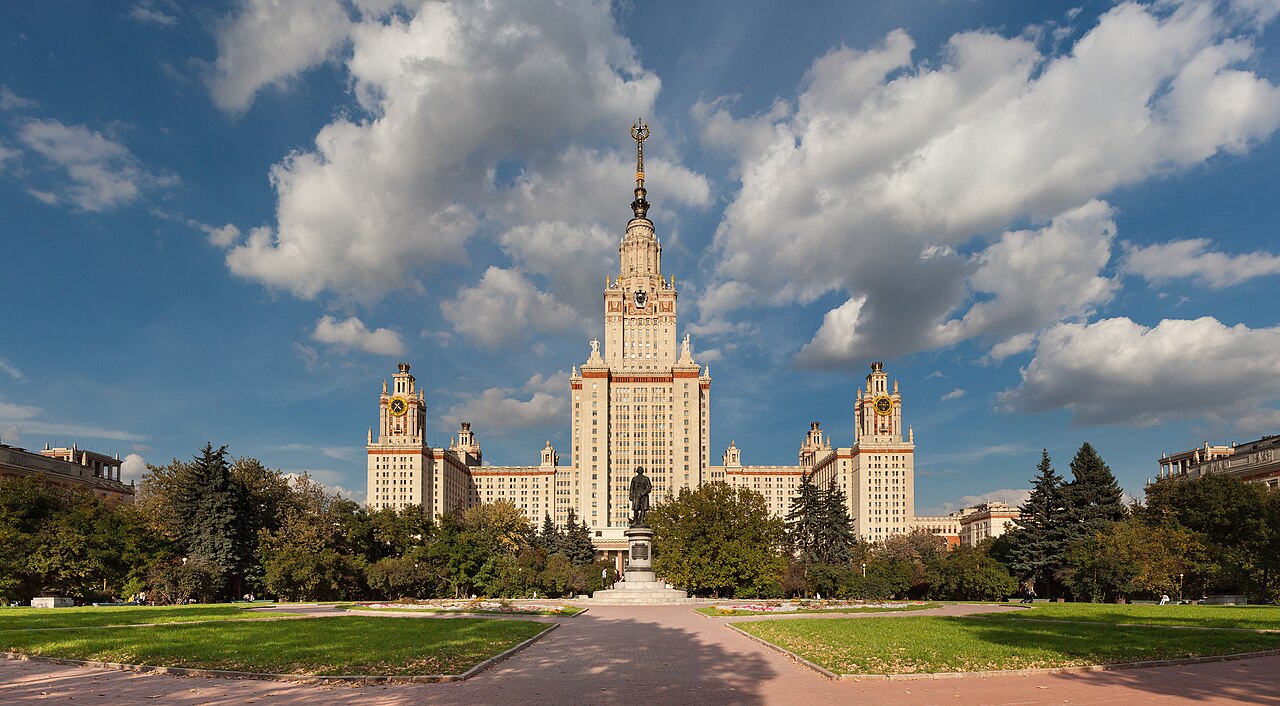
Photo: Roman Balabin · CC BY 2.0 · Wikimedia Commons
Lebedev Physical Institute is a Russian science institute. It is in Moscow, Russia. Named after Pyotr Lebedev, who measured the pressure of light. The free Lokali audio guide runs 6 minutes.
✓ Published October 2026 · how we write these guides
Visitor facts
| Lokali audio guide | 6 min · free |
|---|---|
| Type | Tourist Attraction |
| Location | Moscow, Russia |
| Coordinates | 55.6978, 37.5653 |
| Official website | lebedev.ru |
| Languages | 50+, in the Lokali app |
The story
Stand on the pavement of Leninsky Prospekt for a moment and listen. Traffic moves along one of Moscow's widest avenues, and trees soften the noise along the edges. Behind them rises a calm, formal building with pale walls and tall windows. It does not look dramatic. Yet some of the most important ideas in twentieth-century physics took shape inside these walls, and in the older laboratories that came before them.
This is the Lebedev Physical Institute of the Russian Academy of Sciences. Russian scientists usually call it by a short name, FIAN, from the letters of its Russian title. It is not a museum. It is a working research institute, so the doors are usually closed to casual visitors. Your guide today is the street, the facade, and the stories. That is still plenty.
Let us start with the name. Pyotr Lebedev was a Russian physicist of the late nineteenth and early twentieth centuries. His most famous experiment answered a strange question. Does light push on the things it touches? Theory said yes, but the force is unimaginably small. Lebedev built a delicate apparatus. Tiny, thin vanes hung inside a vacuum, and he shone light on them. Around the turn of the twentieth century, he measured the push. Light really does press on matter.
This matters far beyond the laboratory. Light pressure helps explain why comet tails point away from the Sun. Today engineers design solar sails, spacecraft pushed by sunlight alone. When you look at this building, remember that it carries the name of a man who weighed a beam of light... and got the answer right.
Lebedev's own story has a sad ending. In 1911, many professors left Moscow University in protest against government interference in the university. Lebedev was one of them. He lost his laboratory and much of his working life. He died the following year. Friends and students later honoured him by giving his name to the physics work that continued. So the institute you see today carries a quiet memory of principle, as well as science.
Now for the first surprise. The institute's roots go back much further than its building. It traces its family tree to a physics cabinet in Saint Petersburg in the eighteenth century, during the age of Peter the Great. That cabinet held instruments for demonstrations and experiments. Over two centuries, it grew and changed into a full research laboratory. In 1934, when the Academy of Sciences moved from Leningrad to Moscow, the physics institute moved too, and it took Lebedev's name.
The first director in Moscow was Sergei Vavilov, a physicist who studied light and luminescence, the glow some materials give off. Under his leadership, a young researcher named Pavel Cherenkov noticed something odd. Certain liquids, struck by radiation, gave off a faint blue light. It was not ordinary glow. Cherenkov, together with Igor Tamm and Ilya Frank, showed that it came from particles moving faster than light can travel in that liquid. Today we call it Cherenkov radiation.
In 1958, those three men shared the Nobel Prize in Physics. If you have ever seen photographs of a nuclear reactor underwater, glowing an eerie blue, you have seen their discovery. Detectors around the world still use this light to track particles from space and from giant accelerators. A faint glow in a Moscow laboratory became a tool for the whole of physics.
Here is the second surprise. The laser also has deep roots here. Nikolai Basov and Alexander Prokhorov, both working at FIAN, developed key ideas behind the maser and the laser. A maser does with microwaves what a laser does with visible light. In 1964, they shared the Nobel Prize in Physics with the American physicist Charles Townes. Every barcode scanner, fibre-optic cable, and laser pointer owes something to work done by scientists from this institute.
The theoretical department had its own famous names. Igor Tamm led it for many years. One of his students was Andrei Sakharov, who worked on Soviet nuclear weapons and later became a human rights campaigner. In 1975, he received the Nobel Peace Prize. Another theorist, Vitaly Ginzburg, helped build the theory of superconductivity, the ability of some materials to carry electricity with no resistance. He received the Nobel Prize in Physics in 2003. Counting them all, the institute is linked to seven Nobel laureates.
The work did not stop with the Soviet era. Departments here study lasers, particle physics, plasma, and space. The institute's Astro Space Center ran the RadioAstron mission, a radio telescope launched into orbit in 2011. It worked together with telescopes on the ground, creating a virtual dish far larger than the Earth itself. So the questions asked here now reach well beyond Moscow's sky.
Now look again at the building itself. It belongs to the formal, monumental style that Moscow favoured in the mid-twentieth century. Notice the strong symmetry, the heavy cornice along the roof, and the columns at the entrance. The architects wanted science to look serious and permanent, almost like a palace. Many Academy of Sciences institutes stand along this stretch of the avenue, so you are walking through a scientific district, not just a street.
As you turn away, notice how ordinary the scene feels. People hurry past to the bus stop. Cars stream towards the city centre. Behind those windows, researchers may be running an experiment right now. Somewhere in that quiet facade sits the memory of a beam of light that pushed, a liquid that glowed blue, and a theory written on paper. Take one last look at the windows... and walk on.
Key facts
What to look for
Practical tips
Common questions
Is there a free audio guide to Lebedev Physical Institute?
Yes — the Lokali app narrates Lebedev Physical Institute free of charge in 50+ languages. The guide runs about 6 minutes, covers the history, what to look for on site and practical tips, and works offline once downloaded.
Where is Lebedev Physical Institute?
Lebedev Physical Institute is in Moscow, Russia, at 55.6978, 37.5653. Tap the map link on this page for directions from where you are.
What is Lebedev Physical Institute known for?
Named after Pyotr Lebedev, who measured the pressure of light. Moved from Leningrad to Moscow with the Academy in 1934.
What should you look for at Lebedev Physical Institute?
The columned entrance at the centre of the main facade. The heavy cornice running along the top of the building. Strict symmetry of windows on both wings.
What should you know before visiting Lebedev Physical Institute?
View the facade from across Leninsky Prospekt for the full symmetry. Treat it as a working institute and avoid blocking staff entrances.
When is the best time to visit Lebedev Physical Institute?
Visit in morning light when the pale facade is evenly lit.
On the map
Opens directions to Lebedev Physical Institute from your location.
More to see in Moscow


Hear Lebedev Physical Institute in your language
The full story, narrated, in 50+ languages. Download it before you go and it plays offline, at your own pace, with no ticket and no tour group.