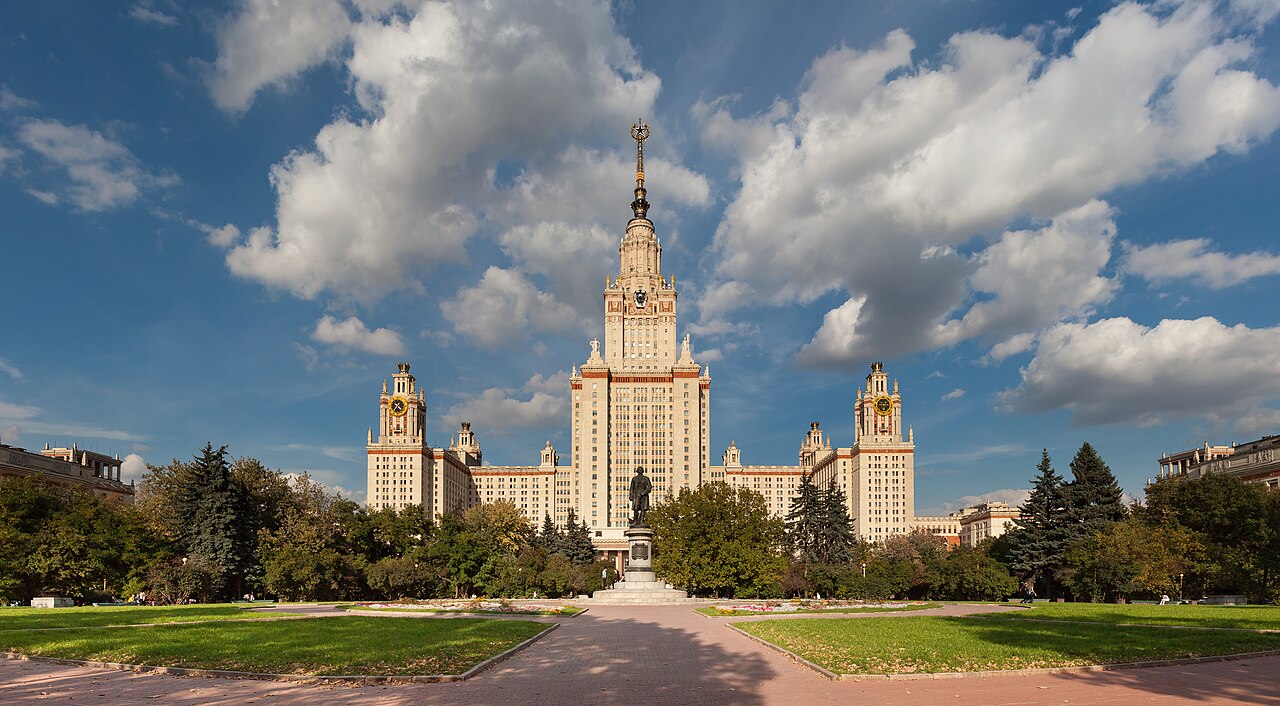
Sparrow Hills is a viewpoint in Moscow, Russia. Highest natural point in Moscow. University tower completed in 1953. Most visitors spend 30-60 min here. The free Lokali audio guide runs 6 minutes.
✓ Verified October 2026 · how we write these guides
Visitor facts
| Time needed | 30-60 min |
|---|---|
| Lokali audio guide | 6 min · free |
| Type | Viewpoint |
| Best for | Photography |
| Location | Moscow, Russia |
| Coordinates | 55.71, 37.5433 |
| Languages | 45, in the Lokali app |
The story
Stand at the stone balustrade and feel the wind coming off the river — it carries the smell of birch trees and diesel from the city below. This is Sparrow Hills, the highest natural point in Moscow, and from here the entire capital spreads out like a map made real. The viewing platform drops away beneath your feet, and beyond it the Moskva River curves through a landscape of Stalin-era towers, glass skyscrapers, and the golden domes of distant churches.
The hill itself is older than the city. Medieval chronicles mention it as a forested ridge where princes hunted and monasteries built their retreats. By the eighteenth century it had become a fashionable spot for aristocratic picnics — nobles would ride out from the Kremlin to admire the view and escape the summer heat. The name comes from a village that once stood here, Vorobyovo, which means sparrow in Russian. That village is long gone, but the name stuck.
Behind you rises the main building of Moscow State University, one of the seven towers Stalin ordered built after the Second World War. Construction began in 1949 and took four years. The central tower reaches two hundred and forty metres, making it one of the tallest educational buildings in the world. Thirty-six storeys, clad in honey-coloured stone, with a steel spire topped by a red star. The architects were Lev Rudnev and a team of engineers who had to sink the foundations deep into the clay hillside to keep the whole structure from sliding downslope.
The viewing platform where you stand now was rebuilt in the nineteen fifties as part of the university complex. Before that, visitors came to a simpler wooden pavilion. The current terrace is paved in granite, with a low wall that lets you lean out over the drop. On clear days you can see the Kremlin's red walls, the Cathedral of Christ the Saviour with its bulbous gold dome, and the Ostankino Tower stitching the northern horizon. Muscovites come here for first dates, wedding photos, and to watch the city lights flicker on at dusk.
Directly below, the Luzhniki Stadium sits in a bend of the river — a vast concrete bowl that hosted the 1980 Olympics and the 2018 World Cup final. To the left, the ski jump from the same Olympic Games rises like a frozen wave. In winter, when snow covers the slope, you can see cross-country skiers threading through the forest that blankets the hillside. In summer, the trees turn the air green and cool.
The hill has always been a place for looking. Tolstoy brought Pierre here in War and Peace, to stand above Moscow and contemplate the French invasion. Napoleon himself is said to have paused on this ridge in 1812, expecting the city to surrender. Instead, fires broke out and burned for days, and the French army found an empty shell. There is no plaque marking the spot where Napoleon stood — the story is part of Moscow's mythology, passed down through generations of schoolchildren.
Walk along the terrace and you will see clusters of newlyweds posing for photographs, their white dresses bright against the stone. It is a Moscow tradition — after the registry office, couples come here to drink champagne and pin ribbons to the railings. The ribbons stay until the wind tears them away. On weekends, the platform fills with tourists, street musicians, and vendors selling Soviet-era military hats and matryoshka dolls.
The forest behind the university is crisscrossed with trails. In the early morning, before the tour buses arrive, you can walk down through the birch and oak trees to the river. The paths are steep and muddy in spring, but they lead to quiet spots where the only sound is water and birdsong. The hillside is a nature reserve now, protected from development, and in autumn the leaves turn gold and red and carpet the ground.
Beneath your feet, the Moscow Metro runs through a tunnel deep in the hillside. Vorobyovy Gory station sits inside the lower deck of a bridge that spans the river — the only metro station in the city built on a bridge. Trains rattle across every few minutes, carrying commuters between the southern suburbs and the city centre. The bridge itself is a double-decker, with road traffic on top and the metro below, and it sways slightly when heavy trucks pass.
As the sun drops, the light changes. The river turns silver, the buildings below lose their detail and become silhouettes, and the air cools. The platform empties out, leaving just a few people leaning on the railings, watching the city settle into evening. The university's floodlights come on, turning the tower a warm amber. This is when the view feels less like a postcard and more like a living thing — a city breathing, moving, layered with centuries of stories.
Before you leave, turn around and look back at the university tower. Notice the sculptural details at the base — hammer and sickle motifs, wheat sheaves, and figures of workers cast in bronze. The building is a monument to a particular vision of progress, and standing here you can see both what that vision built and what it left behind. The wind picks up again, carrying the scent of pine and exhaust, and the city hums below.
Key facts
What to look for
Practical tips
Common questions
How long do you need at Sparrow Hills?
Plan 30-60 min. That is the time most visitors spend at Sparrow Hills. The free Lokali audio guide runs 6 minutes and is made to listen to while you walk.
Is there a free audio guide to Sparrow Hills?
Yes — the Lokali app narrates Sparrow Hills free of charge in 50+ languages. No ticket, tour group or subscription, and it works offline once downloaded.
Where is Sparrow Hills?
Sparrow Hills is in Moscow, Russia, at 55.71, 37.5433. Tap the map link on this page for directions.
What should you know before visiting Sparrow Hills?
Come at sunset for softer light and smaller crowds
What is Sparrow Hills known for?
Highest natural point in Moscow
What is the best time to visit Sparrow Hills?
Come at sunset for softer light and smaller crowds
On the map
Opens directions to Sparrow Hills from your location.
More to see in Moscow


Hear Sparrow Hills in your language
The full story, narrated, in 50+ languages. Download it before you go and it plays offline, at your own pace, with no ticket and no tour group.