
Main Building of Moscow State University
55.7031° N · 37.5306° E · Tower
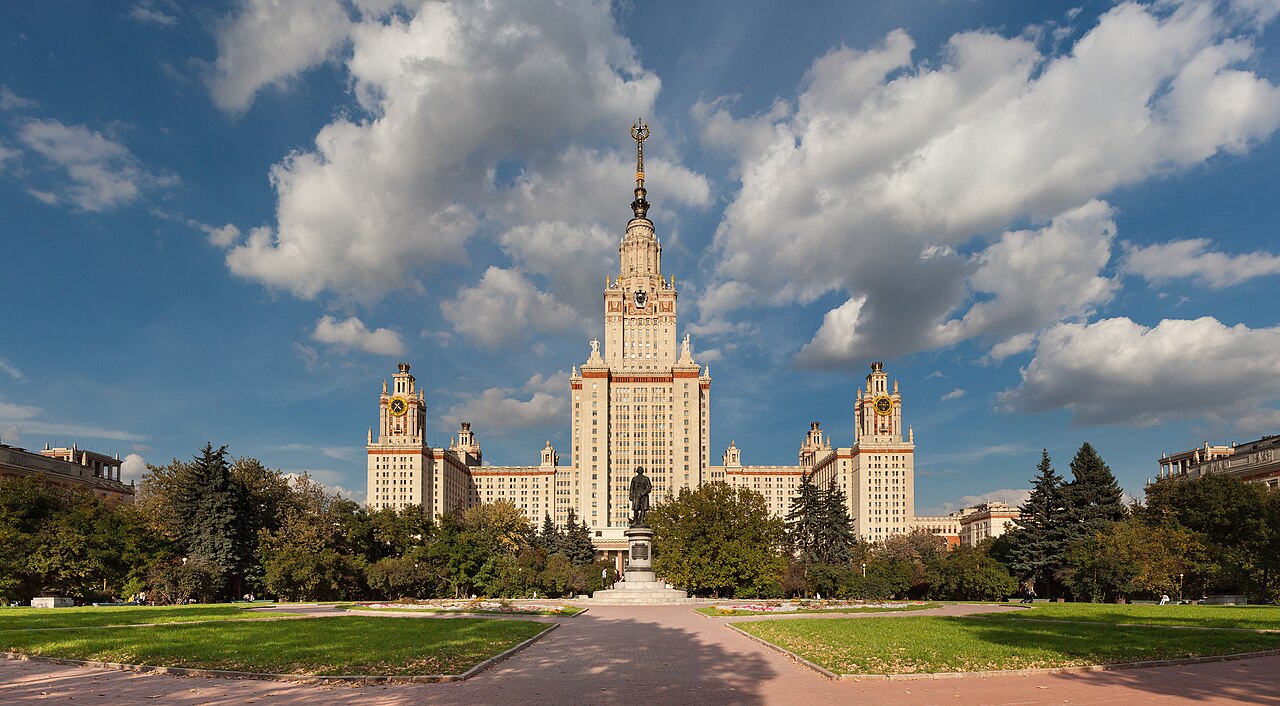
Photo: Dmitry A. Mottl · CC BY-SA 3.0 · Wikimedia Commons
Main Building of Moscow State University is a university building in Moscow. Moscow State University was founded in 1755. The free Lokali audio guide runs 7 minutes.
✓ Published October 2026 · how we write these guides
Visitor facts
| Lokali audio guide | 7 min · free |
|---|---|
| Type | Tower |
| Location | Moscow, Russia |
| Coordinates | 55.7031, 37.5306 |
| Languages | 50+, in the Lokali app |
The story
Stand at the end of the long, straight avenue and look up. Pale stone climbs in stepped layers, terrace after terrace, until a single golden spire takes over. In winter the air up here on the hills is sharp and dry. In summer it smells of cut grass and lime trees. Either way, the building fills your whole field of view, and it keeps rising after you think it has stopped.
This is the main building of Moscow State University, on Sparrow Hills in the southwest of the city. Muscovites often call it simply the Main Building. For decades it was the tallest building in Europe. It is still one of the clearest statements of an idea that shaped Moscow in the years after the Second World War. That idea was that architecture should look permanent, confident, and a little overwhelming.
The university itself is much older than the tower. It was founded in 1755, and it carries the name of Mikhail Lomonosov. He was an eighteenth-century scientist, poet, and reformer, and many Russians still describe him as the father of Russian science. For most of its life, the university sat in the city centre, near the Kremlin. The move to these hills came only in the middle of the twentieth century, when the old buildings could no longer hold the growing number of students.
In 1947, the Soviet government ordered a group of tall buildings for Moscow. The order coincided with the celebration of the city's 800th anniversary. Seven towers were eventually built, and today people call them the Seven Sisters. Some hold ministries, some are hotels, and some are apartments. This tower is the largest of the seven. It was completed in 1953, the same year that Joseph Stalin died. That timing is why the style is often called Stalinist architecture.
The lead architect was Lev Rudnev, working with a large team of engineers and designers. An earlier design by another architect was set aside, and the building moved to its present site on the high bank. The location was chosen with care. From here the tower can be seen across much of the city. In turn, the building looks down over the river and toward the old centre, like a watchtower of learning.
Now look at the shape. The central tower rises in setbacks, each level a little narrower than the one below. Four wings spread out to the sides, and each one ends in its own smaller tower. The effect is close to a wedding cake, and some people do describe it that way. The setbacks recall the early skyscrapers of New York, which Soviet architects studied closely. Here, though, the details come from older Russian and classical traditions.
Here is a detail many visitors miss. High on the side towers there are large dials. One shows the time. Others show the temperature and the air pressure. So the building is a giant clock, thermometer, and barometer at once. It was meant to serve the whole campus like a public instrument. Look closely at the faces as you walk around the wings, and you may be able to read them from the ground.
The spire carries a star set inside a wreath of wheat ears. Wheat appears again and again across the facade, carved in stone around Soviet emblems. In the language of the time, wheat stood for abundance and for the workers of the countryside. Along the terraces, stone sculptures of young men and women hold books and scientific instruments. They are the ideal students of the new state — strong, serious, and looking forward.
The story of the construction has a darker side. Historians have documented that prisoners from the Soviet labour camp system, known as the Gulag, worked on the site alongside regular builders. Some prisoners were reportedly housed on the upper floors during the work. Out of this period came a well-known piece of folklore. Locals say that one prisoner built wings from scraps and flew down from the tower to escape. There is no evidence that it ever happened, but the tale is still told.
Another popular legend concerns the size of the building. Students like to say that if you spent one night in each room, you would need decades to see them all. The number of rooms is very large, and the corridors do seem endless. But treat any exact count you hear with caution. What is certain is that the building holds lecture halls, laboratories, a large library, a museum of earth sciences, and student dormitories in the side wings.
That last point is the surprise for many visitors. This is not only a monument. It is a working place where people live. Generations of students have climbed these stairs to their rooms, cooked in shared kitchens, and studied late beside windows that look out over Moscow. Mathematics, mechanics, and geology students have had their faculties here. Inside, entry is usually limited to people with a university pass, so most visitors see the building from the grounds.
In front of the tower, look for the statue of Lomonosov. He sits with a book, facing the long axis that leads away toward the river. Beyond the avenue, the ground drops steeply to the Moskva River. A short walk brings you to the viewing terrace on the edge of Sparrow Hills. From there you can see Luzhniki Stadium below, and on a clear day the towers of the centre, including some of the other Seven Sisters.
Before you leave, turn back once more. The light changes the stone through the day. In the morning it looks cool and grey. Toward evening it warms to cream and honey, and the spire catches the last of the sun. Listen too — to students crossing the paths, to the wind in the trees, to traffic far below. The building was made to impress, but up close it is also a campus, full of ordinary daily life.
Key facts
What to look for
Practical tips
Common questions
Is there a free audio guide to Main Building of Moscow State University?
Yes — the Lokali app narrates Main Building of Moscow State University free of charge in 50+ languages. The guide runs about 7 minutes, covers the history, what to look for on site and practical tips, and works offline once downloaded.
Where is Main Building of Moscow State University?
Main Building of Moscow State University is in Moscow, Russia, at 55.7031, 37.5306. Tap the map link on this page for directions from where you are.
What is Main Building of Moscow State University known for?
Moscow State University was founded in 1755. The main building was completed in 1953.
What should you look for at Main Building of Moscow State University?
Large clock and weather dials on the side towers. Golden star inside a wreath of wheat ears. Stone students holding books along the terraces.
What should you know before visiting Main Building of Moscow State University?
Walk the long avenue to see the tower's full height. Bring a valid university pass if you hope to enter.
When is the best time to visit Main Building of Moscow State University?
Visit in late afternoon for warmer light on the stone.
On the map
Opens directions to Main Building of Moscow State University from your location.
More to see in Moscow


Hear Main Building of Moscow State University in your language
The full story, narrated, in 50+ languages. Download it before you go and it plays offline, at your own pace, with no ticket and no tour group.