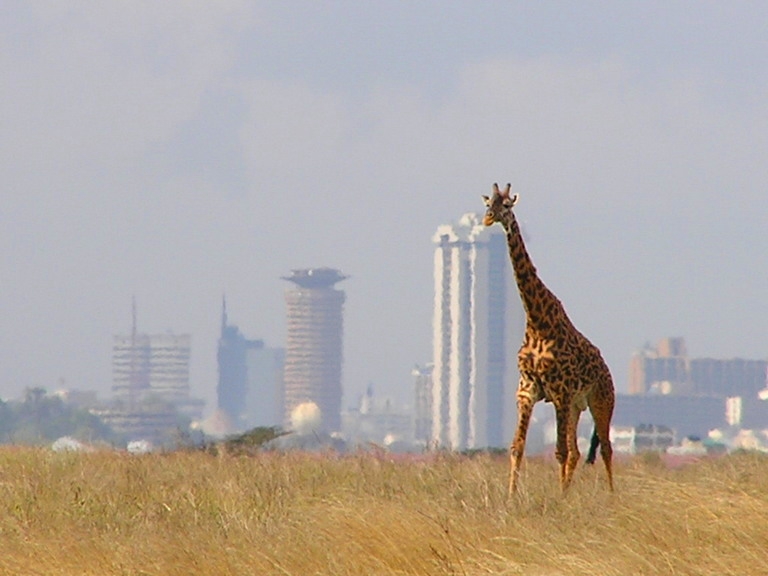
Nairobi National Park
1.3733° S · 36.8589° E · National Park
Photo: The original uploader was Mkimemia at English Wikipedia. · CC BY-SA 3.0 · Wikimedia Commons
Nairobi National Park is the first national park in Kenya, Africa. Established in 1946 as Kenya's first national park. The free Lokali audio guide runs 7 minutes.
✓ Published October 2026 · how we write these guides
Visitor facts
| Lokali audio guide | 7 min · free |
|---|---|
| Type | National Park |
| Location | Nairobi, Kenya |
| Coordinates | -1.3733, 36.8589 |
| Official website | kws.go.ke |
| Languages | 50+, in the Lokali app |
The story
Listen first. Somewhere close, a hornbill calls with a hollow, knocking cry. A dry wind moves across the grass, carrying red dust and the faint smell of acacia. Then a deeper sound arrives from overhead: the rumble of a passenger jet coming down towards the city. Look up, and look out. A giraffe is standing in the foreground. Behind it, glass towers rise on the horizon. Welcome to Nairobi National Park, where the wild and the urban share a single view.
You are only a short drive from the heart of Kenya's capital. To the north lies Kibera, one of the largest informal settlements in Africa, home to many thousands of families. To the south, the grassland opens towards the sky. Few places on Earth hold these two worlds this close together. That contrast is part of what you came to see. It is also the story of how this park survives.
The city's name comes from the Maasai language. Enkare Nyirobi means a place of cool water. The Maasai are pastoral herders who have grazed cattle across these plains for generations. Long before there were roads or towers, this was open rangeland. Wildlife and livestock moved across it together, following the rains. When the railway arrived in the late nineteenth century, a small depot grew into a town. Then the town grew into a capital, and it kept growing.
In 1946, this land became Kenya's first national park. It was a bold decision for the time. The city was still small, but some people could already see the pressure coming. Fences went up along much of the boundary, especially on the side facing the city. But here is the first thing most visitors miss — the park was never fully closed in. Its southern edge stayed open, and that choice still shapes everything you see today.
Along the south, the Mbagathi River marks the boundary. Beyond it stretch the wider plains, where herds have long moved in and out with the seasons. In the dry months, zebra and wildebeest drift into the park towards permanent water. When the rains return, many move back out to graze. So the park is not a sealed box. It is one end of a much larger system, and that system depends on open land beyond the river.
That open land is under pressure. Houses, fences, and quarries now push out across the southern plains. Conservation groups and local landowners work to keep migration routes clear. You will also notice newer intrusions inside the park. In the late 2010s, an elevated railway line was built across part of it. The decision drew strong protest from Kenyans who saw the park as a national treasure. The concrete pillars still stand, and the debate about them has not fully faded.
Now, the animals. On a good day you may see lions resting in the shade of a whistling thorn tree. Maasai giraffes, with their jagged, leaf-shaped patches, browse at the acacias. Buffalo stand heavy and still near the water. Ostriches stride across the grass, and hartebeest lift their long faces to watch you pass. Cheetahs and leopards live here too, though they are harder to find. Patience matters more than speed on these tracks.
Here is the second surprise. One large animal is missing. There are no wild elephants in this park. The space is too small and too close to the city for them to roam safely. Yet the park is famous for another giant. It has become one of Kenya's most important sanctuaries for the black rhino. These animals were hunted close to extinction across much of Africa. Here, behind the fences and under constant watch, they have been able to breed.
If you do see a rhino, take a moment. Notice the pointed upper lip of the black rhino. It uses that lip like a finger to pull leaves and twigs from bushes. Rangers patrol this park day and night to protect these animals. The skyline in the background is a reminder of why that work is needed. Every rhino here lives within sight of millions of people.
The park also carries a sombre piece of modern history. In 1989, Kenya's president set fire to a large stockpile of seized elephant ivory inside this park. The image of those burning tusks travelled around the world. It sent a clear message against the ivory trade. In 2016, Kenya burned an even larger stockpile here. Today a memorial site marks the place, a quiet patch of ground that holds a loud idea.
Birds deserve their own moment. Several hundred species have been recorded in and around the park. Watch the sky for vultures circling slowly on warm air. Look at the grass for the secretary bird, a tall bird of prey that hunts snakes on foot. Near the wetlands, herons and storks stand in the shallow water. Even if the big animals hide, the birdlife rarely disappoints. Bring binoculars, and the park becomes twice as large.
Near the main gate, the park offers more than the drive. The Kenya Wildlife Service has its headquarters here. There is a walking area with raised boardwalks, where you can see animals up close on foot. There is also an orphanage for animals that cannot return to the wild. Close by, on the edge of the park, a well-known trust cares for orphaned baby elephants. So, in a way, elephants are present after all — just very small ones, and not yet wild.
In the south of the park, a short guided trail leads to the hippo pools along the river. Here you leave the vehicle and walk with a ranger. The air feels cooler under the trees. You may hear hippos before you see them, a deep, grunting sound from the brown water. Crocodiles sometimes lie still on the banks. Stay close to your guide, and keep your voice low. This is one of the quietest corners of the park.
Before you leave, stop the engine for a minute. Listen to the wind in the grass and the far-off hum of the city. Look once more at the line where the plain meets the towers. That line is where the future of this place will be decided. As you drive back towards the gate, watch the roadside. A warthog may trot past with its tail held high, like a small flag — saying goodbye, in its own way.
Key facts
What to look for
Practical tips
Common questions
Is there a free audio guide to Nairobi National Park?
Yes — the Lokali app narrates Nairobi National Park free of charge in 50+ languages. The guide runs about 7 minutes, covers the history, what to look for on site and practical tips, and works offline once downloaded.
Where is Nairobi National Park?
Nairobi National Park is in Nairobi, Kenya, at -1.3733, 36.8589. Tap the map link on this page for directions from where you are.
What is Nairobi National Park known for?
Established in 1946 as Kenya's first national park. Nairobi comes from Maasai words meaning cool water.
What should you look for at Nairobi National Park?
Giraffes framed against Nairobi's glass towers on the horizon. The pointed, grasping upper lip of the black rhino. The ivory burning memorial site near the main gate.
What should you know before visiting Nairobi National Park?
Arrive early when animals are most active and light is soft. Bring binoculars for distant rhinos and the park's birdlife.
When is the best time to visit Nairobi National Park?
Arrive early when animals are most active and light is soft.
On the map
Opens directions to Nairobi National Park from your location.
More to see in Nairobi


Hear Nairobi National Park in your language
The full story, narrated, in 50+ languages. Download it before you go and it plays offline, at your own pace, with no ticket and no tour group.