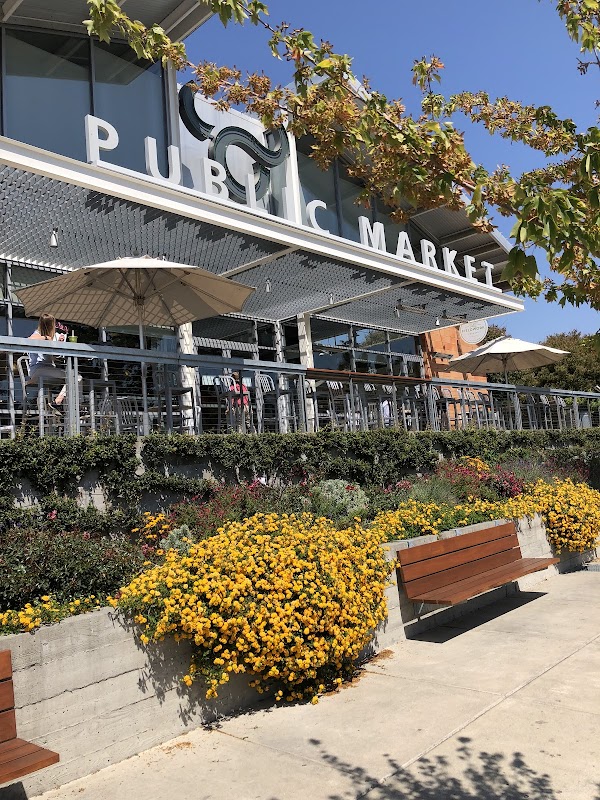
Oxbow Market is a year-round public market in downtown Napa featuring local producers, artisanal food vendors, and prepared-food stalls. It is in Napa, United States. Most visitors spend 45–90 min here. The free Lokali audio guide runs 5 minutes.
✓ Verified August 2026 · how we write these guides
Visitor facts
| Time needed | 45–90 min |
|---|---|
| Lokali audio guide | 5 min · free |
| Type | Food Market |
| Best for | Local life |
| Location | Napa, United States |
| Coordinates | 38.2975, -122.2869 |
| Languages | 45, in the Lokali app |
The story
Follow your nose through the glass doors on First Street. Espresso first. Then baking bread, wood smoke, fresh oysters on ice. Under one high wooden roof, the Oxbow Public Market gathers the tastes of Northern California into a single noisy, happy room. This is Napa's public pantry.
The name comes from the river outside. Just here, the Napa River swings into a tight U-shaped loop. Geographers call that curve an oxbow. The market sits on the inside of the bend, among old warehouses and rail sidings. Water shaped this block long before food did.
The market opened in December 2007. Its founder, Steve Carlin, had already helped build one of America's most loved food halls: the Ferry Building Marketplace in San Francisco. In Napa he tried the same idea on a smaller, more local scale. No national chains. Just farmers, bakers, butchers, and cooks from the region.
The hall covers roughly 40,000 square feet. Its design is simple and honest: exposed wooden trusses, steel columns, concrete floors, and long runs of glass. Daylight falls onto communal tables. Ceiling fans turn slowly overhead. The building never pretends to be old. It borrows the shape of a farm shed and fills it with noise and steam.
The stalls read like a map of the region. Hog Island Oyster Company hauls its oysters in from Tomales Bay, where it has farmed the tidewater since 1983. The Model Bakery brings its famous English muffins from a business with roots in the 1920s. Ritual Coffee roasts in San Francisco. Five Dot Ranch cuts beef from a California cattle family with a long pedigree. Owners often work their own counters.
Seasons steer the menus. In spring the counters fill with asparagus and strawberries from nearby farms. Summer brings stone fruit and tomatoes. Autumn is harvest season, when the whole valley smells of crushed grapes and the market cooks with figs, squash, and new olive oil. Even in winter the oyster bar stays busy and the soup pots steam.
You can eat your way around the world without leaving the room. Tacos filled with local duck. Wood-fired pizza. Burgers from Gott's Roadside on the corner of the building. Cheese counters, spice shops, a bookstore, a wine bar. Prices range from snack money to splurge. Every stall is small enough that the owner might be the one serving you.
The market opened at a hard moment. The financial crisis arrived within a year, and Napa's tourism slowed. Some early vendors did not survive. But locals kept coming, and the market slowly became what its founder wanted: a daily kitchen and meeting hall for the town, not just a stop for visitors.
Walk out the back doors and the Napa River is right there. A patio faces the water across a strip of grass and marsh. Herons stalk the shallows. Kayaks slide past on the current, and cyclists ring their bells on the river trail. On warm evenings, people carry oysters and cold wine outside and let the afternoon go slack with the tide.
The market anchored a whole new district. The Wine Train depot sits across McKinstry Street. The CIA's Copia campus, a center for food and wine learning, stands a block away. Oxbow Commons, a green flood-control park, spreads along the river. What was once a quiet back corner of Napa now hums from morning until night.
Oxbow also marks a shift in Napa's story. For decades, visitors drove straight past the city and into the valley's wineries. The town itself was quiet. Places like this market helped change that. Napa the city became a food destination in its own right, and the crowds finally stepped off the highway.
Come hungry and wander first. Do a slow lap before you commit. Watch what the locals carry. A tray of oysters here, a paper bag of pastries there. The best strategy is to share small plates from several stalls and eat at the long tables, elbow to elbow with strangers. Mornings have their own rhythm too: regulars take the same seats, order the same coffee, and read the paper. By noon the room turns over to visitors, maps out, plates crowded.
Markets like this are old technology. People have gathered to trade food beside this river for as long as anyone remembers, from native communities to farmers with wagons to the vendors of today. The Oxbow Public Market simply gives that instinct a roof. Buy something small. Sit by the water. Take part in the oldest habit a town can have.
Key facts
What to look for
Practical tips
Common questions
How long do you need at Oxbow Market?
Plan 45–90 min. That is the time most visitors spend at Oxbow Market. The free Lokali audio guide adds about 5 minutes of narration you can listen to as you walk, so it fits inside your visit rather than adding to it.
Is there a free audio guide to Oxbow Market?
Yes — the Lokali app narrates Oxbow Market free of charge in 50+ languages. It covers the history, what to look for on site and practical tips, and it works offline once downloaded.
Where is Oxbow Market?
Oxbow Market is in Napa, United States, at 38.2975, -122.2869. Tap the map link on this page for directions from where you are.
What should you know before visiting Oxbow Market?
Visit weekday mornings to avoid the lunch crowds.
What is Oxbow Market known for?
Opened in December 2007 in Napa's Oxbow District.
What is the best time to visit Oxbow Market?
Visit mid-morning on a weekday to avoid crowds.
On the map
Opens directions to Oxbow Market from your location.
More to see in Napa


Hear Oxbow Market in your language
The full story, narrated, in 50+ languages. Download it before you go and it plays offline, at your own pace, with no ticket and no tour group.